
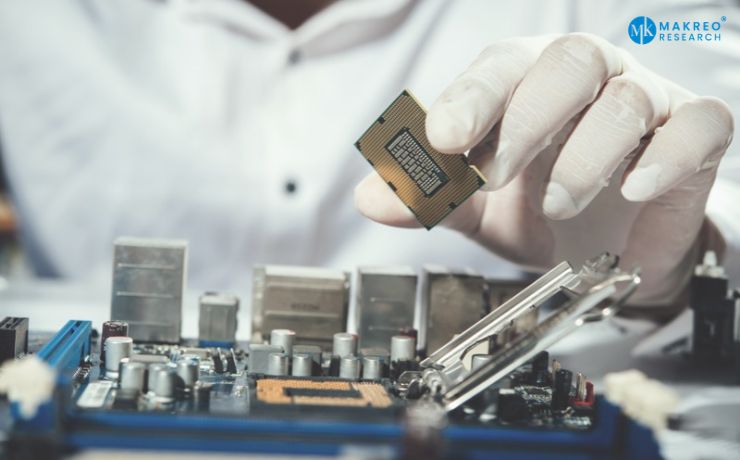
AI Chip Market Outlook to 2032 - 20–25% Growth as Custom Silicon, Inference Demand and Supply Constraints Reshape Competition
AI chip market projected to grow 20–25% annually through 2032. Explore Makreo Research insights on inference demand, custom silicon, supply risks and competition.
The global AI chip market is expanding as hyperscalers increase investment in AI data centres, inference workloads and accelerated computing infrastructure. Makreo Research projects growth of approximately 20–25% a year during 2027–2032. Rising demand for GPUs, custom ASICs and high-bandwidth memory is now meeting constraints in manufacturing capacity, memory supply and data centre power availability.
The outlook examines the factors driving AI chip demand, how competition between GPUs and custom silicon is evolving, where supply constraints are tightening and what these developments mean for chip vendors, cloud operators, investors and policymakers.
How Will Growth and Competition Reshape the AI Chip Market Through 2032?
Global AI chip revenue grew at a CAGR of 40.65% between 2020 and 2026E, according to Makreo Research. Growth is expected to moderate to approximately 20–25% annually during 2027–2032, with around 22% as the central forecast, as the market moves from its initial infrastructure build-out towards sustained, larger-scale deployment. The study uses 2026 as its base year.
GPUs remain the leading AI chip type by volume in 2026, and Makreo Research estimates NVIDIA's share of the AI accelerator market at more than 70%. However, leadership by volume does not imply a fixed competitive structure. Hyperscalers are deploying proprietary accelerators at increasing scale, and the balance between merchant GPUs and custom ASICs varies according to workload requirements, customer economics and procurement strategies.
The AI chip market also operates within a broader semiconductor ecosystem encompassing memory, networking, advanced packaging and supporting components. The growth of AI computing infrastructure is therefore creating opportunities beyond accelerator manufacturers, although semiconductor industry revenue, AI chip revenue and total AI infrastructure expenditure represent distinct market measures.
For semiconductor suppliers and investors, the strategic consideration is how projected market growth translates into demand across specific chip architectures, applications and geographic markets.
Key Factors Driving AI Chip Market Growth
Hyperscaler Investment and AI Data Centre Expansion
Data centre investment remains one of the most important sources of AI chip demand. The expansion of accelerated computing infrastructure requires substantial expenditure on GPUs, custom ASICs, memory, networking equipment and supporting power systems.
Makreo Research projects global investment in AI data centre infrastructure to exceed USD 6.7 trillion between 2025 and 2030. Within this broader investment outlook, cumulative capital expenditure by Microsoft, Amazon, Alphabet and Meta is estimated at approximately USD 5.3 trillion.
Recent company guidance indicates that infrastructure spending continues to increase.
-
Alphabet - Maintained its 2026 capital expenditure guidance at USD 195–205 billion in October 2026 and indicated that investment is expected to increase significantly in 2027.
-
Amazon - Maintained its outlook of approximately USD 220 billion in cash capital expenditure for 2026. AWS revenue increased 39% year on year in the third quarter.
-
Meta - Narrowed its 2026 capital expenditure guidance to USD 135–145 billion, including principal payments on finance leases.
-
Microsoft - Reported capital expenditure of USD 45.2 billion, including finance leases, for the quarter ended 30 September 2026.
These investments support demand throughout the AI semiconductor value chain, but the allocation of expenditure varies by infrastructure architecture, deployment requirements and supplier relationships.
For AI chip manufacturers, understanding hyperscaler investment patterns is important for estimating accelerator demand, assessing customer concentration and identifying opportunities across custom silicon, memory and networking.
Training vs Inference - How AI Workloads Are Changing
Training and inference place different demands on AI chips. Training large models requires substantial clusters of flexible, high-performance accelerators. Inference, the process of running trained models for end users, scales with usage, making cost per token, latency and power efficiency increasingly important in processor selection.
The market's focus is shifting towards inference, with several major AI chip acquisitions and venture funding rounds in 2026 targeting specialised inference silicon. Energy efficiency is also becoming an important commercial consideration. In a modelled AI colocation facility, utilities account for approximately 55% of lifetime infrastructure costs, while power and cooling equipment represent just under 30%, excluding IT hardware.
These cost considerations are influencing demand for specialised AI accelerators, particularly where high-volume workloads can justify custom chip development and deployment.
GPU vs Custom ASICs - How Competition Is Evolving
Merchant GPUs and custom ASICs are increasingly deployed alongside one another rather than functioning as direct substitutes. Their relative advantages depend on workload flexibility, deployment scale, software requirements and total cost of ownership.
| Factor | Merchant GPUs | Custom ASICs |
|---|---|---|
| Workload flexibility | High; suited to training and changing model architectures | Optimised for defined, high-volume workloads |
| Software ecosystem | Mature and widely supported | Requires in-house or partner software investment |
| Time to deployment | Available as commercial products | Multi-year design and validation cycles |
| Efficiency at scale | Strong general-purpose performance | Potentially lower cost and power per operation for targeted workloads |
| Typical buyers | Hyperscalers, neoclouds, enterprises and sovereign AI programmes | Large cloud operators with stable, high-volume workloads |
Custom silicon is gaining ground among the largest cloud operators. Broadcom reported AI semiconductor revenue of USD 16.7 billion in its third fiscal quarter of 2026, an increase of 221% year on year, supported by demand for custom accelerators and AI networking.
In April 2026, Broadcom disclosed a long-term agreement with Google to develop and supply future generations of Tensor Processing Units (TPUs), alongside networking components for next-generation AI infrastructure, through up to 2031.
Qualcomm also announced a multi-generational collaboration with Amazon in September 2026 to develop customised silicon and optical connectivity solutions supporting AWS's AI infrastructure and inference workloads.
Merchant GPU demand nonetheless remains strong. NVIDIA reported Data Center revenue of USD 89.0 billion in the second quarter of fiscal 2027, representing growth of 117% year on year. The company also confirmed that its Vera Rubin platform was moving into full-scale production deployment.
Custom ASICs typically become economically attractive when four conditions are met:
-
The workload is stable and operates at sufficiently high volume.
-
The operator controls or can support the necessary software environment.
-
Deployment scale is sufficient to recover design and integration costs.
-
Supply diversification provides strategic or commercial value.
For semiconductor buyers, the central decision is not necessarily whether GPUs or ASICs will dominate, but which architecture provides the strongest combination of performance, flexibility, supply security and deployment economics.
HBM4, Advanced Packaging and Semiconductor Supply Constraints
AI chip production depends on more than processor design. High-performance accelerators require leading-edge wafers, high-bandwidth memory, advanced 2.5D or 3D packaging and high-speed networking technologies.
Constraints in any of these components can extend delivery schedules, increase costs and delay computing infrastructure deployment.
High-bandwidth memory is an important supply-chain consideration:
-
SK hynix - Reported third-quarter 2026 revenue of KRW 104.6 trillion and operating profit of KRW 83.3 trillion. The company expects HBM4 to become its mainstream HBM product from the fourth quarter and has secured long-term agreements covering more than half of its total planned production capacity for 2027–2028.
-
Samsung Electronics - Reported third-quarter operating profit of KRW 107.4 trillion, supported by strong semiconductor demand, including advanced memory products used in AI infrastructure.
-
Chinese AI chip suppliers - Continue to face manufacturing and memory-access constraints, reinforcing the strategic importance of secure semiconductor supply chains and domestic technology development.
Leading-edge logic production is also expanding. TSMC reported that its 2nm process contributed 8% of wafer revenue in the third quarter of 2026, up from 3% in the preceding quarter, while 3nm accounted for 33%.
The increasing contribution of advanced process nodes reflects demand for high-performance computing and continued investment in manufacturing technologies that support next-generation AI accelerators.
Global AI Chip Market Segmentation by Technology and Application
Makreo Research AI chip market analysis evaluates demand across five dimensions, reflecting differences in chip architecture, workload requirements, deployment environments and purchasing behaviour.
| Segment | Categories Assessed | Key Market Observation |
|---|---|---|
| Chip type | GPU, ASIC, CPU, FPGA | GPUs lead by volume; ASIC adoption is rising among hyperscalers |
| Function | Training, inference | New investment is increasingly directed towards inference |
| Processing type | Cloud, edge | Edge AI capability is consolidating into broadline semiconductor suppliers |
| End user | Data centres and cloud providers, consumer electronics, automotive, industrial manufacturing, healthcare, telecommunications, others | Data centres and cloud providers are the largest source of demand in Asia Pacific in 2026 |
| Enterprise size | Small and medium enterprises, large enterprises | Assessed separately to reflect differing procurement models |
Edge AI is an important part of this market. Processors that run AI models locally in vehicles, robots, industrial equipment and connected devices are attracting strategic investment and acquisition interest.
For semiconductor suppliers, market segmentation helps distinguish high-growth applications from commercially attractive customer opportunities. Adoption rates, deployment volumes, pricing expectations and competitive requirements vary significantly across end-user industries.
This makes application-level demand analysis and customer research important for evaluating product development, market entry and growth strategies.
Which Regions Are Driving AI Chip Market Growth and Semiconductor Investment?
Geographic demand for AI chips is shaped by differences in cloud infrastructure investment, semiconductor manufacturing capability, industrial AI adoption, policy support and access to advanced computing technologies.
| Region | 2026 Revenue | CAGR, 2023–2026 | Primary Demand Drivers |
|---|---|---|---|
| Europe | USD 45.35 billion | 44.42% | Industrial AI, sovereign compute and AI gigafactories |
| Asia Pacific | USD 43.45 billion | 45.66% | Leading-edge manufacturing, memory and national AI strategies |
| North America | Detailed in Makreo's North America report | Detailed in Makreo's North America report | Hyperscaler capital expenditure and AI data centre expansion |
North America AI Chip Market
North America remains the centre of AI compute deployment. Accelerated AI servers accounted for 98% of total AI server spending in 2025, and the United States accounted for 12.1% of global AI patent grants in 2024. Mexico has become the region's leading nearshoring destination, accounting for 15.4% of total United States imports in 2026, which strengthens its role in hardware supply chains.
Europe AI Chip Market
Europe's AI chip market is estimated to reach USD 45.35 billion in 2026. Demand is anchored in industrial adoption - 81% of German industrial companies consider Industry 4.0 essential to competitiveness, and France hosts 1,114 AI startups, the largest AI startup ecosystem in Europe. Sovereign compute is a second driver. France alone has attracted major AI infrastructure commitments, including a EUR 10 billion supercomputing project, while the European Union is advancing a proposed Chips Act 2.0 and a tender for up to seven AI gigafactories that closes on 12 November 2026.
Asia Pacific AI Chip Market
The Asia Pacific AI chip market is estimated to reach USD 43.45 billion in 2026, the fastest growth rate of the regions assessed over 2023–2026. Taiwan produces more than 90% of the world's leading-edge semiconductors, and national programmes are expanding capacity across the region:
-
South Korea unveiled a KRW 900 trillion initiative in June 2026 to expand chip manufacturing, with Samsung Electronics and SK hynix each planning two new fabs.
-
Japan's national AI strategy targets JPY 370 trillion (USD 2.3 trillion) in public-private investment by 2040.
-
India approved Semicon 2.0 in July 2026 with an outlay of INR 1,27,500 crore, supporting a national target of a USD 110 billion semiconductor market by 2030.
-
China accounted for 74.2% of global AI patent grants in 2024 and continues to invest in domestic AI accelerators as export restrictions limit access to advanced semiconductors.
Asia Pacific's significance extends beyond domestic AI chip consumption. The concentration of advanced manufacturing, memory production and semiconductor supply-chain capabilities makes the region important to global AI infrastructure development.
Consequently, regional market assessments need to distinguish between semiconductor production capacity, domestic demand and export-oriented manufacturing opportunities.
Beyond these three regions, the Middle East is emerging as a significant buyer of AI infrastructure. Saudi Arabia's HUMAIN has expanded its AI computing plans with both NVIDIA and AMD, and the United States has eased AI chip export licensing for approved entities in the United Arab Emirates.
Which Companies Are Leading the AI Chip Market and How Is Competition Evolving?
Competition in the global AI chip market is intensifying as suppliers broaden their portfolios across training, inference, memory, networking and semiconductor manufacturing.
Leading market participants compete through technology capabilities, product performance, software ecosystems, manufacturing access, customer relationships and strategic partnerships.
-
NIDIA, the AI accelerator market leader - NVIDIA holds more than 70% of the AI accelerator market. It reported Data Center revenue of USD 89.0 billion in the second quarter of fisVcal 2027, up 117% year-on-year, and record networking revenue of USD 14.8 billion in the first quarter, up 199%.
-
AMD, expanding in AI inference chips - AMD is broadening its inference portfolio through the pending acquisition of Taalas. Its Helios rack-scale platform combines 72 Instinct MI455X GPUs and anchors a six-gigawatt agreement with OpenAI, with first deployments expected in Q4 2026.
-
Broadcom and Qualcomm, custom ASIC design partners - Broadcom's AI semiconductor revenue reached USD 16.7 billion in its third fiscal quarter of 2026, up 221% year-on-year, with fourth-quarter guidance of USD 21.7 billion. Qualcomm has agreed to develop multiple generations of custom inference chips for Amazon Web Services.
-
Hyperscalers building custom AI silicon - Google, Amazon and Apple are deploying proprietary accelerators such as TPU v5, Trainium 2 and Neural Engine. Makreo Research estimates cumulative capital expenditure by Microsoft, Amazon, Alphabet and Meta at approximately USD 5.3 trillion over 2025–2030.
-
SK hynix, Samsung Electronics and Micron, HBM suppliers - SK hynix reported third-quarter 2026 revenue of KRW 104.6 trillion, with long-term agreements covering more than half of its 2027–2028 capacity. Samsung Electronics reported operating profit of KRW 107.4 trillion, while Micron acquired a fab in Taiwan for approximately USD 1.8 billion to expand DRAM and HBM output.
-
Huawei and Cambricon, China's domestic AI chip suppliers - Cambricon's third-quarter revenue rose 104.47% to CNY 3.53 billion, and the company maintained its 2026 target of at least CNY 13.5 billion. Huawei has brought forward its Ascend 960DT launch to the first quarter of 2027.
-
Inference chip start-ups - Tenstorrent, Positron AI, Etched and FuriosaAI raised a combined total of more than USD 3.6 billion in 2026, with Etched valued at USD 21 billion.
Makreo Research benchmarks 18 companies across revenue, chip volumes, market value, compute capacity, product portfolios and manufacturing capabilities.
AI Chip Mergers, Acquisitions and Funding in 2026
Investment activity across the AI semiconductor industry is increasingly directed towards inference acceleration, edge computing and specialised semiconductor technologies.
Several transactions illustrate how established semiconductor suppliers are expanding their capabilities.
Strategic acquisitions in edge AI and inference silicon
-
onsemi and Synaptics (pending) - onsemi agreed to acquire Synaptics in an all-stock transaction valued at approximately USD 7 billion, adding edge AI processors and connectivity for physical AI applications.
-
Analog Devices and Alif Semiconductor (pending) - Analog Devices agreed to acquire Alif Semiconductor for USD 1.35 billion in cash, plus up to USD 200 million in contingent payments, to strengthen its edge AI processing portfolio. Completion is expected in Q4 2026.
-
AMD and Taalas (pending) - AMD agreed to acquire Taalas, a developer of inference silicon, for an undisclosed sum. The transaction remains subject to regulatory approval.
-
Microchip Technology and Hailo (completed) - Microchip Technology completed its acquisition of edge AI processor developer Hailo in September 2026.
Funding Supports Specialised AI Accelerator Development
Venture investment is also supporting new AI chip architectures and inference platforms.
-
Tenstorrent - Announced USD 1.5 billion in Series E funding in October 2026 at a post-money valuation of USD 6.2 billion.
-
Positron AI - Announced USD 875 million in Series C funding in September 2026 at a USD 5 billion post-money valuation.
-
FuriosaAI - Announced USD 620 million in Series D funding in October 2026 to expand production and commercial deployment of its inference accelerators.
The funding highlights investor interest in differentiated semiconductor architectures, particularly where developers can demonstrate performance efficiency, manufacturing readiness and commercial customer adoption.
However, investment activity alone does not establish long-term market viability. Commercial assessment increasingly depends on customer contracts, production capacity, product economics, software compatibility and competitive positioning.
For investors and acquiring companies, these factors are central to AI semiconductor commercial due diligence and market opportunity assessment.
AI Chip Market Opportunities and Risks Through 2032
The next phase of AI semiconductor growth is expected to create opportunities across several interconnected technology segments.
-
Inference accelerators - Increasing AI application deployment is supporting demand for processors capable of delivering cost-effective, energy-efficient inference.
-
High-bandwidth memory - Continued growth in accelerator performance requirements is reinforcing the strategic importance of HBM production, capacity planning and long-term customer agreements.
-
Advanced semiconductor packaging - Increasing complexity in chip integration is strengthening demand for packaging technologies capable of supporting high-performance computing architectures.
-
Edge AI processors - Adoption of intelligent systems across industrial, automotive and connected-device applications is creating demand for specialised, energy-efficient semiconductors.
-
Networking and interconnect technologies - Larger AI computing clusters require high-speed data transmission, supporting investment in networking and connectivity infrastructure.
These opportunities are accompanied by risks related to manufacturing concentration, supply allocation, power availability, export restrictions and changing AI infrastructure economics.
Makreo Research projects AI-specific data centre power demand to increase from 44 GW in 2025 to 155 GW by 2030, illustrating the scale of the infrastructure requirements associated with future AI deployment.
What the AI Chip Market Outlook Means for Business Decision-Makers?
The evolving AI chip market presents different strategic questions for different industry participants.
-
Chip vendors - Inference economics and memory access will determine design wins.
-
Hyperscalers and neoclouds - Multi-vendor strategies spanning GPUs and custom ASICs reduce supply risk but require investment in software portability.
-
OEMs and industrial companies - Edge AI capability is consolidating into a smaller number of broadline suppliers.
-
Investors - Inference start-up valuations have repriced quickly, so production volumes and customer contracts are the metrics to monitor.
-
Policymakers - Power, permitting and memory supply are now as relevant to AI competitiveness as fabrication subsidies.
The strategic question is shifting from how much AI compute capacity the market can add to where that capacity can be built with the strongest combination of chip supply, power availability and geopolitical resilience.
How Makreo Research Supports Decisions in the AI Chip Market?
Strategic decisions in the AI chip market require insights beyond publicly available financial disclosures and industry announcements. Businesses need to understand which buyers are shifting from merchant GPUs to custom ASICs, how procurement teams balance cost per token against supply security, where HBM and advanced packaging constraints could restrict capacity, and which regions offer commercially viable expansion opportunities.
Makreo Research's projected 20–25% annual growth during 2027–2032 indicates substantial market potential. However, growth opportunities will vary across chip architectures, applications, semiconductor suppliers and geographic markets. For businesses evaluating this industry, the priority is to identify commercially attractive demand segments, assess supplier competitiveness and understand how manufacturing and infrastructure constraints could influence investment decisions.
Makreo Research and Consulting's AI Chip Market and Forecast to 2032 provides structured analysis of market developments, technology segmentation, regional opportunities and competitive positioning.
For chip vendors, hyperscalers, OEMs, investors and policymakers evaluating the AI chip market, relevant research and consulting mandates include:
-
Market sizing and segment prioritisation - AI chip market sizing by chip type, function and end user, with forecasts to 2032 and assessment of high-growth segments such as inference and edge AI.
-
Competitive intelligence and benchmarking - Benchmarking of GPU, custom ASIC and AI accelerator suppliers across product portfolios, roadmaps, pricing and manufacturing capability.
-
GPU vs custom ASIC assessment - Total cost of ownership, workload suitability and supply risk analysis to support architecture and procurement decisions.
-
Supply chain and capacity analysis - Evaluation of foundry, HBM, advanced packaging and networking capacity, and its effect on lead times and costs.
-
Customer and buyer research - Interviews and surveys with cloud operators, enterprise IT buyers and OEMs on purchase criteria, vendor preferences and switching triggers.
-
Regional market entry and localisation - Assessment of demand, incentives and policy across North America, Europe, Asia Pacific and emerging markets, including semiconductor programmes and export control exposure.
-
Commercial due diligence - Market validation and target screening for investors and acquirers in AI chips, memory, packaging and interconnect.
To discuss a specific requirement, explore Makreo Research Consulting and Market Survey Services, request sample pages from the full report, or contact the team at [email protected].
Frequently Asked Questions About the AI Chip Market
What is driving AI chip market growth through 2030?
Investment in AI data centres is the main driver, as semiconductors account for more than 50% of the capital needed to build and operate each facility. Global investment in AI data centre infrastructure is expected to exceed USD 6.7 trillion between 2025 and 2030.
What is the AI chip market forecast to 2032?
Makreo Research projects the global AI chip market to grow at approximately 20–25% a year during 2027–2032, with about 22% as the central case. Hyperscaler investment, AI data centre expansion and demand for GPUs, custom chips and high-bandwidth memory are expected to support that growth.
Do GPUs still lead the AI chip market as custom ASICs gain ground?
Yes. Graphics processing units (GPUs) remain the leading AI chip type by volume in 2026, and NVIDIA holds more than 70% of the AI accelerator market. Even so, Google, Amazon and Apple are deploying proprietary accelerators such as TPU v5, Trainium 2 and Neural Engine to reduce reliance on merchant GPUs.
How do Europe and Asia Pacific compare in the AI chip market in 2026?
Europe’s AI chip market is estimated at USD 45.35 billion in 2026, slightly ahead of Asia Pacific at USD 43.45 billion. Asia Pacific recorded the fastest growth of the regions assessed over 2023–2026, supported by Taiwan, which produces more than 90% of the world’s leading-edge semiconductors.
What semiconductor market size is India targeting by 2030?
India is targeting a USD 110 billion semiconductor market by 2030, equal to 10% of global consumption. The India Semiconductor Mission, launched in December 2021, supports that goal, and Semicon 2.0 extends the focus to chip design, equipment and advanced packaging.
Explore Makreo Research's AI Chip Market and Forecast to 2032 or contact [email protected] to discuss report access and tailored semiconductor market intelligence requirements.
AI Chip Market, AI Chip Market Research Report, AI Chip Market Forecast 2032, AI Chip Market Size and Share, AI Semiconductor Market, AI Accelerator Market, AI Chip Market Growth, AI Chip Competitive Landscape, GPU vs Custom ASIC, AI Inference Chips, Custom AI Silicon, High Bandwidth Memory (HBM), Semiconductor Supply Chain, AI Data Centre Infrastructure, Semiconductor Market Research, Semiconductor Competitive Intelligence, AI Chip Market Entry Consulting, AI Chip Demand Forecasting