
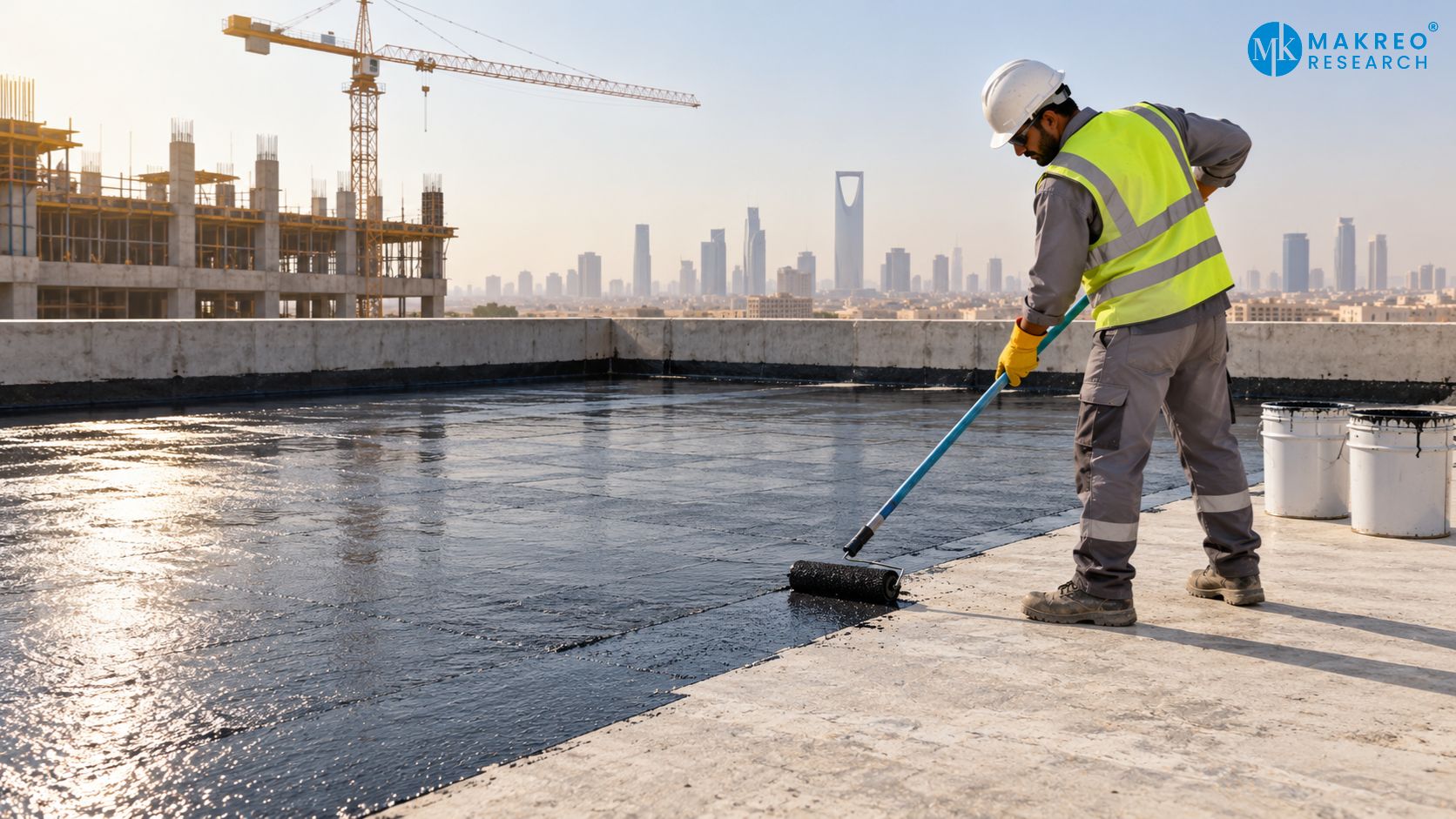
Saudi Arabia Construction Chemicals Market to 2030 - SAR 123.9 Billion in Awards, 35.1 Million Tonnes of Cement Sales and a Shift to Local Manufacturing
Makreo Research analyses Saudi Arabia’s construction chemicals market, including demand trends, product opportunities and the shift towards local manufacturing.
The Saudi Arabia construction chemicals market still rests on the largest construction programme in the Gulf, but the timing and mix of new work changed sharply in 2026. For manufacturers of concrete admixtures, waterproofing systems, protective coatings, industrial flooring, tile adhesives, grouts and sealants, the question is less whether demand exists than where it sits - which owners, regions and specifications will decide who wins it.
Makreo Research estimates the Saudi Arabia construction chemicals market to grow at a CAGR of 5.3% between 2025 and 2030. Waterproofing systems account for the largest share of product revenues at around 31%, while tile adhesives and grouts are expected to record the fastest growth as housing and fit-out programmes move from award to delivery.
Award data confirms how sharply the cycle has turned. Projects awarded on the Saudi Contractors Authority (SCA) monitoring platform peaked at more than SAR 71.3 billion (about USD 19.0 billion) across 66 projects in Q2, before contracting to SAR 22.4 billion across 33 projects in Q3. According to Makreo Research, this represents a 68.6% quarter-on-quarter decline and brings nine-month awards to approximately SAR 123.9 billion (USD 33.0 billion) across 119 projects. The mix, however, remains weighted towards buildings - building projects accounted for 67.6% of July’s award value, and all 13 projects awarded in August were commercial, residential, data centre or other building schemes.
Makreo Research’s analysis points to three shifts. Spending is moving from the most ambitious gigaprojects towards deadline-bound infrastructure, housing, healthcare, energy and industrial work. Specifications are placing more weight on durability and embodied carbon. International suppliers are buying or partnering with Saudi producers to manufacture inside the Kingdom. This analysis sets out where demand is moving, how specifications and competition are changing, and what suppliers and investors should assess before committing capital.
Saudi Arabia Construction Chemicals Market Overview and Outlook to 2030
Saudi Arabia’s construction chemicals market covers specialty products that are added to, or applied on, concrete, masonry and structures to improve workability, strength, durability and protection. Demand to 2030 is likely to be steadier but more selective than during the gigaproject peak, with growth increasingly decided by technical specification and local supply.
The main product groups are concrete admixtures (plasticisers, polycarboxylate ether (PCE) superplasticisers, retarders, accelerators and durability admixtures); waterproofing membranes and liquid-applied systems; protective coatings and industrial flooring; concrete repair and protection products; tile adhesives and grouts; and construction sealants. Buyers include ready-mix and precast producers, main contractors and specialist applicators, while consultants and project owners shape demand through specifications.
Saudi Arabia’s climate adds a technical layer to demand. High temperatures, UV exposure and aggressive soils raise the value of slump-retaining admixtures, durable membranes and protective coatings across every project type.
Three indicators frame the outlook:
-
Award momentum has slowed - Q2 accounted for about 70% of H1 award value, and Q3 awards averaged about SAR 7.5 billion a month, roughly half the nine-month average of SAR 13.8 billion. Projects awarded in Q2 will drive much of the chemicals demand placed on site in 2027 and 2028.
-
Cement volumes are stable, not growing - concrete placement is broadly flat year on year, as the cement section below sets out.
-
Costs are rising - construction costs rose 2.2% year on year in September, according to the General Authority for Statistics (GASTAT), led by equipment rental, labour, material and energy costs.
Makreo Research assess that value growth to 2030 will come less from additional concrete volume and more from higher-specification products, lower-carbon mix designs and locally manufactured supply. Even with a market-level estimate in hand, companies should size their own opportunity against a defined product scope, region and customer base.
Exploring opportunities in the construction chemicals market?
Access our latest market reports, forecasts and competitive insights in the Construction Chemicals Report Store.
Where Saudi Construction Chemicals Demand Will Come From to 2030
The Saudi project pipeline is being reprioritised rather than abandoned. Large awards continued through the first half - 18 projects worth more than SAR 30 billion (about USD 8.0 billion) in May 2026, the highest monthly value of the year, followed by 25 projects worth more than SAR 29.5 billion (about USD 7.9 billion) in June, the highest monthly count. These values describe whole construction contracts. Construction chemicals account for only a small share of any project’s cost, so award values indicate where demand will arise rather than the size of the chemicals opportunity.
Five Demand Pools Shaping the Market to 2030
-
Riyadh infrastructure and event-linked projects - Riyadh accounted for SAR 7.50 billion of July’s SAR 9.75 billion in awards and SAR 3.39 billion of August’s SAR 4.86 billion, about 75% of award value across the two months. The Royal Commission for Riyadh City (RCRC) was July’s largest owner, with three infrastructure projects worth SAR 2.79 billion, and in October it awarded SAR 5.5 billion of contracts for 94 additional metro trains.
-
Housing and mixed-use development - the National Housing Company was June’s largest project owner by value, with more than SAR 5 billion across six projects, and mixed-use residential apartments were June’s highest-value segment at more than SAR 6 billion. Apartments and mixed-use schemes appeared again among August awards, supporting demand for admixtures, waterproofing, tile adhesives and sealants.
-
Eastern Province energy and industrial assets - the Eastern Province led June awards with 10 projects worth SAR 11.44 billion, about 39% of the month’s value, and Saudi Aramco was the second-largest owner. In September, water and energy led awards, with the Saudi Power Procurement Company and ACWA Power owning four projects worth SAR 3 billion.
-
Transport corridors beyond Riyadh - May’s largest award was the Aseer-Jazan Expressway, valued at more than SAR 18 billion, or roughly 60% of the month’s award value, showing that major transport work now extends well beyond the capital.
-
Healthcare and institutional buildings - Q3 2026 awards included USD 208 million of mechanical, electrical and plumbing works at Almoosa Hospital in Al-Khobar and USD 105.6 million to complete Taiba University Hospital in Madinah. These projects support demand for industrial flooring, waterproofing, sealants and protective coatings.
Gigaprojects Now Play a Smaller Role in Construction Chemicals Demand
Gigaproject developers still appear on monthly award lists, but they no longer set the pace. Spending is concentrating on projects with fixed delivery dates or those already under construction, while the most capital-intensive desert developments are being phased. Three signals support this shift:
-
Award lists - in July, the Diriyah Gate Development Authority (SAR 1.16 billion) and Qiddiya Investment Co. (SAR 0.75 billion) ranked behind RCRC, alongside housing and real estate developers.
-
Policy direction - the Public Investment Fund’s 2026-2030 strategy, approved in April 2026, describes a “value realisation” phase focused on returns, asset performance and a larger private-sector role. Media reports in October also indicated that the NEOM World Cup stadium had been shelved and that five of the 15 planned venues could be dropped. Neither report has been officially confirmed, and the World Cup 2034 Hosting Higher Authority said construction milestones are being delivered.
-
Power procurement - in August 2026, the Saudi Power Procurement Company signed agreements for four battery storage projects totalling 2,000 MW / 8,000 MWh, with investment above SAR 4.35 billion. These projects use less concrete per riyal than conventional generation, but still require foundations, cable trenches, waterproofing and protective coatings.
The takeaway for suppliers is that headline award values are a poor guide to construction chemicals demand. Each demand pool has its own specifications, approval routes and product mix, so demand should be assessed by project type, owner and region. This is where primary research with contractors and specifiers adds the most value.
Saudi Cement Demand and the Outlook for Concrete Admixtures
Project mix shapes which products are needed; cement data shows how much concrete is actually being placed. Cement sales are the closest indicator of concrete admixture demand, and 2026 data points to a market that is stable rather than growing. Based on Yamama Cement’s monthly industry data, Makreo Research estimates Saudi cement sales at about 35.1 million tonnes in January to August 2026, around 2% below the same period of 2025.
-
Weak start - Q1 sales fell 4.7% year on year to 12.76 million tonnes, as Ramadan, the Eid holidays and regional disruption slowed site activity.
-
August - domestic sales rose 0.5% while exports fell about 18%, with nine of 17 producers growing local sales, led by Yamama Cement at 835,000 tonnes, up 12.1%.
-
Surplus supply - clinker production rose 8.5% to about 5.02 million tonnes, and inventories continued to build.
A stable, well-supplied cement market is a price-competitive one. Ready-mix and precast producers are therefore likely to prioritise mix-design efficiency, cement optimisation and hot-weather performance. This favours admixture suppliers that offer technical service and trial support over those competing on price per litre alone.
Low-Carbon Concrete Moves from Pilot to Project Specification
Flat volumes do not mean a static product mix. Low-carbon concrete is entering project specifications faster than concrete volumes are growing, as three developments show:
-
King Salman International Airport - in July 2026, a consortium of PIF-backed Almabani, CarbonCure and FCC Construcción won a contract to supply lower-carbon concrete that injects captured CO₂ into fresh concrete. For the third runway, FCC estimates about 6,800 tonnes of CO₂ equivalent will be permanently sequestered, cutting embodied carbon by 5 to 10%.
-
Local PCE production - CasTech International has opened a factory in Dammam 3rd Industrial City under a PIF partnership, with Tasnee supplying acrylic acid for a domestic raw material chain.
-
Local-material trials - Saudi Readymix and CHASM Advanced Materials demonstrated carbon nanotube-enhanced concrete in Dammam using only Saudi-sourced materials. The trial is still under monitoring.
Admixture demand on major projects will increasingly be won at the specification stage. High-range PCE superplasticisers and durability admixtures are moving from premium options to baseline requirements on PIF-backed assets. Suppliers that can document carbon performance and engage consultants early are best placed.
Waterproofing, Coatings, Flooring and Sealants Follow the Project Mix
Demand for waterproofing, protective coatings, industrial flooring and sealants is following the award mix rather than concrete volumes. While cement sales are broadly flat, Saudi construction contracts rose 7.6% year on year to USD 9.2 billion in Q3 2026 and gas awards rose 80.1% to USD 6.9 billion, both segments that specify protective and finishing systems heavily.
Three recent developments show where this demand is forming:
-
Grid and energy storage - As power procurement shifts towards battery storage and transmission infrastructure, demand is increasing for foundation waterproofing, cable-trench protection, enclosure waterproofing and protective coatings.
-
Data centres - The GCC pipeline includes more than 174 active and planned data centre projects valued at over USD 93 billion, including a proposed USD 5 billion development at Oxagon in NEOM. These facilities require anti-static flooring, fire-rated sealants and high-performance waterproofing systems.
-
Local specialist production - The April 2026 partnership between VIP Coatings and CIC Construction Chemicals brings polyurea, polyaspartic and cool-roof systems into local production, reducing lead times for industrial flooring, waterproofing and roofing applications in Saudi Arabia.
Each product group draws on a different part of the pipeline:
-
Waterproofing - Below-grade and roof protection for housing, mixed-use and Riyadh metro projects, plus cable trench and foundation protection for storage and grid assets.
-
Protective coatings and industrial flooring - Chemical-resistant and heavy-duty systems for Eastern Province gas, petrochemical and industrial assets, and hygienic flooring for hospitals.
-
Sealants - Facade, glazing and expansion-joint applications in commercial, mixed-use, data centre and healthcare buildings.
Two points put these numbers in context:
-
Later in the build cycle - These products are applied at structural, envelope and fit-out stages, so 2026 awards will convert into demand mainly in 2027 and 2028.
-
Approval-led buying - Most systems are named in consultant specifications or approved-vendor lists, so a project award does not guarantee access for every supplier.
For suppliers, the takeaway is that consultant approvals, trained applicator networks and local stock will decide who captures this demand, because product failure on site is costly and specifiers favour proven systems.
Ceramics Demand Points to Stronger Tile Adhesive and Grout Value
Tile adhesives, grouts and finishing mortars follow the fit-out cycle, and listed ceramics producers reported strong Saudi demand in Q2 2026:
-
Saudi Ceramics - Domestic sales rose 30.6% and exports 26.6% year on year, tiles and sanitaryware sales increased by about 17%, and gross margin rose to 33.2% from 24.6%. The company described demand as very strong compared with the same quarter of the previous five years and expects Q3 to return to normal levels.
-
RAK Ceramics - Saudi revenue rose 11.6% to AED 60.8 million (about USD 16.6 million), driven by a shift from ceramic to higher-value gres porcelain. Its Yanbu greenfield tiles plant is now expected to be completed by Q2 2027.
The move to larger, denser porcelain tiles is the key signal for adhesive suppliers. These formats typically require polymer-modified, higher-deformability adhesives and specialist grouts, which raises value per square metre even where tiled floor area grows more slowly.
Competitive Landscape and Construction Chemicals Manufacturing in Saudi Arabia
Competition in the Saudi construction chemicals market is shifting from import-based distribution to local manufacturing. Since 2024, several international manufacturers have entered or deepened their Saudi presence by acquiring established local producers or forming production partnerships, rather than building new plants from scratch.
-
Master Builders Solutions and Arkaz - Master Builders Solutions completed its acquisition of Arkaz from Alturki Holding on 10 March 2026. Arkaz produces concrete admixtures, waterproofing and building products, with production facilities in Dammam and Jeddah and a Kingdom-wide technical sales team. The deal combines global admixture technology with local plants and established contractor relationships.
-
Sika and Gulf Seal - On 20 November 2025, Sika announced the acquisition of Gulf Seal (Awazil Al Khaleej Industrial Co.), a Riyadh-based manufacturer of bituminous waterproofing membranes with export channels across the GCC. The deal adds locally made membranes to Sika’s broad waterproofing systems portfolio.
-
MAPEI and Bitumat - In February 2024, MAPEI acquired Bitumat from Gulf Investment Corporation, gaining a waterproofing systems plant in Dammam’s 2nd Industrial City and offices and warehouses in Riyadh and Jeddah. MAPEI describes it as its first direct industrial investment in Saudi Arabia.
-
VIP Coatings and CIC Construction Chemicals - On 9 April 2026, the two companies announced a production partnership to manufacture polyurea, polyaspartic and hybrid systems in Saudi Arabia for waterproofing, flooring and roofing. The licensing route gives a Saudi producer access to specialised technology without a new plant.
-
CasTech International - CasTech’s PIF-supported plant in Dammam pairs PCE admixture production with domestic acrylic acid from Tasnee, showing how raw material localisation can follow finished-product localisation.
Two routes are emerging. Multinationals buy established producers to gain plant capacity, approvals and contractor relationships at once. Regional manufacturers use licensing and toll manufacturing to access specialised technology faster. Tighter local content rules in government procurement reinforce both routes.
What Determines Market Position
Eight factors decide competitive position, weighted differently by product category:
-
Local manufacturing - Lead times, freight cost and local content eligibility.
-
Raw material security - Access to acrylic acid, bitumen and resins.
-
Proven performance - Trials and references in heat, UV and aggressive soils.
-
Specification influence - Relationships with consultants and contractors.
-
Supplier approval - A place on owner and consultant approved-vendor lists.
-
Distribution reach - Riyadh, Jeddah, Dammam and secondary cities.
-
Technical service - Mix-design support, site supervision and applicator training.
-
Pricing discipline - Essential while cement oversupply squeezes ready-mix margins.
Reliable public data on company market shares and production capacities does not exist for this market. Competitor positions are best mapped through benchmarking, distributor interviews and contractor surveys rather than secondary estimates.
Regional Opportunities for Construction Chemicals Suppliers in Saudi Arabia
Where suppliers manufacture matters as much as what they make. Saudi Arabia is not one market for construction chemicals - each region has a different project mix, customer base and supply footprint, and award leadership moves between regions month by month.
-
Riyadh and the Central Region - the largest and most diverse demand centre, spanning metro and road works, event venues, housing and King Salman International Airport. Demand is strongest for PCE admixtures, waterproofing, tile adhesives and sealants, supplied mainly through ready-mix producers and main contractors.
-
Eastern Province - gas, petrochemical, industrial and logistics assets drive demand for protective coatings, industrial flooring, chemical-resistant linings and durable waterproofing. It is also the main manufacturing base, with Arkaz, Bitumat and CasTech all producing in Dammam.
-
Western Region - Makkah led May awards by project count, with seven of 18 projects. Jeddah hosts Arkaz manufacturing and Bitumat warehousing, and RAK Ceramics is building a tiles plant in Yanbu, which signals growing finishing-materials demand.
-
Southern Region - the Aseer-Jazan Expressway made Aseer the largest region by award value in May, so transport-grade admixtures and waterproofing now reach well beyond the main cities.
Delivery distance matters because construction chemicals are often bulky, low in value per tonne or temperature-sensitive in transit. Suppliers should map regional demand, competitor plant locations and distributor coverage together before choosing a plant site, warehouse network or sales territories. Regional market share data is not publicly available, so project-level and distributor-level research is essential.
What This Means for Construction Chemicals Suppliers to 2030
The three shifts identified at the outset point to a clear set of priorities. As spending moves to deadline-bound and building projects, suppliers need sales coverage aligned to specific owners and regions rather than to headline award totals. As specifications tighten on durability and carbon, technical evidence and early consultant engagement become the deciding factors. As localisation accelerates, local plants, raw material security and approved-vendor status increasingly separate market leaders from importers.
For manufacturers, distributors and investors, the opportunity to 2030 is real but selective. It will be captured by companies that define their target product scope, region and customer base precisely, and that test those choices with primary evidence before committing capital.
How Makreo Research Supports Decisions in the Saudi Construction Chemicals Market
The decisions that matter in this market depend on evidence that award data cannot provide - which contractors and ready-mix producers are switching suppliers, which consultants control specifications, how distributors perform and where local capacity is genuinely needed. Makreo Research and Consulting builds that evidence through custom research and B2B market surveys, following a documented methodology that combines primary fieldwork with secondary analysis.
For construction chemicals manufacturers, distributors and investors evaluating Saudi Arabia, typical research mandates include:
-
Market entry and segment prioritisation - product-scope market sizing, segment and region prioritisation, and entry-mode assessment.
-
Competitor intelligence and benchmarking - product, price and service benchmarking of admixtures, waterproofing, coatings, flooring, adhesives, grouts and sealants against local and multinational suppliers.
-
Distributor selection and network planning - partner screening, capability assessment, channel due diligence and warehouse coverage across Riyadh, Jeddah, Dammam and secondary cities.
-
Manufacturing localisation and plant feasibility - demand-backed capacity planning, site comparison across industrial cities and raw material sourcing for PCE, resins and polymers.
-
Customer and specifier research - interviews and surveys with contractors, ready-mix and precast producers, applicators and consultants on purchase criteria, approval routes and switching triggers.
-
Pricing analysis - price positioning by product category, channel and region.
-
Regulatory and local content assessment - implications of local content rules, Saudi Building Code provisions and SASO conformity for product approval and procurement eligibility.
-
Commercial due diligence - market validation and target screening for investors and acquirers.
To discuss a specific requirement, explore Makreo Research Consulting and Market Survey services, or contact the team at [email protected].
Frequently Asked Questions
What is driving the Saudi Arabia construction chemicals market in 2026?
Saudi Arabia’s construction pipeline remains the core demand driver, with about SAR 123.9 billion in projects awarded on the Saudi Contractors Authority platform in the first nine months of 2026. Despite a Q3 slowdown, housing, Riyadh infrastructure, airports and Eastern Province industrial assets now anchor demand.
What is the growth outlook for the Saudi Arabia construction chemicals market?
Makreo Research estimates the Saudi Arabia construction chemicals market to grow at a CAGR of 5.3% between 2025 and 2030. Value growth is expected to come less from additional concrete volume and more from higher-specification admixtures, waterproofing and protective systems, and locally manufactured supply.
Which construction chemicals are seeing stronger demand in Saudi Arabia?
High-performance PCE admixtures and low-carbon concrete solutions are gaining ground on major infrastructure and PIF-backed projects. Protective coatings and industrial flooring benefit from gas and industrial awards in the Eastern Province, while polymer-modified tile adhesives benefit from the shift towards large-format porcelain tiles.
Who are the major construction chemicals manufacturers in Saudi Arabia?
International groups with Saudi manufacturing include Master Builders Solutions (through Arkaz), Sika (through Gulf Seal) and MAPEI (through Bitumat). CasTech International produces PCE admixtures locally, and CIC Construction Chemicals manufactures polyurea and flooring systems under licence from VIP Coatings. Reliable public market share data is not available, so competitive position is best assessed through benchmarking and customer research.
What should manufacturers assess before producing locally in Saudi Arabia?
Manufacturers should assess regional demand by product, competitor plant locations, raw material availability, distributor coverage and the local content rules that apply to their target buyers. Product conformity, approved-vendor requirements and expected payment terms should also be tested before committing capital.
How can Makreo Research help construction chemicals companies evaluating Saudi Arabia?
Makreo Research supports market entry, competitor benchmarking, distributor selection, pricing analysis, plant feasibility and commercial due diligence. Its methods combine interviews and surveys with contractors, ready-mix producers, applicators, distributors and consultants with secondary market analysis.
Saudi Arabia construction chemicals market, Saudi construction chemicals market 2030, construction chemicals market report, Saudi construction industry, construction chemicals manufacturers Saudi Arabia, concrete admixtures Saudi, waterproofing systems Saudi Arabia, protective coatings Saudi Arabia, industrial flooring Saudi Arabia, construction sealants, tile adhesives and grouts, low-carbon concrete Saudi Arabia, Saudi cement demand, local manufacturing Saudi Arabia, Saudi construction project pipeline, Riyadh construction market, Eastern Province industrial projects, construction materials market research, Saudi market entry strategy