India Flexible Packaging Market Analysis and Forecast (2018-2028) - Segmentation by Raw Material, Type of Films, End User and Organization Type
Overview
India Flexible Packaging Market Size
The India Flexible Packaging Market is experiencing robust growth, propelled by urbanization, shifting consumer lifestyles, heightened awareness, and a rapidly expanding e-commerce sector. Recent insights into the flexible packaging market size in India reveal that a variety of materials such as plastic films, aluminum foils, and paper—are being utilized to create versatile flexible packaging solutions. Known for its convenience and cost-efficiency, flexible packaging has quickly become a favored option, driving significant adoption and steady expansion within the flexible packaging industry in India.
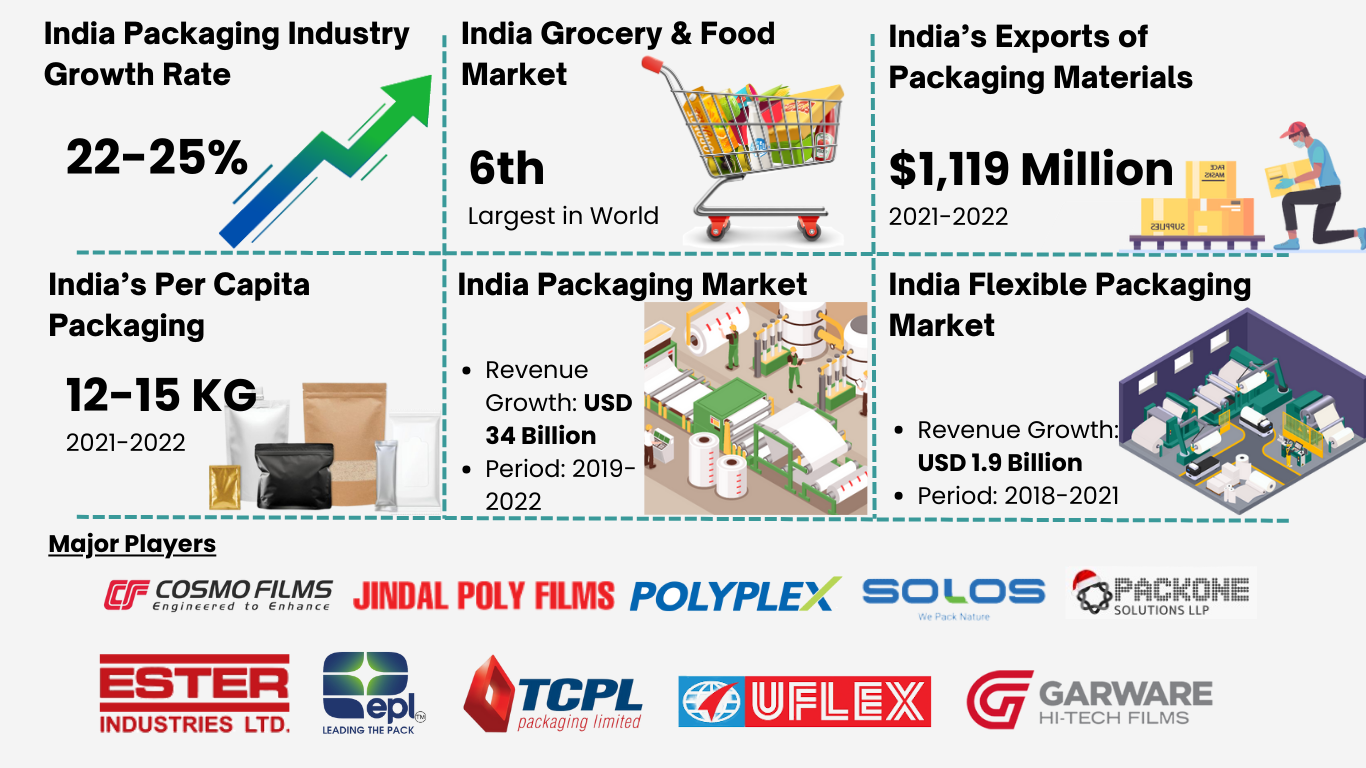
The broader packaging industry in India continues to grow swiftly, recording an annual growth rate of 22-25% as of 2021. As the fifth largest sector in India’s economy, packaging has shown strong development, particularly in exports. Within this context, flexible packaging has emerged as a major driver of growth.
The flexible packaging sector in India is achieving considerable advancements, increasingly impacting the country’s export market. Between 2018-2019 and 2021-2022, exports of Indian flexible packaging materials rose from USD 844 million to USD 1,119 million, highlighting a rising global footprint. The United States stands as the largest importer, followed by key markets like the UK, UAE, Netherlands, and Germany. This sustained demand in both domestic and international markets indicates a promising future for the flexible packaging sector in India.
The India Flexible Packaging Market is also seeing significant innovations in materials and technology. Key advancements in the flexible packaging industry in India include the development of barrier films, smart packaging, and anti-counterfeiting solutions. One of the emerging trends is active packaging, where edible and water-soluble films are gaining attention. Driven by the ongoing demand for environmentally friendly and reduced-material packaging, edible and soluble films are expected to see a rise in demand over the coming years.
The flexible packaging sector in India has also seen an influx of companies in the BOPP and BOPET markets. Over the past year, eight new BOPET production lines, with a combined capacity exceeding 300 KT annually, were launched by companies like Ester, Cosmo, U-flex, and Chiripal, among others. These investments, totaling over INR 3,000 crores, reflect the growth potential of the flexible packaging market in India. Both domestic and international companies are active players, with local firms often tailoring products for the Indian market, while global companies contribute advanced technology and quality standards.
Segmentation of the India Flexible Packaging Market
Packaging Type: The India Packaging Market can be broadly categorized into two main types: flexible packaging and rigid packaging, with all other packaging types falling under these categories. Although rigid packaging currently holds a larger market share, the flexible packaging market in India is expanding at a notable pace. This growth is largely due to consumers’ desire for packaging that is practical and user-friendly, as product packaging is often their first physical interaction with a product. Additionally, flexible packaging solutions in India are cost-effective, further boosting their popularity.
Company Size: In the flexible packaging sector in India, Micro, Small, and Medium Enterprises (MSMEs) hold a significant market share, while only a few large companies are present. There are reportedly over 200 flex-pack converters across the country, most of which are small businesses with processing capacities of less than 250 metric tons per month. These flexible packaging companies in India primarily produce items like overwraps, co-extrusion films, and polysacks.
Material Type: Within the flexible packaging industry in India, plastic packaging dominates, representing around 63% of the market’s value, followed by paper, glass, and metal. With advances in the barrier properties of plastic, especially clear plastic films, plastic and paper packaging are increasingly replacing glass and metal, particularly for retorted and hot-filled products.
End Users: The flexible packaging market in India serves several industries, including Food, Non-Alcoholic Beverages, Cosmetics & Toiletries, and others. The food segment is the largest, driven by the rapidly growing consumption of packaged food and beverages. Convenience and the rise of ready-to-eat options are key factors fueling the growth of the packaged food market in India.
Future Outlook of the India Flexible Packaging Market
The Indian flexible packaging industry is dynamic and continues to evolve to meet the changing needs and preferences of consumers and businesses. The India Flexible Packaging Market is anticipated to increase at a CAGR of 13.9% from 2023 to 2028.
Sustainability has become a prominent theme in the industry, leading to the exploration and adoption of eco-friendly and sustainable packaging materials. Innovation in barrier films, smart packaging, and anti-counterfeiting features has also been a focus.
In addition, the fast-moving consumer goods (FMCG) market in India is estimated to grow at a CAGR of more than 18% during the forecast period. Therefore, the growing retail sector in India will increase the demand for flexible packaging, thereby driving the growth of the India flexible packaging market during the forecast period.
Scope of the Study
Makreo Research has published a study on the packaging industry titled, “India Flexible Packaging Market Analysis and Forecast (2018-2028) ”. The study evaluates flexible packaging market demand and production facts with a detailed assessment of past and present market trends. This holistic approach enhances the overall analysis and makes the study a valuable resource for individuals or organizations interested in exploring the share of Flexible packaging, consumption statistics, demand of BOPP & BOPET, and polymer pricing in India. The market has witnessed many shifts in the recent past that have impacted profit margins of the players but also accounted for the rise in demand. The report contains a good balance of macroeconomic and microeconomic analysis, both qualitative and quantitative. The competition has also been carefully examined in terms of significant M&A transactions that have occurred in the market and recent financial infusions.
The report examines the corrugated packaging market in terms of market revenue and further breakdown into market segmentation:
- By Flexible
- Rigid Packaging
- By Company Size
- Large Companies
- MSME’s
- By Material Type
- Plastic
- Paper
- Glass
- Metal
- Others
- By End User
- Food
- Non-Alcoholic Beverages
- Cosmetic
- Toiletries
- Others
Key Questions Answered
- How the Indian economy has performed in the past and what is the future expected growth outlook?
- At what rate has India's Flexible packaging market revenue grown in the past and what is the present state of the industry?
- What are the major driving factors that accounted for a push to the industry in the past?
- What is the expected future of the Indian Flexible packaging market?
- Who are the major players operating in the Flexible packaging market in India and how are these players are contributing to the industry?
- Which industry plays a dominant role in terms of generating maximum demand for Flexible packaging in India?
- What is the average cost of the plastic polymer in India and what price trend has been followed?
- What segment holds the major market share by film type?
- What is India's present demand for BOPP and BOPET, and how quickly will it increase in the near future?
- What are the strength, weakness, opportunities & threats in the flexible packaging market in India?
Companies Covered
- Cosmo Films (Cosmo First Limited)
- Jindal Poly Films Limited
- Polyplex Corporation Ltd
- Ester Industries Limited
- EPL Ltd.
- Solos Polymer
- TCPL Packaging Ltd.
- Packone Solution LLP
- Uflex Ltd.
- Garware Hi-tech Films Limited.
Looking for a Section from Report? Start your Partial Purchase Request
Table of Contents
- Report Synopsis
- Market Definitions
- 1.Research Methodology
- 1.1.Objective of the Study
- 1.2.Research Process
- 1.3.Data Collection Methods
- 1.4.Analytical Framework
- 2.India Flexible Packaging Market - EPTD Analysis
- 2.1.Country Overview – EPTD Analysis
- 2.2.EPTD Analysis – India Economic Overview
- 2.3.EPTD Analysis – India Political Overview
- 2.4.EPTD Analysis – Technological Overview
- 2.5.EPTD Analysis – India Demographic Overview
- 3.India Flexible Packaging Market - Trade Performance
- 3.1.Trade Performance: Plastic Export Statistics
- 3.1.1.Trade Performance: Top Plastic Items Exported
- 3.2.Import Statistics: LDPE & LLDPE
- 3.3.Import Statistics: PTA
- 3.1.Trade Performance: Plastic Export Statistics
- 4.India Flexible Packaging Market - Past & Present Performance
- 4.1.India Flexible Packaging Market – Segmentation Snapshot
- 4.2.India Packaging Market: An Overview
- 4.3.India Flexible Packaging Market: An Overview
- 4.3.1.India Flexible Packaging Market: Advantages of Flexible Packaging
- 4.3.2.India Flexible Packaging Market: Export Statistics
- 4.3.3.India Flexible Packaging Market: Consumption Statistics
- 4.3.4.India Flexible Packaging Market: Government Initiatives
- 4.4.India Flexible Packaging Market Revenue: Past & Present Performance
- 5.India Flexible Packaging Market – Market Segmentation
- 5.1.India Flexible Packaging Market: Share of Flexible Packaging
- 5.2.India Flexible Packaging Market: By Company Size
- 5.3.India Flexible Packaging Market: by Material Type
- 5.4.India Flexible Packaging Market: by End Users
- 6.India Flexible Packaging Market - By Material Type (Paper, Plastic, Metal, Glass)
- 6.1.Paper Packaging Market: An Overview
- 6.1.1.Demand of Paper Packaging in India
- 6.2.Plastic Packaging Market: An Overview
- 6.2.1.Plastic Packaging Consumption Statistics
- 6.2.2.Plastic Packaging Raw Material PVC Pricing
- 6.2.3.Demand of Polyolefin & Polyethylene
- 6.3.Glass Packaging Market: An Overview
- 6.3.1.Contribution of Beverages in India
- 6.4.Metal Packaging Market: An Overview
- 6.1.Paper Packaging Market: An Overview
- 7.India Flexible Packaging Market - By Film Type (BOOP & BOPET)
- 7.1.BOOP & BOPET Film Market: An Overview
- 7.1.1.BOPP & BOPET Major Manufacturing Plant
- 7.1.2.BOOP & BOPET Film Demand in India
- 7.1.2.1.BOPP Film Capacity & Demand in India
- 7.1.2.2.Thin BOPET Film Capacity & Demand in India
- 7.1.2.3.Thick BOPET Film Capacity & Demand in India
- 7.1.BOOP & BOPET Film Market: An Overview
- 8.India Flexible Packaging Market - Polymer Pricing
- 8.1.PTA+MEG Pricing Scenario
- 8.2.PET Pricing Index
- 8.3.LLDPE & LDPE Pricing Index
- 8.4.Polymer Pricing in Major Cities of India
- 9.India Flexible Packaging Market - by Type of Packaging
- 9.1.India Flexible Packaging Market: by Type of Packaging
- 9.2.India Flexible Packaging Trend
- 10.India Flexible Packaging Market - by End User (Food & Beverage, Pharmaceutical, E-commerce and Others)
- 10.1.Food & Beverages Market Performance
- 10.1.1.India Processed Food Market Performance
- 10.1.2.India Packed Food Market Performance
- 10.2.India Pharmaceuticals Market Performance
- 10.3.India E-Commerce Market Performance
- 10.4.India Retail Industry Performance
- 10.5.India Beauty & Personal Care Market Performance
- 10.6.India Consumer Electronics Market Performance
- 10.7.India Automobile Component Market Performance
- 10.1.Food & Beverages Market Performance
- 11.India Flexible Packaging Market - Future Outlook
- 11.1.India Flexible Packaging Market: Future Outlook
- 11.2.Factors to Drive the Flexible Packaging Market in Future
- 12.India Flexible Packaging Market - SWOT Analysis
- 12.1.SWOT Analysis: Strength & Weakness
- 12.2.SWOT Analysis: Opportunities & Threats
- 13.India Flexible Packaging Market - Trends & Development
- 13.1.India Flexible Packaging Trends & Development
- 14.India Flexible Packaging Market - Competitive Landscape
- 14.1.India Flexible Packaging Competitive Landscape
- 15.India Flexible Packaging Market - Mergers/Acquisitions/Investments 2018-2023 & Funding Timeline
- 15.1.Market Mergers/Acquisitions/Investments 2018-2023
- 15.2.Funding Timeline
- 16.India Flexible Packaging Market - Company Profiles
- 16.1.Company Profile: Cosmo Films
- 16.2.Company Profile: Jindal Poly Films Limited
- 16.3.Company Profile: Polyplex Corporation Ltd.
- 16.4.Company Profile: Ester Industries Limited
- 16.5.Company Profile: EPL Ltd.
- 16.6.Company Profile: Solos Polymer
- 16.7.Company Profile: TCPL Packaging Ltd.
- 16.8.Company Profile: Packone Solution LLP
- 16.9.Company Profile: Uflex Ltd.
- 16.10.Company Profile: Garware Hi-tech Films Limited
- Analyst Recommendations
- Limitations of the Study
- List of Figures & Tables
- GDP Growth (Annual %) of India, 2015-2022
- India Consumer Inflation Rate, 2015-2021
- India Consumer Spending, Q1/2022-Q3/2023
- India FDI Investments by Countries (%), 2021-2022
- Top 5 States Attracting Highest FDI Equity Inflow in India (%), 2021-2022
- Political Framework Parameters of Top Asian Economies
- Total Population of India, 2016-2022
- Poverty Headcount (% of population), 2015-2019
- Category wise % growth in plastics export by India, 2023-2023
- India Packaging Material Export, 2018/19-2021/22
- Imports of Various Grade of Raw Material, 2017/18-2022/23
- India LDPE Balance Sheet, 2019/20-2022/23E
- India Polymer Import, 2022
- India Import of PTA from China
- India Packaging Market Revenue, 2019-2022
- Share of Flexible in Total Packaging by Volume
- India Packaging Material Export, 2018/19-2021/22
- Per capita Packaging Consumption
- India Flexible Packaging Market Revenue, 2018-2023E
- Share of Flexible and Rigid Packaging in Total Packaging, 2022
- Share of large companies and MSME’s in Packaging Market
- India Flexible Packaging Market by Material Type, 2022
- India Flexible Packaging Market by End Users, 2021
- Annual Paper Demand in million metric Tonnes, 2013- 2022
- Share of Plastic Packaging in Total Plastic, 2019
- Per Capita Polymer Consumption
- Polymer Consumption Share, 2021
- PVC Price Index, Jul/22- Jul/23
- Polyolefins Production Capacity in India by Type, 2022
- Polyethylene (PE) consumption in India in by sectors, (%), 2022
- Volume contribution of Beverage in India by Type, 2021
- Global BOPP Film Demand by Region, 2022
- Global BOPP Film Capacity by Region, 2022
- Global Thin PET Film Demand by Region, 2022
- Global Thin PET Film Capacity by Region, 2022
- Global Thick PET Film Demand by Region, 2022
- Global Thick PET Film Capacity by Region, 2022
- PET Price Index, Jul/22- Jul/23
- LLDPE Price Index, Jul/22- Jul/23
- LDPE Price Index, Jul/22- Jul/23
- India Processed Food Market, 2020-2023
- India Packed Food Market, 2015- 2022
- India Drug & Pharmaceutical Export, 2016/17-2022/23
- Number of online Shoppers in India, 2018-2022
- Online Retail Industry in India, 2016-2022
- Personal Care and Hygiene Market Size , 2022-2026
- Personal Care and Hygiene Trade, 2022
- India Electronic Production, 2017/18-2022/23
- India Electronic Export, 2018-2023
- Auto Component Industry Performance, 2018/19-H1/2023
- India Flexible Packaging Market Revenue, 2022-2028F
- India Packaged Food Market Value, 2020-2026F
- Impact of Top 10 Packaging Trend
- Market Capitalization of Flexible Packaging Company, 2023
- Market Share of Top 5 Companies in Flexible Packaging, 2023
- Cosmo First Net Sales, 2020-2023
- Cosmo First Export, 2022/23
- Cosmo First EBITDA, 2020-2023
- Jindal Poly Films Total Revenue, 2021/22-2022/23
- Jindal Poly Films Packaging Films Segment Revenue, 2021/22-2022/23
- Jindal Poly Films Revenue From Operation by Region, 2021/22-2022/23
- Polyplex Corporation Ltd. Total Revenue, 2021/22-2022/23
- Polyplex Corporation Ltd. Revenue by Segment, 2021/22-2022/23
- Ployplex Corporation Ltd. Company Wise Sales Breakup, 2022/23
- Ployplex Corporation Ltd. Region Wise Sales Breakup, 2022/23
- Ployplex Corporation Ltd. Product Breakdown, 2022/23
- Ployplex Corporation Ltd. Application Wise Sales Breakdown, 2022/23
- Ester Industries Limited Total Revenue, 2021/22-2022/23
- Ester Industries Limited Revenue by Segment, 2022/23
- Ester Industries Limited Revenue by Region, 2022/23
- EPL Limited Total Revenue, 2021/22-2022/23
- EPL Limited Revenue by Region, 2021/22-2022/23
- TCPL Packaging Limited Revenue by Segment, 2021/22-2022/23
- TCPL Packaging Limited Revenue by Segment, 2021/22-2022/23
- TCPL Revenue by business Segments, 2021 (%)
- Uflex Total Revenue, 2021/22-2022/23
- Uflex revenue by Segment, 2021/22-2022/23
- Garware Hi-tech Films Limited Revenue, 2021/22-2022/23
- Garware Hi-tech Films Limited Revenue by Region, 2021/22-2022/23
Related Reports - Manufacturing & Construction