India Infrastructure Market Report - Transport, Energy, Residential and Commercial Projects
Overview
India Infrastructure Projects
The Indian infrastructure market is currently experiencing a transformative phase with significant investments across multiple sectors. Indian Government support and initiatives are playing a crucial role in boosting infrastructure development nationwide. This report provides a thorough analysis of India's infrastructure projects, focusing on key sectors such as transport infrastructure, residential and commercial developments, and energy infrastructure
The government's emphasis on infrastructure development has sparked increased construction activities. Initiatives like the Smart Cities Mission and Housing for All have created a conducive environment for developers and investors, aiming to improve urban living standards through better housing, transportation, and essential amenities. India's economic prosperity is significantly benefiting from these developments, positioning the country as a prominent player among global leaders. The Indian infrastructure Market completion and ongoing execution of mega projects across various sectors have made substantial contributions to India's overall progress.
In recent years, the infrastructure sector in India has made remarkable strides with a focus on constructing world-class highways, railways, airports, and ports. These projects not only enhance domestic connectivity but also attract foreign investments and stimulate trade in the Indian infrastructure Development market.
This report explores the strategic significance, current status, and prospects of these critical infrastructure projects. Through detailed segmentation based on infrastructure types, investment levels, and regional developments, stakeholders can gain actionable insights into the evolving opportunities and challenges within India's dynamic infrastructure market.
India Transportation Infrastructure Market: Strategic Insights on Ports, Railways, Highways, and Aviation
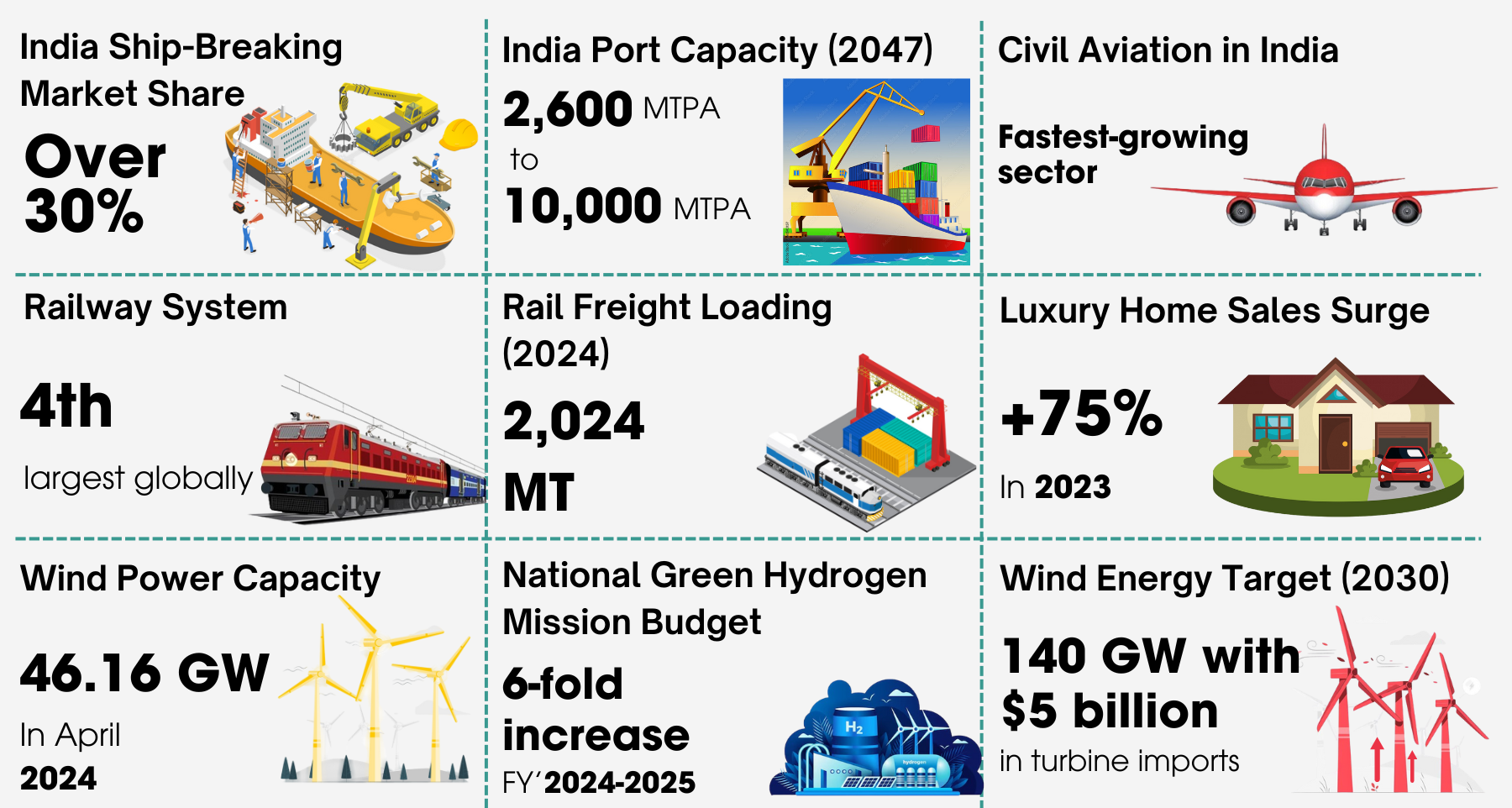
India's transportation infrastructure is strategically positioned with a coastline spanning approximately 7,517 km, facilitating its role as a key player in global shipping routes. The country boasts the world's largest ship-breaking facility in Alang, commanding over 30% of the global infrastructure market share in this industry. The government has introduced significant incentives to stimulate the development and operation of ports, inland waterways, and shipbuilding, aiming to enhance India's maritime sector under the Maritime India Vision 2030. This initiative outlines numerous strategies to accelerate Indian infrastructure sector growth through collaboration with stakeholders and comprehensive development plans.
Indian Railways, the 4th railway network globally, plays a pivotal role in the domestic transport sector, with an extensive track length and ongoing electrification efforts aimed at becoming the world's largest green railway network. The railway system operates a vast number of passenger and freight trains daily, achieving record-high loading and track-laying rates in recent years.
In the highways sector, India has allocated substantial investment, focusing on infrastructure development through innovative models like the Hybrid Annuity Model and toll-operate-transfer in India. Major projects in the India infrastructure market such as the Bharatmala Pariyojana are set to expand and upgrade the road network, including the ambitious Delhi-Mumbai Expressway.
The Indian civil aviation industry has also witnessed rapid growth, despite challenges like the COVID-19 pandemic, with significant expansions in Indian airport infrastructure and the UDAN Scheme facilitating increased domestic air connectivity in the India infrastructure market.
Bharatmala Pariyojana: Transforming India's Road Connectivity
The Bharatmala Pariyojana focuses on optimizing the efficiency of goods and passenger movement across India by connecting 550 districts through National Highway linkages. Phase I involves developing new highways, creating national corridors, and generating substantial employment in the construction and infrastructure sectors. This phase also includes completing remaining roadworks under the National Highways Development Project, presenting significant investment opportunities and enhancing economic activity through improved road connectivity.
Funding for Bharatmala comes primarily from the Central Government, supplemented by additional resources from the Ministry. By December 2023, contracts for the construction of 26,418 km had been awarded, and approximately 15,549 km had been completed. The initiative also includes the development of 24 logistics parks along national corridors, which will cater to key production and consumption hubs, covering 45% of India's road freight.
India Residential and Commercial Infrastructure Market: Growth Trends and Urbanization Impact
In recent years, India has witnessed significant growth and transformation in both residential development in India and commercial infrastructure in India. This surge in construction activity across the country can be attributed to rapid urbanization in India, population growth, and various governmental initiatives aimed at boosting Indian infrastructure development. A key driver of residential construction is the expanding middle-class population, drawn to urban areas for better job prospects, thus increasing the demand for affordable housing solutions in India. Real estate developers are capitalizing on this demand by focusing on projects that cater to the needs and financial constraints of the middle class.
India Infrastructure Market: Housing, Commercial Growth & Sustainability
On the commercial infrastructure front, India has seen robust growth in sectors such as office spaces, retail developments, and industrial zones. This growth in the Indian infrastructure market is driven by increasing urbanization in India, economic expansion, and the country's emergence as a global business hub. Major cities are witnessing significant investments in commercial real estate in India, supported by a burgeoning economy and favorable regulatory reforms aimed at facilitating business operations.
However, alongside these Indian infrastructure developments, challenges such as environmental concerns and sustainability issues remain pertinent. Projects like the Great Nicobar Island Development Project exemplify efforts to balance economic growth with environmental conservation. Scheduled for completion by 2028, this project aims to enhance infrastructure in the southern Andaman and Nicobar Islands while ensuring sustainable practices and preserving the region's natural heritage through collaboration with environmental experts.
India's Rising Renewable Energy Infrastructure Market
India's renewable energy sector is growing at a significant rate, driven by ambitious targets and government initiatives. Solar energy in India and wind energy in India dominate the landscape, with India's renewable energy targets set at 280 GW and 140 GW respectively by 2030.
Additionally, the "One Nation, One Gas Grid India" initiative aims to expand India's natural gas infrastructure, enhancing connectivity and opportunities in LNG infrastructure in India, pipelines, and city gas distribution in India. These efforts are part of the broader Indian infrastructure market and contribute to Indian infrastructure developments. Initiatives like the National Hydrogen Mission India and Production Linked Incentive Schemes India aim to promote energy storage systems, inviting collaboration with international partners.
Future Growth Outlook of Indian Infrastructure Market
The future outlook for the infrastructure market in India is positive, driven by various government initiatives and increasing investments. Significant efforts are being made to enhance the country's maritime and transport infrastructure, including the development of numerous waterways and extensive consultation with stakeholders to boost the maritime sector. Additionally, the government's substantial allocation for infrastructure investment in India, particularly in highways, and the successful implementation of the Hybrid Annuity Model (HAM), which rolled out over 60 road projects worth USD 10 billion, indicate a strong emphasis on improving connectivity and reducing logistics costs in India.
In the energy sector, India's ambitious renewable energy targets of 500 GW by 2030 and commitment to green hydrogen and energy storage systems present significant growth opportunities. However, the sector must address challenges related to the reliance on imports for solar panels and wind turbines by boosting domestic manufacturing. Overall, the Indian infrastructure market is expected to see robust growth due to these strategic initiatives, increased funding, and the focus on sustainable infrastructure development in India.
Scope of India Infrastructure Market Report
The India Infrastructure Market Report offers an in-depth analysis of the country's infrastructure sector, focusing on current and upcoming projects across various sectors. It offers insights into segment-wise dynamics, historical and current market performance, and various government initiatives and investments. The report categorizes the market by types of infrastructure, investment or project costs, and regional or state-wise developments, covering major projects of transport, residential, commercial, and energy infrastructure. Additionally, it covers key builders and contractors, detailing their recent and upcoming key projects. The report also highlights various schemes and initiatives undertaken by the government, covering ongoing and future projects across different infrastructure types. This analysis aims to provide stakeholders and industry experts with comprehensive insights into the evolving dynamics of India's rapidly growing infrastructure sector.
-
2019 - 2024: Past and Present Scenario
-
Till 2030: Future Outlook of the Industry
-
Marine
-
Air
-
Rail
-
Road
-
Wind Power Projects
-
Solar Renewable Projects
-
Hybrid Energy Infrastructure
-
What are the major infrastructure projects currently underway in India?
-
What are the major future projects, and what are their expected completion dates?
-
What government schemes and investments are benefiting the market?
-
What are the recent developments and key facts related to various types of infrastructure in India?
-
How is the Indian government funding these infrastructure projects?
-
What impact do infrastructure projects have on the local economy and job market in India?
-
How does India’s infrastructure development align with its long-term economic goals?
-
What environmental sustainability practices are being implemented in India’s infrastructure projects?
-
What are the prospects for India’s energy infrastructure in the future?
-
How are infrastructure projects in India contributing to the country's overall development and modernization?
Looking for a Section from Report? Start your Partial Purchase Request
Table of Contents
- 1.Research Methodology
- 1.1.Research Objective
- 1.2.Research Design and Procedure
- 1.3.Methodology of Research
- 1.4.Analytical Framework
- 2.India Infrastructure Market
- 2.1.India Infrastructure Market: Key Facts
- 3.India Transport Infrastructure: Marine, Air, Rail, Road
- 3.1.India Marine Transport Infrastructure: An Overview
- 3.1.1.India Marine Transport Infrastructure: Key Facts
- 3.1.2.India Marine Transport Infrastructure: Key Projects
- 3.2.India Air Transport Infrastructure: An Overview
- 3.2.1.India Air Transport Infrastructure: Key Projects
- 3.3.India Rail Transport Infrastructure: An Overview
- 3.3.1.India Rail Transport Infrastructure: Key Projects
- 3.4.India Road Transport Infrastructure: An Overview
- 3.4.1.India Road Transport Infrastructure: Key Projects
- 3.1.India Marine Transport Infrastructure: An Overview
- 4.India Residential & Commercial Infrastructure
- 4.1.India Residential Infrastructure: An Overview
- 4.1.1.India Residential Infrastructure: Key Facts and Figures
- 4.1.2.India Residential Infrastructure: House Price Index
- 4.1.3.India Residential Infrastructure: Government’s Initiatives and Projects
- 4.1.4.India Residential Infrastructure: Upcoming Luxury Projects
- 4.2.India Commercial Infrastructure Market: An Overview
- 4.2.1.India Commercial Infrastructure Market: Key Projects
- 4.2.2.India Commercial Infrastructure Market: Upcoming Malls
- 4.1.India Residential Infrastructure: An Overview
- 5.India Energy Infrastructure
- 5.1.India Energy Infrastructure: An Overview
- 5.2.India Energy Infrastructure: Recent Developments
- 5.3.India Energy Infrastructure: Power Capacity by Sector & Region
- 5.4.India Energy Infrastructure: Energy Requirement & Supply
- 5.5.India Energy Infrastructure: Wind & Waste to Energy Projects
- 5.6.India Energy Infrastructure: Wind Power Projects by Capacity
- 5.7.India Energy Infrastructure: Wind Renewable Projects
- 5.8.India Energy Infrastructure: Solar & Hydro Energy
- 5.8.1.India Energy Infrastructure: Solar Renewable Projects
- 5.8.1.1.India Energy Infrastructure: Solar Renewable Projects: Capacity
- 5.8.1.2.India Energy Infrastructure: Solar Renewable Projects: Developer, Location, Capacity, Schedule
- 5.8.1.India Energy Infrastructure: Solar Renewable Projects
- 5.9.India Hybrid Energy Infrastructure: by Capacity
- 5.9.1.India Hybrid Energy Infrastructure: Developer, Location, Capacity, Schedule
- 5.10.India Energy Infrastructure: Future Prospects
- Limitations of the Study
Related Reports — Manufacturing & Construction