Indonesia Food Cold Storage Market Competition and Future Outlook (2019-2028)
Overview
Indonesia Food Cold Storage Market Size
The Indonesian food cold storage market experienced robust double-digit growth of approximately 10% in 2023 compared to the previous year, reflecting a strong upward trajectory. This growth is primarily driven by increasing consumption of perishable food items such as seafood, meat, dairy products, fruits, and vegetables.
Key factors contributing to this growth include the country's rapid urbanization and the expanding middle class with higher disposable incomes. Indonesia's economic performance, with a projected GDP growth of 5.0% in 2024, further supports this trend. The food demand growth rate in Indonesia is estimated at around 4.03% per year, emphasizing the need for efficient cold storage infrastructure to accommodate rising consumption.
Indonesia Food Cold Storage Market: Agricultural and Foodservice Dynamics
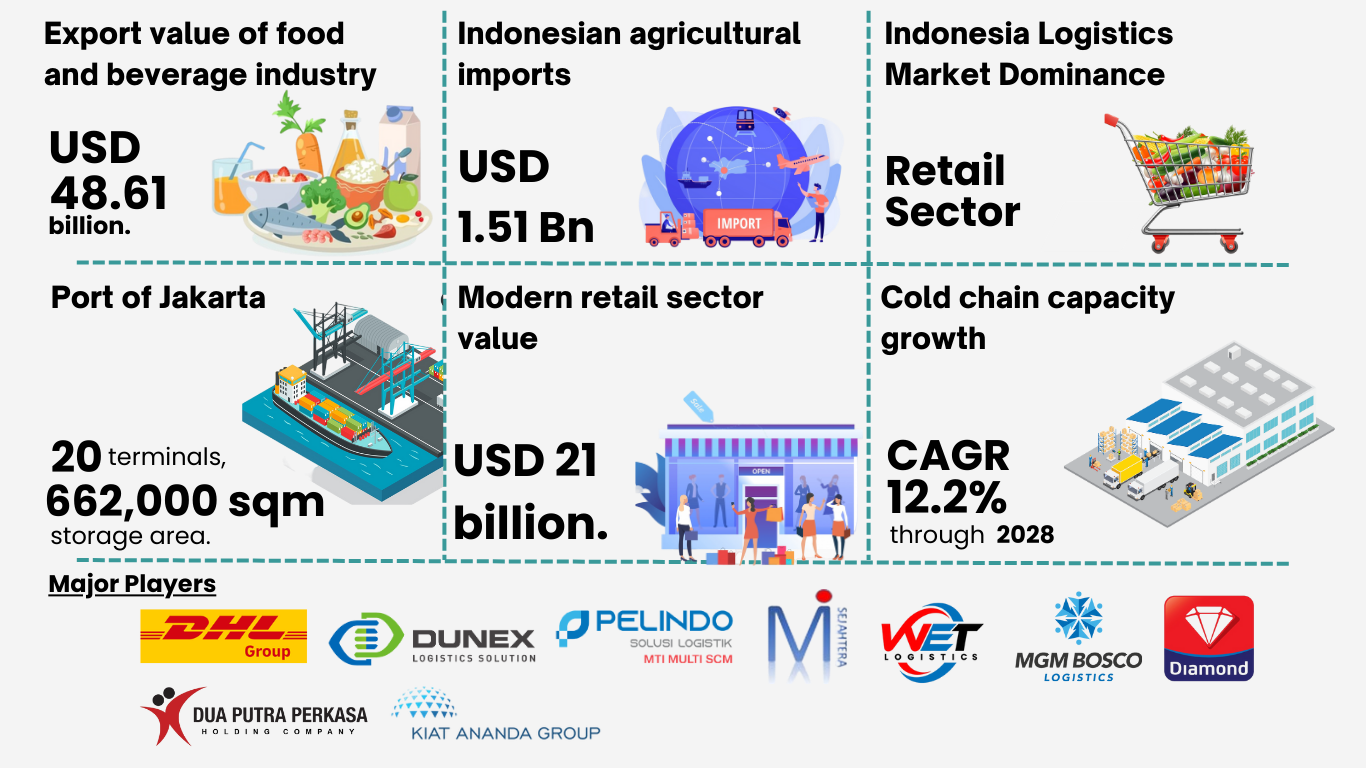
Indonesia's food industry is broad, encompassing agricultural producers and food-service restaurants. The country is a major global producer and exporter of agricultural products such as palm oil, natural rubber, cocoa, coffee, rice, and spices. It is also the second-largest poultry producer in the Asia-Pacific region and a significant global seafood producer. In 2022, the food service sector contributed nearly USD 32 billion to the GDP, with small restaurants and street-side eateries being predominant.
Impact of Urbanization and Consumer Trends on Indonesia Food Cold Storage Market
Urbanization has led to increased demand for packaged and processed foods due to their convenience and safety. Modern retail establishments, equipped with temperature control devices, provide consumers with access to safe, packaged foods. Additionally, a growing health consciousness among the educated population is driving the consumption of healthier foods and drinks in Indonesia. The rise in packaged foods and the need for efficient logistics are key factors propelling market growth.
Infrastructure Challenges and Investment in Indonesia Food Cold Storage Market
Despite the increasing demand, Indonesia's current cold storage capacity is insufficient, highlighting a critical infrastructure gap. Over 75 million kilograms of food are distributed daily, but only 50 thousand tons are transported using trucks and refrigerated containers. Addressing this imbalance requires enhanced integration and collaboration in cold parcel delivery services, supported by well-connected digital infrastructure.
The Indonesian government is actively working to bridge this gap through initiatives aimed at reducing food wastage and improving food security. These include policies to enhance logistics and transportation networks, the construction of new cold storage warehouses, and the modernization of existing facilities. As the market continues to evolve, there will be significant investment opportunities and advancements in cold storage solutions to meet the growing demand.
Indonesia Refrigerated Food Cold Storage Installation Share, 2023
Note: Please note that the data in the chart above is for illustrative purposes only. For accurate market size and trends, please reach out to us directly.
Sectoral Distribution in Indonesia Food Cold Storage Market: Seafood and Dairy Dominance
The seafood processing plants and cold storage sector hold the leading share in terms of utilization of cold storage, underscoring the significance of the seafood industry in Indonesia. The country’s extensive coastline and rich marine biodiversity make seafood a crucial component of both the domestic diet and export economy. Following this, the dairy food sector also holds a substantial share, indicative of rising dairy product consumption driven by increasing urbanization and shifting dietary preferences.
Indonesia Cold Storage Market Revenue, 2019 – 2024E
Note: Please note that the data in the chart above is for illustrative purposes only. For accurate market size and trends, please reach out to us directly.
In recent years, the cold storage market in Indonesia has demonstrated notable recovery and growth, driven by heightened demand from various industries including food cold storage. This resurgence follows an initial revenue decline during the pandemic, reflecting a strong rebound and continued momentum in subsequent years. As demand for food cold storage solutions remains high, the sector’s resilience and upward trajectory underscore opportunities for expansion and investment in advanced logistical infrastructure to address evolving industry requirements.
Competition in Indonesia Food Cold Storage Market
The report encompasses a wide range of companies within the Indonesia food cold storage market, including global players such as DHL group and regional players such as Mulia Bosco Utama (MGM Bosco), PT Dunia Express, PT Wahana Cold Storage, PT Diamond Food Indonesia Tbk etc. These companies represent different segments of the industry, offering a comprehensive overview of the key players and their impact on the market.
Future Outlook of the Indonesia Food Cold Storage Market
The Indonesia food cold storage market is anticipated to experience significant growth driven by several key factors. One major driver is the increasing consumption of perishable food items, including seafood, meat, dairy products, and fruits and vegetables, propelled by the rising urban population and changing consumer preferences towards convenience foods. The expansion of the middle class and higher disposable incomes are contributing to this demand, necessitating efficient cold storage solutions to maintain food quality and safety. Notably, the food demand growth rate in Indonesia is estimated to be approximately 4.03% per year, underscoring the need for robust cold storage infrastructure to support this increasing demand.
The increasing role of Indonesia as a regional hub for food exports, particularly in Southeast Asia, is also expected to boost the demand for cold storage facilities. The country's strategic location and robust agricultural sector position it as a key player in the regional food supply chain, necessitating reliable cold storage solutions to support export activities.
Overall, the future of Indonesia's food cold storage market looks promising, with growth driven by demographic trends, government policies, technological innovations, and the country's strategic economic positioning.
Scope of Indonesia Food Cold Storage Market
Makreo Research has released a comprehensive analysis titled “Indonesia Food Cold Storage Market Competition and Future Outlook.” This detailed report examines the historical performance and current status of the Indonesian food cold storage market while identifying key opportunities and drivers that will shape its future growth. It begins by exploring Indonesia’s food and beverage trade performance, analysing import and export trends and their relation to the cold storage market. The report then delves into Indonesia’s cold chain market, providing a thorough understanding of its performance, identifying demand and supply gaps, and offering an in-depth analysis of the food cold storage market, including refrigerated food demand and infrastructure.
Additionally, the report highlights key companies in the food cold storage market, examining their merger and acquisition activities, funding timelines, services, rental scenarios, and more. Overall, this report equips stakeholders with a detailed analysis of the Indonesian food cold storage market, aiding in understanding its current state, future growth prospects, and potential investment and strategic decision-making opportunities.
Market Assessment
The report comprehensively examines the Indonesian food cold storage market, analysing key aspects such as cold storage market revenue, demand and supply dynamics, and prospects, alongside historical and current performance, considering various related factors. It investigates the influence of food and beverage product trade on the market and the impact of food loss. Additionally, the report covers Indonesia’s cold chain storage market to understand its connection to the food cold storage sector. It also provides a detailed competitive landscape by profiling major companies and comparing these players across various parameters.
-
2019 – 2023: Past and Present Scenario
-
2023 – Base year of study
-
2024 – 2028: Future Prospects
Competitive Landscape
This section provides a detailed market comparison of key players in the Indonesian food cold storage market based on various parameters such as storage capacity, location, and pricing. It highlights their recent investments, mergers and acquisitions (M&A), and funding activities. Additionally, it includes comprehensive profiles of selected industry players, covering their financials and latest business activities. The Makreo team has reached out to all major participants to understand the offerings of each player, their positioning, temperature, pallet size, Key storage items, and presence in the country.
-
What is the total available capacity of food cold storage in Indonesia?
-
What is the supply required for food cold storage in Indonesia?
-
What are the trends in food consumption in Indonesia?
-
What is the current state of cold chain and storage facilities across different industries in Indonesia?
-
Who are the key players in Indonesia's food cold storage market and what are their primary business activities?
-
What is the trade performance of Indonesia's food and beverage sector, and how does it impact the food cold storage market in the country?
-
What is the average pallet size of major food cold storage in Indonesia?
-
What is the average rental of food cold storage?
Companies Covered
-
DHL Group
-
Mulia Bosco Utama (MGM Bosco)
-
PT Dunia Express
-
PT Wahana Cold Storage
-
PT. MEGA INTERNATIONAL SEJAHTERA
-
PT. Kiat Ananda Group
-
PT. Dua Putera Perkasa
-
PT Multi Terminal Indonesia
-
PT Diamond Food Indonesia Tbk
Looking for a Section from Report? Start your Partial Purchase Request
Table of Contents
- 1.Research Methodology
- 1.1.Research Objective
- 1.2.Indonesia Cold Storage Definitions
- 1.3.Research Process
- 1.4.Research Design and Procedure
- 1.5.Analytical Framework
- 2.Indonesia Food And Beverage Trade Performance
- 2.1.Indonesia Food And Beverage Trade: Overview
- 2.2.Indonesia Food And Beverage Trade: Imports
- 2.2.1.Indonesia Import of Selected Food Ingredients in 2022
- 2.3.Indonesia Food And Beverage Trade: Exports
- 3.Indonesia Cold Chain Market
- 3.1.Indonesia Logistics Demand by Industries
- 3.2.Indonesia Warehousing and Storage Market
- 3.3.Indonesia Warehouse Market Classification
- 3.4.Indonesia Cold Chain Logistics Interactive System
- 3.4.1.Indonesia Cold Chain Services: Business Model
- 3.5.Indonesia Cold Chain Market Segmentation: by Services (Cold Transport & Cold Storage)
- 3.6.Indonesia Cold Storage Market: Demand & Supply Gap
- 3.7.Importance of Greater Jakarta in Indonesia Cold Storage Sector
- 3.8.Indonesia Sectoral Contribution to GDP
- 3.9.Indonesia Cold Storage Foreign Ownership
- 3.10.Indonesia Number of Cold Storage Facilities by Territory
- 3.11.Indonesia Cold Storage Market Revenue: Past and Present Performance
- 4.Indonesia Refrigerated Food & Cold Storage Demand
- 4.1.Demand for Cold Storage: Indonesia Food Consumption Trends
- 4.1.1.Demand for Cold Storage: Indonesia Food Losses & Infrastructure
- 4.2.Indonesia Food Industry: Key Facts
- 4.2.1.Indonesia Food Industry: Retail
- 4.3.Indonesia Refrigerated Food Storage Installation and Infrastructure
- 4.4.Indonesia Refrigerated Food Storage: COVID-19 Impact Assessment on Cold Storages
- 4.5.Indonesia Refrigerated Food Storage: by Products, Temperature, Humidity
- 4.1.Demand for Cold Storage: Indonesia Food Consumption Trends
- 5.Indonesia Food Cold Storage Competitive Landscape
- 5.1.Indonesia Key Players in Food Cold Storage
- 5.2.Competitive Analysis of Leading Food Cold Storage Companies in Indonesia
- 5.3.Major Food Cold Storages in Indonesia with Storage Capacity & Technology
- 5.4.Major Food Cold Storages in Indonesia with Storage Type, Commodities & Rental
- 6.Indonesia Cold Storage Company Profiles
- 6.1.Company Profile: DHL Group
- 6.2.Company Profile: Mulia Bosco Utama (MGM Bosco)
- 6.3.Company Profile: PT Dunia Express
- 6.4.Company Profile: PT Wahana Cold Storage
- 6.5.Company Profile: PT. MEGA INTERNATIONAL SEJAHTERA
- 6.6.Company Profile: PT. Kiat Ananda Group
- 6.7.Company Profile: PT. Dua Putera Perkasa
- 6.8.Company Profile: PT Multi Terminal Indonesia
- 6.9.Company Profile: PT Diamond Food Indonesia Tbk
- 7.Indonesia Food Cold Storage Future Prospects
- 7.1.Food Cold Storage Future Prospects in Indonesia
- Limitations of the Study
Related Reports - Automotive & Transportation