UAE Cold Chain Market Size and Forecast (2019-2029) - Analysis by Emirates, Cold Chain Type, Temperature Range, and Industry Applications
Overview
UAE Cold Chain Market Size
The UAE cold chain market has shown significant growth, achieving a compound annual growth rate (CAGR) of 8.42% from 2020 to 2023. This growth is fueled by rising demand for perishable goods, a population exceeding 10 million, and the expansion of e-commerce, all of which necessitate the preservation of temperature-sensitive products. The demand for UAE cold storage facilities is particularly pronounced in key sectors such as pharmaceuticals, vaccines, and food products, including dairy, seafood, fruits, and vegetables.
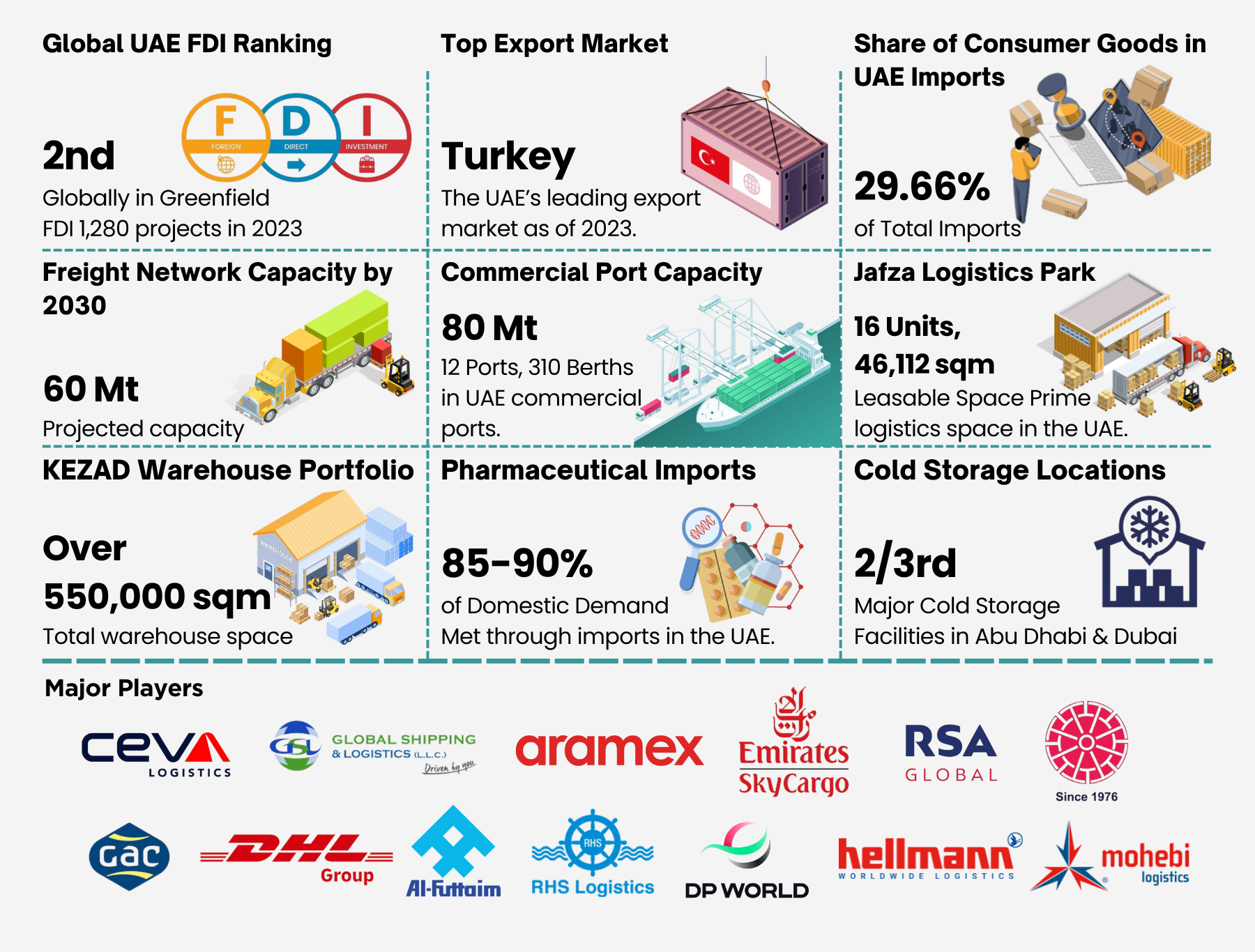
Government investments in logistics infrastructure and modern cold storage facilities in the UAE have been pivotal in enhancing food security and driving market growth. Recognized as a leading logistics hub in the MENA region, the UAE benefits from advanced infrastructure, featuring 12 commercial ports with a cargo capacity of 80 million tonnes annually, which facilitates the efficient transport of cold chain goods. The UAE Cold Chain Logistics Market is supported by local and international operators managing sophisticated infrastructure to deliver effective services across various industries. The recent inauguration of the 900 km Etihad Rail network in March 2023 has further bolstered the logistics sector, significantly improving the transportation of goods throughout the Emirates and contributing to the overall expansion of the Emirates cold chain market.
 Innovations in the UAE Cold Chain Market
Innovations such as drones and autonomous vehicles are increasingly being implemented in the UAE cold chain market to enhance operational efficiency and minimize delivery times. The country’s warehousing hubs, including Dubai Logistics City and Jebel Ali Free Zone, feature state-of-the-art UAE cold storage facilities equipped with temperature-controlled environments to meet the rising demand for logistics services. These facilities are especially crucial for the food and pharmaceutical sectors. The UAE temperature-sensitive pharmaceutical market is anticipated to grow by 27% from 2021 to 2025, underscoring the critical need for effective cold storage solutions within the cold chain sector in the UAE.
Challenges in the UAE Cold Chain Market
Despite its robust growth, the UAE cold chain market faces several challenges. High operating costs, particularly related to energy and labor, have contributed to rising operational expenses. Furthermore, the extreme climate in the UAE intensifies these costs, creating difficulties in maintaining optimal temperatures within UAE cold storage facilities. Disparities in UAE cold chain infrastructure between different Emirates also pose obstacles, as some regions lack modern cold storage solutions and efficient transportation networks. Additionally, regional competition is increasing, particularly from countries like Saudi Arabia, which is heavily investing in its own cold chain infrastructure.
Nevertheless, the UAE cold chain market growth trajectory remains positive, fueled by the escalating demand for UAE temperature-controlled logistics services, particularly within the food and pharmaceutical sectors. Government initiatives, such as the Dubai Logistics Strategy 2020 and Abu Dhabi Economic Vision 2030, continue to bolster infrastructure development and trade facilitation. Addressing the challenges of high operational costs and infrastructure gaps will be crucial for maintaining the market's upward momentum. With ongoing investments and technological advancements, the UAE is well-positioned to remain a key player in the global cold chain sector.
UAE Cold Storage Market by Application, 2023
In the UAE cold chain market, food products lead as the most significant application, closely followed by pharmaceuticals. Due to the country's heavy reliance on imports for both sectors, maintaining adequate storage facilities is crucial. Together, food and pharmaceutical products make up 88.8% of the market share, highlighting their dominance as the two largest end-users in the UAE cold chain industry.
Future Outlook of the UAE Cold Chain Market
The UAE cold chain market is poised for substantial growth, with a projected compound annual growth rate (CAGR) of 7.98% from 2024 to 2029. This expansion is primarily fueled by the UAE’s increasing population and urbanization, which is expected to significantly elevate the demand for warehousing solutions. For instance, in Dubai, a 1% increase in population is forecasted to drive a 0.5% boost in warehouse capacity.
Another significant factor propelling this growth is the UAE pharmaceutical sector, which is anticipated to expand by 27% between 2021 and 2025. The rising need for temperature-controlled storage in UAE, essential for the management of sensitive pharmaceutical products, will play a critical role in supporting this growth trajectory.
Tourism also serves as a vital contributor to the growth of the cold chain sector in the UAE. This sector is projected to inject AED 450 billion (USD 122.5 billion) into the UAE’s GDP by 2031. Government initiatives, including Multiple-Entry and Golden Visas, are expected to enhance food consumption, thereby accelerating the development of the cold chain infrastructure market in the UAE.
Scope of the UAE Cold Chain Market Report
Makreo Research has published a comprehensive report titled “UAE Cold Chain Market Size and Forecast (2019-2029) - Analysis by Emirates, Cold Chain Type, Temperature Range, and Industry Applications”. This in-depth analysis examines the historical performance and current status of the UAE cold chain market, identifying key opportunities and drivers that will influence its future growth.
The report begins by assessing the UAE’s economic, political, technological, and demographic factors and their impact on the cold chain market. It then explores the logistics and warehousing sector, highlighting key trends, warehouse rental rates, and logistics infrastructure. Subsequently, the report provides a detailed examination of the UAE cold chain market, focusing on the prevalence of cold storage, rental rates, key locations, and market segments and their respective shares.
Furthermore, it highlights significant companies within the UAE cold chain market, analyzing their merger and acquisition activities, funding timelines, services offered, pallet locations, temperature ranges, and more. The report also addresses the challenges and opportunities present in the UAE cold chain market and offers a future outlook. This report equips stakeholders with a thorough analysis of the UAE cold chain market, enhancing their understanding of its current state, future growth potential, and strategic investment opportunities.
-
2020 - 2023: Past and Present Scenario
-
2023: Base year of study
-
2024 – 2029: Future Prospects
-
Abu Dhabi Emirate
-
Dubai Emirate
-
Sharjah Emirate
-
Ajman Emirate
-
Segmentation: by Type of Temperature-Controlled Storage
-
Segmentation: by Emirates
-
Segmentation: by Application
-
Application by Food Sector
-
Application by Pharmaceuticals
Competitive Landscape
This section provides a detailed market comparison of key players in the UAE cold chain market based on various parameters such as pallet positions, temperature ranges, geographic presence and certifications, etc. It also highlights their recent investments, mergers and acquisitions (M&A), and funding activities. Additionally, it includes comprehensive profiles of selected industry players, covering their financials and latest business activities.
-
What is the current state of the logistics and warehousing sector in the UAE?
-
How is the UAE's transport infrastructure structured and developed?
-
Which are the major trade zones and industrial hubs in the UAE?
-
How has the performance of the UAE's cold chain market, both past and present, influenced the overall logistics industry?
-
What are the key benefits and strategic importance of establishing cold storage facilities in the UAE?
-
What are the guidelines for starting a cold chain business in the UAE?
-
What are the rental rates for cold storage facilities across different regions in the UAE?
-
Who are the major players in the UAE cold chain market, and what are their core business activities?
-
What significant mergers, acquisitions, and funding activities have impacted the UAE cold chain market?
-
What future opportunities and prospects exist for growth in the UAE cold chain market?
Companies Covered
-
Gulf Warehousing Company Q.P.S.C
-
Dubai Ports (DP) World Ltd
-
Gulf Agency Company Ltd. (GAC)
-
Emirates SkyCargo
-
Arab-American Express (Aramex)
-
Global Shipping And Logistics LLC (GSL)
-
Mohebi Logistics LLC
-
Rais Hassan Saadi (RHS) Logistics LLC
-
RSA Global
-
Tameem Logistics & Warehousing
-
Al-Futtaim Logistics LLC
-
DHL Group
-
CEVA Logistics
-
Hellmann Worldwide Logistics SE & Co. KG.
Looking for a Section from Report? Start your Partial Purchase Request
Table of Contents
- 1.Research Methodology
- 1.1.Research Objective
- 1.2.UAE Cold Storage Definitions
- 1.3.Research Design and Procedure
- 1.4.Data Collection Methods
- 1.5.Research Methodology
- 1.6.Analytical Framework
- 2.UAE EPTD (Economic, Political, Technology, Demographic) Analysis
- 2.1.EPTD Analysis: An Overview
- 2.2.EPTD Analysis: UAE Economic Overview
- 2.3.EPTD Analysis: UAE Political Overview
- 2.4.EPTD Analysis: UAE Technological Overview
- 2.5.EPTD Analysis: UAE Demographic Overview
- 3.UAE Trade Performance
- 3.1.UAE Trade Performance: Exports
- 3.1.1.UAE Exports by Commodities
- 3.1.2.UAE Exports by Countries
- 3.2.UAE Trade Performance: Re-Export
- 3.2.1.UAE Re-Exports by Commodities
- 3.3.UAE Trade Performance: Import
- 3.3.1.UAE Imports by Commodities
- 3.3.2.UAE Imports by Countries
- 3.1.UAE Trade Performance: Exports
- 4.UAE: Key Facts
- 4.1.UAE Key Facts
- 4.1.1.UAE: Key Facts About Abu Dhabi Emirate
- 4.1.2.UAE: Key Facts About Dubai Emirate
- 4.1.3.UAE: Key Facts About Sharjah Emirate
- 4.1.4.UAE: Key Facts About Ajman Emirate
- 4.1.UAE Key Facts
- 5.UAE Logistics Infrastructure
- 5.1.UAE Transportation Sector: Key Facts
- 5.2.UAE Logistics Performance Index
- 5.3.UAE Logistics Infrastructure: Air Transport
- 5.4.UAE Logistics Infrastructure: Marine Transport
- 5.5.UAE Logistics Infrastructure: Rail Transport
- 6.UAE Logistics and Warehousing Market
- 6.1.UAE Logistics and Warehousing Market: An Overview
- 6.2.UAE Logistics and Warehousing: VAT Rates
- 6.3.UAE Logistics and Warehousing Market: UAE Key Industrial Zones
- 6.3.1.UAE Logistics and Warehousing Market Key Industrial Zones: Jabel Ali Free Zone
- 6.3.2.UAE Logistics and Warehousing Market Key Industrial Zones: Khalifa Economic Zones Abu Dhabi
- 6.3.3.UAE Logistics and Warehousing Market Key Industrial Zones: Saja’a Industrial Investment Park
- 6.3.4.UAE Logistics and Warehousing Market Key Industrial Zones: Dubai Industrial City
- 6.4.UAE Transport Logistics Sector Developments
- 6.5.UAE Transport and Logistics Hubs
- 6.6.UAE Warehousing Market: Key Developments
- 6.7.UAE Warehouse Lease Rates
- 6.7.1.UAE Warehouse Rent in Different Free Zones
- 7.UAE Cold Chain Market Past and Present Performance
- 7.1.UAE Cold Chain Market: An Overview
- 7.2.UAE Cold Chain Market: Importance and Advantages of Cold Storage Facilities
- 7.3.UAE Cold Chain Market: Cities Expanding Cold Storage Facilities
- 7.4.UAE Cold Chain Market: Steps to Establish a Cold Storage Business
- 7.5.UAE Cold Chain Market: Key Recent Developments
- 7.6.UAE Cold Chain Market: Past and Present Performance
- 7.7.UAE Cold Chain Market: Key Locations
- 7.8.Dubai Cold Storage Rates
- 8.UAE Cold Chain Market Segmentation
- 8.1.UAE Cold Chain Market Segmentation: by Type
- 8.1.1.UAE Cold Storage Market Segmentation: by Type of Temperature-Controlled Storage
- 8.2.UAE Cold Chain Market Segmentation: by Emirates
- 8.3.UAE Cold Chain Market Segmentation: by Application
- 8.3.1.UAE Cold Chain Market by Application: Food Products
- 8.3.1.1.UAE Cold Chain Food Application: Type of Cold Food Cold Storage Facilities
- 8.3.1.2.UAE Cold Chain Food Application: Global Farming and Logistics Network
- 8.3.1.3.UAE Cold Chain Food Application: Halal Food Industry
- 8.3.1.4.UAE Cold Chain Food Application: Comprehensive Guide to Packaging, Tracking, and Warehousing for Frozen Foods
- 8.3.1.5.UAE Cold Chain Food Application: Regulatory Landscape for Food Products
- 8.3.2.UAE Cold Chain Market by Application: Pharmaceuticals
- 8.3.2.1.UAE Cold Chain for Pharmaceuticals: Regulatory Landscape for Pharmaceutical Products
- 8.3.1.UAE Cold Chain Market by Application: Food Products
- 8.1.UAE Cold Chain Market Segmentation: by Type
- 9.UAE Cold Chain Market Competitive Landscape
- 9.1.Comparative Analysis of Major UAE Cold Chain Companies
- 9.2.Comparative Analysis of Key Players - Geographical Reach
- 9.3.Comparative Analysis of Key Players - Compliance & Certifications
- 9.4.Comparative Analysis of Key Players – Pallet Positions
- 9.5.Industrial Zones of Companies with Cold Chain Facilities in the UAE
- 10.UAE Cold Chain Market Mergers/Acquisitions/Investments/Divestments and Funding Timeline
- 10.1.Market Mergers /Acquisitions/ Investments/Disinvestments
- 10.2.Funding Timeline
- 11.UAE Cold Chain Logistics Market Company Profiles
- 11.1.Company Profile: Gulf Warehousing Company Q.P.S.C (GWC)
- 11.2.Company Profile: Dubai Ports (DP) World Ltd
- 11.3.Company Profile: Gulf Agency Company Ltd. (GAC)
- 11.4.Company Profile: Emirates SkyCargo
- 11.5.Company Profile: Arab-American Express (Aramex)
- 11.6.Company Profile: Global Shipping And Logistics LLC (GSL)
- 11.7.Company Profile: Mohebi Logistics LLC
- 11.8.Company Profile: Rais Hassan Saadi (RHS) Logistics LLC
- 11.9.Company Profile: RSA Global
- 11.10.Company Profile: Tameem Logistics & Warehousing
- 11.11.Company Profile: Al-Futtaim Logistics LLC
- 11.12.Company Profile: DHL Group
- 11.13.Company Profile: CEVA Logistics
- 11.14.Company Profile: Hellmann Worldwide Logistics SE & Co. KG
- 12.UAE Cold Chain Market Challenges
- 12.1.UAE Cold Chain Market Challenges
- 13.UAE Cold Chain Market Opportunities
- 13.1.UAE Cold Chain Market Opportunities
- 14.UAE Cold Chain Market: Future Outlook
- 14.1.UAE Cold Chain Market: Future Outlook
- Analyst Recommendations
- Limitations of the Study
Related Reports - Automotive & Transportation