
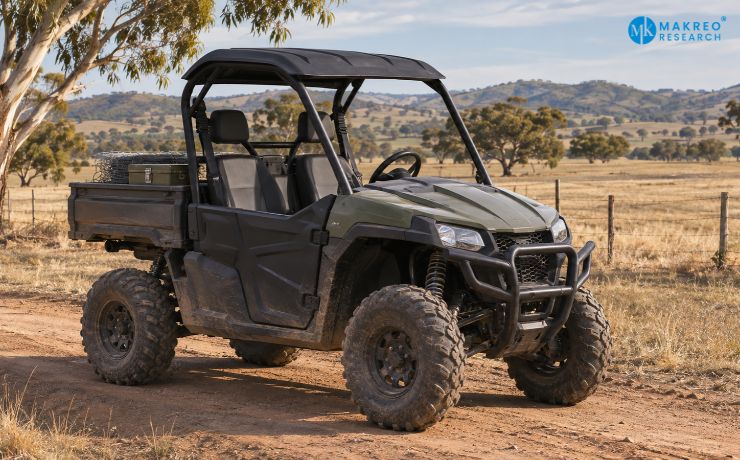
Australia 4WD UTV Market Outlook to 2032 - Utility Applications Account for 48% of 2026 Market Value as Farm Safety and Commercial Demand Shape Growth
Utility applications account for 48% of Australia's 4WD UTV market value in 2026 as farm safety, commercial demand and product innovation shape its outlook to 2032.
Australia 4WD utility terrain vehicle (UTV) market is supported by demand from agriculture, mining, construction and rural operations. Farm safety considerations, the availability of specialised vehicles and emerging defence applications are influencing the industry, while changing investment conditions and cautious equipment spending continue to affect purchasing decisions.
As manufacturers expand their utility vehicle portfolios and commercial buyers reassess operating requirements, these developments have implications for original equipment manufacturers (OEMs), distributors and institutional fleet buyers. This article examines market performance, demand drivers, product innovation and competitive strategies through 2032.
Australia 4WD UTV Market Growth and Sales Trends
According to Makreo Research, the Australia 4WD UTV market registered a compound annual growth rate (CAGR) of 0.84% between 2023 and 2026, with approximately 5,000 UTVs sold in 2025. Agricultural businesses and rural operators are important buyers, using these vehicles for transport, livestock management and routine farm work.
Market performance has been uneven. In the fourth quarter of 2024, expenditure on equipment, plant and machinery declined by 0.8% quarter on quarter, while mining investment fell by 0.6%. These changes reflect wider capital investment conditions rather than direct measures of UTV sales. Improving agricultural activity and investment conditions from 2025 were expected to support demand for working vehicles.
The 2025 UTV sales estimate should not be compared directly with broader industry figures covering all-terrain vehicles (ATVs) and side-by-side vehicles (SSVs), or with data limited to participating manufacturers. These differences in reporting coverage matter when assessing the Australian UTV market.
Why Utility Applications Lead Australia 4WD UTV Demand?
Utility applications account for approximately 48% of the Australia 4WD UTV market by value in 2026, making them the largest application segment. These vehicles perform essential tasks across agriculture, rural operations, mining, property maintenance and other commercial activities.
Australia's extensive farming properties require vehicles for crop monitoring, livestock management, fencing, spraying and materials transport across challenging terrain. Continued farm mechanisation reinforces their role in day-to-day operations.
Nevertheless, the 2026–27 agricultural outlook presents mixed conditions for buyers. National winter crop production is forecast at approximately 61 million tonnes, an upward revision from earlier expectations, while average broadacre farm profits are projected to decline by 39% amid lower prices and higher costs. For OEMs and dealers, these pressures may increase buyers' focus on operating costs, durability and multipurpose capability rather than premium specifications.
Farm Safety and the Transition from Quad Bikes to Side-by-Side Vehicles
The transition from quad bikes to side-by-side vehicles is an important development in Australia's agricultural vehicle market. Following the withdrawal of quad bikes from sale by several major manufacturers, some farms have adopted UTVs as alternatives for specific tasks.
This transition also presents safety challenges. In 2024, side-by-side vehicles were associated with 14 farm fatalities, compared with ten involving quad bikes, although annual figures fluctuate. Failure to wear seatbelts can undermine the protection provided by rollover structures, while removing doors may increase risks. Some farms also continue to operate older, poorly maintained quad bikes.
A national consultation on improving workplace quad bike safety closed in June 2026. The changes under consideration remained proposals rather than enacted requirements. Recent prosecutions and fatal rollover incidents have maintained attention on farm vehicle safety among regulators and industry bodies.
For OEMs and dealers, safety is an important purchasing consideration alongside regulatory compliance. Rollover protection, seatbelt interlocks, speed-limiting keys and operator training are relevant to commercial and institutional buyers assessing vehicle suitability.
Mining Construction and Rural Infrastructure Support Commercial UTV Demand
Mining and mineral exploration create demand for compact, manoeuvrable UTVs used to transport personnel, equipment and tools, as well as to support inspections and maintenance at remote sites. Mining equipment investment rose by 7.2% in the March quarter of 2026, providing a broader indicator of capital spending rather than a direct measure of UTV purchases.
Construction and regional infrastructure projects create further applications in site access, materials handling and maintenance, particularly where conventional vehicles have limited access. Continued debate over rural road funding suggests that infrastructure-related demand may develop gradually.
For commercial fleet buyers, uptime, payload, towing capacity and service intervals are important considerations. Suppliers with dependable maintenance capabilities in remote regions may be better positioned to serve mining and construction operators.
Outdoor Recreation Broadens the Australia UTV Customer Base
Australia's caravan, camping and outdoor recreation culture supports interest in UTVs beyond agricultural and commercial settings. Off-road touring, hunting, trail riding and recreational property use attract customers seeking multipurpose vehicles. Caravan and camping participation has reached record levels in several states, supporting interest in outdoor activities.
However, recreational vehicle purchasing remains sensitive to prices and financing costs. Australian off-highway vehicle sales among participating brands declined by 3.3% to 9,502 units in the first nine months of 2026, compared with 9,828 units a year earlier. Global manufacturers have reported softer recreational demand alongside more resilient utility demand. As several major suppliers are excluded from the national sales audit, these figures do not represent total Australian UTV sales.
Australian Defence Trials Highlight Potential Tactical UTV Applications
Defence is an emerging source of demand for 4WD UTVs. Military users value compact, agile off-road vehicles for mobility, reconnaissance, logistics, border patrol and operations in difficult terrain, and rising defence investment is lifting interest in these applications.
In July 2026, the Australian Army’s 2nd Cavalry Regiment trialled UTVs for the first time during Exercise Tiger Dingo, using them to rehearse reconnaissance, infiltration and raids on enemy positions. Their low noise signature let troops move through close terrain undetected, showing their potential for tactical mobility.
Lightweight tactical UTV platforms are also being evaluated in Australia, and a US Marine Corps contract for ultra-light tactical vehicles worth up to USD 98 million shows how such programmes can scale. In Australia these remain trials rather than confirmed procurement, but they signal a potential channel for OEMs with defence-grade platforms and local support capability.
Product Innovation in the Australia 4WD UTV Market
Manufacturers are developing enclosed cabins, improved durability, safety features and alternative powertrains in response to agricultural, mining and commercial operating requirements. Recent product developments centre on all-weather utility vehicles, diesel models for demanding work and electric UTVs for specialised applications.
Cabbed Utility Vehicles Supporting Year Round Operations
Manufacturers are expanding enclosed-cab ranges to improve comfort during extended work in varying weather conditions. The Can-Am Defender HD11, offered in Australia from AUD 32,399, has a 95 hp three-cylinder engine, multiple driving modes and optional climate-controlled cabin configurations. Polaris has also introduced factory-installed heating and heating, ventilation and air conditioning (HVAC) options in its RANGER range.
These features are relevant to agricultural and commercial operators undertaking personnel transport, property maintenance and other tasks over long working hours. Cabin comfort, vehicle handling and serviceability complement conventional towing and cargo requirements.
Diesel UTVs Addressing Commercial Fleet Requirements
Diesel UTVs remain relevant to farms, mining operations and commercial fleets with existing diesel infrastructure. The Polaris Ranger Diesel, Kawasaki Mule PRO-DX and Bobcat UV34 offer options for users considering durability, fuel logistics and extended working hours.
For institutional buyers, propulsion choice depends on operating conditions, maintenance requirements and compatibility with existing fleet infrastructure. Diesel vehicles therefore remain relevant where established refuelling arrangements and demanding duty cycles influence procurement.
Electric UTVs Expand Propulsion Options in Australia
Electric UTVs are commercially available in Australia for agricultural and light commercial applications. The CFMOTO UFORCE U6 EV offers a manufacturer-estimated range of up to 110 km under ideal conditions, a 250 kg cargo tray capacity and 800 kg towing capacity. The Polaris Ranger XP Kinetic and John Deere Gator TE provide additional electric options.
Electric vehicles can be useful in vineyards, horticulture, livestock management and short-distance site operations where quiet running and reduced routine maintenance are valuable. Charging access, operating range and extended duty cycles remain important limitations for buyers managing large properties and remote worksites.
These developments demonstrate greater product differentiation. Manufacturers, distributors and fleet buyers must assess vehicle capability, operating costs and after-sales support against specific applications.
Australia 4WD UTV Market Competitive Landscape and OEM Strategies
The Australia 4WD UTV market includes Polaris Inc., BRP Inc. (Can-Am), Yamaha Motor Co., Ltd., Honda, Kawasaki, John Deere, Kubota, CFMOTO, Segway Powersports and Bobcat. Makreo Research profiles seven companies in its report. Global OEM developments indicate changes in utility vehicle strategy, costs and partnerships, but do not independently establish Australian sales trends.
-
Polaris Inc. reported worldwide third-quarter 2026 sales of USD 2.04 billion, up 11% year on year, while North American utility off-road vehicle retail increased by 6% as recreational demand softened. Utility models accounted for more than 60% of the company's powersports sales. Polaris also completed the separation of Indian Motorcycle and expected approximately USD 215 million in tariff costs for 2026, reflecting international supply chain and US trade exposure. These costs are not a direct measure of the Australian market, although they may influence global pricing and product allocation.
-
BRP Inc. reported second-quarter fiscal 2027 revenue of CAD 2.24 billion, up 18.5%, with Year-Round Products revenue increasing by 33.3% following higher off-road vehicle volumes and a more favourable side-by-side product mix. Tariffs and supplier costs affected margins, although the company raised its full-year guidance. In Australia, Can-Am confirmed its MY27 Defender HD11 for agricultural customers, reflecting continued attention to utility applications.
-
Yamaha Motor Co., Ltd. announced restructuring of its outdoor land vehicle business in August 2026, including an end to in-house production of recreational off-highway vehicles in the United States and a transition towards partner-supplied models. In October 2026, Yamaha and John Deere agreed to jointly develop and supply future side-by-side vehicles focused on utility applications, while retaining their respective brands and dealer networks. These arrangements may affect Yamaha's future Australian product offering and John Deere's utility vehicle positioning.
Together, these developments indicate a stronger global emphasis on utility applications, cost management and strategic partnerships. For Australian distributors and dealers, regional servicing capacity, spare parts availability and support for institutional fleets remain important competitive considerations.
What the Australia 4WD UTV Market Means for Key Stakeholders?
With utility applications accounting for approximately 48% of market value in 2026, the developments outlined above carry different commercial implications for each stakeholder group.
-
OEMs - Match product portfolios to Australian commercial applications, from broadacre farming to remote mine sites, with attention to durability, local operating conditions and continuity of supply.
-
Distributors and dealer groups - Strengthen regional servicing, spare parts availability and fleet maintenance support to meet the requirements of customers who depend on vehicle uptime.
-
Institutional fleet buyers - Set procurement criteria by application. Agricultural operators consider versatility and operating costs; mining and construction buyers assess site compliance and uptime; government and defence agencies focus on suitability for specialised tasks.
-
Safety regulators - Address the risks associated with both quad bikes and side-by-side vehicles through task-specific suitability assessments, operator training, seatbelt use and appropriate controls.
-
Investors - Monitor utility-led demand, farm profitability, tariffs and exchange rates, while treating defence procurement and electric UTV adoption as developing rather than established opportunities.
Australia 4WD UTV Market Outlook to 2032
Makreo Research expects steady growth in the Australia 4WD UTV market during 2027–2032. Following post-pandemic fluctuations associated with vehicle prices, financing costs, inventory adjustments and cautious discretionary spending, a gradual recovery was anticipated from 2025 onwards.
Four demand areas are expected to support the market - agriculture and broadacre farming, mining and mineral exploration, construction and rural infrastructure, and caravan, camping and outdoor recreation. Defence trials, electric vehicles and the replacement of quad bikes with side-by-side vehicles present additional possibilities. Farm profitability, interest rates, tariff-related pricing and exchange rate movements remain risks to monitor.
The Makreo Research report, Australia 4WD Utility Terrain Vehicle (UTV) Market and Forecast to 2032, provides a structured assessment of historical market performance, current industry dynamics, demand indicators, supply chain and distribution structures, competitive developments and market projections through 2032.
The study examines demand drivers, industry trends, commercial applications and end-user requirements, with market segmentation across the following categories:
-
By engine capacity - Below 400 cc, 400–800 cc, above 800 cc
-
By propulsion type - Petrol, diesel, electric
-
By vehicle type - Utility, recreational, sport and multipurpose UTVs
-
By application - Utility, sports, recreation, military, construction, others
-
By end user - Individual consumers, commercial users, government agencies, defence agencies
Makreo Research and Consulting provides OEMs, distributors, fleet buyers and investors with market intelligence covering the Australia 4WD UTV market and the wider powersports and off-road vehicle industry.
-
Consulting Services - Market entry, dealer network, pricing and competitive benchmarking studies tailored to your objectives.
-
Market surveys - Primary research with farmers, fleet managers, dealers and recreational buyers on purchase drivers and brand preference.
Evaluating opportunities in the Australian UTV market?
Connect with Makreo Research to discuss your strategic objectives and explore tailored market research, competitive intelligence and market-entry solutions.
Frequently Asked Questions About the Australia 4WD UTV Market
What is the size of the Australia 4WD UTV market?
Makreo Research estimates the Australia 4WD Utility Terrain Vehicle market at approximately USD 72.83 million in 2026, following a CAGR of 0.84% between 2023 and 2026.
How many UTVs are sold in Australia each year?
According to Makreo Research, Australia recorded approximately 5,000 UTV sales in 2025, representing around 3.9% of Asia Pacific UTV sales.
Which application leads the Australia 4WD UTV market?
Utility applications account for approximately 48% of market value in 2026, supported by agriculture, mining, rural operations and property maintenance.
Who are the key players in the Australia 4WD UTV market?
Manufacturers include Polaris Inc., BRP Inc. (Can-Am), Yamaha Motor Co., Ltd., Honda, Kawasaki, John Deere, Kubota and CFMOTO. Makreo Research profiles seven companies in its report.
Australia UTV Market, Utility Terrain Vehicles, Side-by-Side Vehicles, Off-Road Vehicles, Agricultural Machinery, Farm Vehicle Safety, Electric UTVs, Commercial Fleet Vehicles, Automotive Market Research, Australia 4WD UTV Market, Australia UTV Market Outlook 2032, Australia Utility Terrain Vehicle Market, Australia Side-by-Side Vehicle Market, Australia UTV Market Forecast, Australia 4WD UTV Market Trends, Australia Farm Utility Vehicles, Australia UTV Market Growth, Australia UTV Market Opportunities, Australia Commercial UTV Market, Australia UTV Competitive Landscape, Australia Electric UTV Market, Australia UTV Manufacturers, Australia UTV Market Analysis