
How Saudi Arabia Is Rewiring Global Trade Routes Through Logistics, Rail, Ports, and Air Cargo Expansion
Explore Saudi Arabia’s $133 billion logistics transformation through rail, ports, air cargo, warehousing, and Vision 2030 trade expansion across GCC trade hub.
Saudi Arabia’s Logistics Transformation
Every era has a choke point that redraws global trade routes. In the 1800s it was the Suez Canal. In the 2000s it was container shipping out of Southeast Asia. Right now, quietly and at speed, Saudi Arabia is building the infrastructure to be next, rail that bypasses the Suez, ports on two coasts, air cargo zones attracting Apple and Shein.
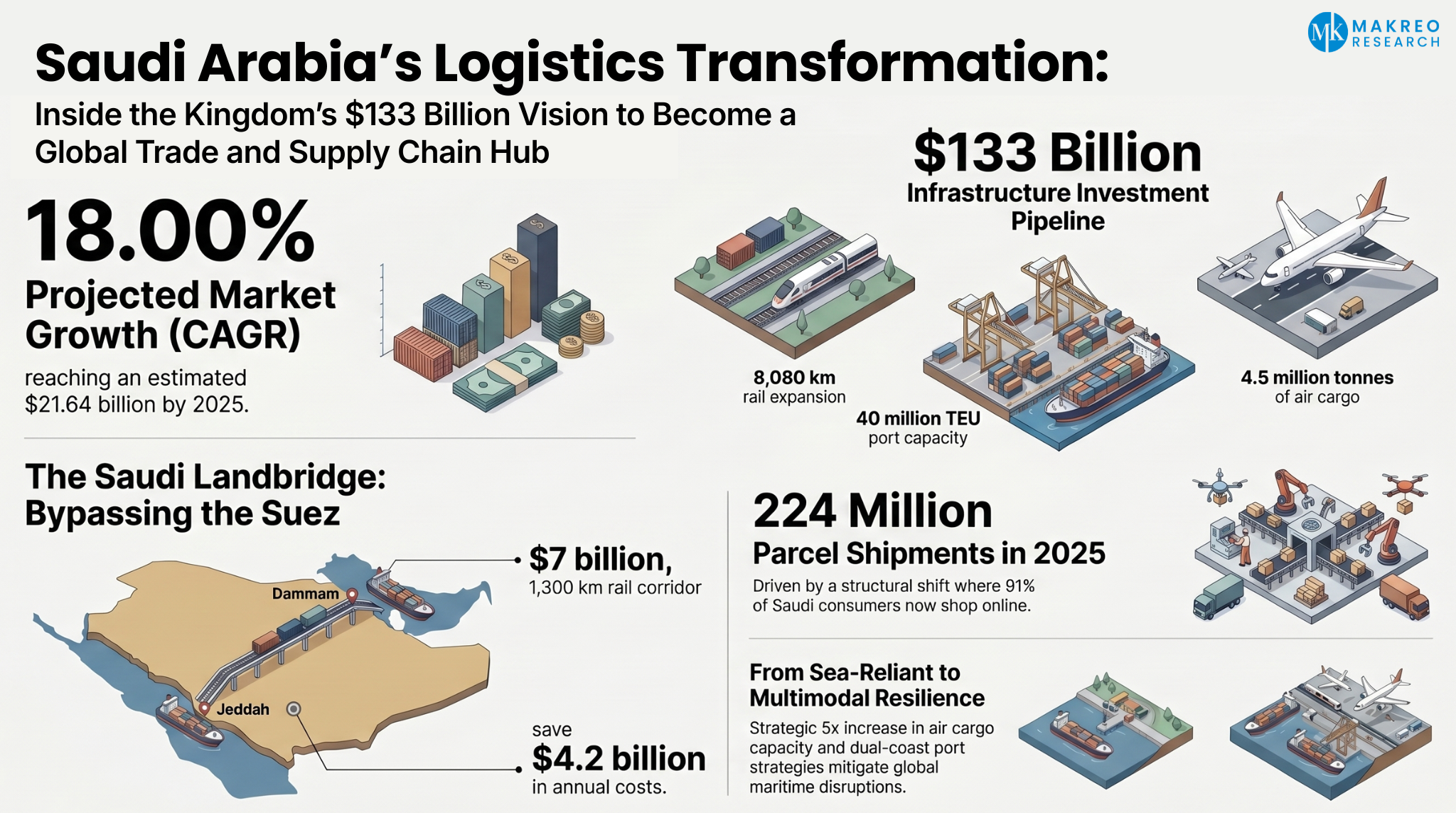
Saudi Arabia's freight and logistics sector has transitioned from a support function to a core economic engine, and the numbers confirm it. Between 2021 and 2025, the market grew at a CAGR of 13.24%, reaching an estimated USD 21.64 billion. Looking ahead, Makreo Research projects the market to expand at a CAGR of 18.00% through 2030 as Vision 2030 mandates, infrastructure megaprojects, e-commerce explosion, and demographic momentum converge into a multi-decade demand cycle.
The Kingdom currently contributes approximately 6% of GDP from logistics, with an ambitious government target of doubling that to 10% by 2030. With Saudi Arabia positioned along the Arabian Gulf and the Red Sea, handling approximately 13% of global seaborne trade, the strategic case is not aspirational. It is operational.
This blog draws on Makreo Research's February 2026 comprehensive study on the Saudi Arabia Freight and Logistics Market (2021-2030), enriched with comprehensive market intelligence from H2 2025 and Q1 2026.
Why This Market Matters to Decision-Makers
Whether you are a global logistics operator assessing Saudi market entry, an infrastructure investor evaluating asset allocation across GCC, a procurement leader managing cross-border supply chains, or a policymaker benchmarking national logistics performance - the Saudi freight market offers some of the clearest investment signals in the Middle East. But the data gap between public information and actionable intelligence is wide. That is precisely where independent market research adds measurable value.
What Is Driving Saudi Arabia's Freight Demand?
Saudi Arabia's freight demand is not concentrated in a single sector. It is being pulled forward simultaneously from e-commerce, manufacturing, pharmaceutical imports, food security imperatives, and petrochemical exports. This multi-vector demand structure is one reason the sector's growth is broadly resilient rather than cyclically fragile.
E-Commerce and CEP - The Structural Demand Shift
With 91% of Saudi consumers shopping online and 14% making daily purchases, the e-commerce logistics segment is experiencing demand that is structural, not cyclical. Makreo Research data shows the e-commerce logistics market is projected to grow at a CAGR of 11.25% through 2030. The numbers beneath this rate are equally telling:
-
224+ million parcel shipments processed nationally in 2025, up from 180+ million in 2024
-
Over 50 million deliveries processed in a single quarter of 2025 alone
-
74% of Saudi online shoppers prefer domestic platforms over cross-border alternatives
-
Average delivery time declined from 45 to 35 minutes in 2024 within the quick-commerce segment
-
Riyadh alone accounts for nearly half of all registered e-commerce order volume in Q2 2025
The next competitive frontier is not urban speed, it is economically viable logistics in Saudi Arabia's secondary and tertiary cities, where delivery costs run 15–20% above GCC averages due to route length and sparse drop density.
Vision 2030 and the National Transport & Logistics Strategy (NTLS)
The Kingdom's National Transport and Logistics Strategy is backed by SAR 10 billion committed specifically to logistics parks and port expansion, alongside a broader USD 133 billion approved investment pipeline spanning airports, rail, and ports. Since 2021, total sector investments have exceeded SAR 250 billion (approx. USD 66.6 billion), with private sector participation rising year-on-year.
The NTLS targets are ambitious and measurable: an 8,080 km rail network, 40 million TEUs of annual port throughput, and 4.5+ million tonnes of air cargo capacity, all to be achieved with approximately 80% private sector funding participation.
Non-Oil Economic Diversification
Saudi Arabia's non-oil exports reached USD 137 billion in 2024, with downstream petrochemicals, machinery, and consumer goods driving complex, time-sensitive freight requirements. Manufacturing is forecast to be the fastest-growing end-use sector in logistics demand, at approximately 6.43% CAGR through 2031, driven by automotive assembly clusters, NEOM megaproject construction, and electronics manufacturing localization mandates.
Food Security and Pharmaceutical Imports
Saudi Arabia imports up to 80% of key food categories, creating massive cold chain logistics requirements. The cold chain market is currently growing at a CAGR that keeps pace with the fastest sub-segments of the logistics ecosystem, driven by pharmaceutical import volumes of USD 5.58 billion annually and a government food security agenda that has accelerated 22 of 59 planned logistics centres to active status.
In March 2026, Saudi TGA eased GCC refrigerated truck entry rules, a regulatory development that will materially accelerate cross-border cold chain volumes in the near term.
Where Saudi Arabia’s USD 133 Billion Logistics Infrastructure Investment Is Actually Going
Saudi Warehousing - Scale, Speed, and Specification Upgrade
In the first half of 2025 alone, over 1.3 million m² of new warehouse space was added to the national stock. As of 2024, Saudi Arabia had 23 activated logistics centres spanning a total of 34.6 million m², with Industrial City Logistics Zones accounting for 15 of these facilities. The Western Region holds the largest share of logistics market value, driven by port-linked infrastructure - while Riyadh leads in warehousing and cold chain demand at 37% geographic share.
The market is not just growing, it is upgrading in specification. Three headline investments signal a new benchmark:
-
DHL Supply Chain: EUR 130 million investment in a 70,000+ m² Riyadh distribution hub
-
Tamer Group: USD 200 million AutoStore-integrated logistics park
-
Almajdouie Logistics + CEVA Logistics: Joint venture combining domestic infrastructure with global network reach
Industrial rental rates in Riyadh increased 18% in H1 2025, with occupancy levels reaching 96% - a supply-demand imbalance that will sustain elevated yields for well-positioned warehouse assets through 2027 at minimum.
The Saudi Landbridge - Rewriting Trade Route Economics
The Saudi Landbridge project is the single most consequential infrastructure development for the Kingdom's logistics sector. Spanning approximately 1,300 kilometres, it will connect Jeddah Islamic Port on the Red Sea to Dammam on the Arabian Gulf, creating an inland freight corridor that bypasses the Suez Canal route and directly addresses vulnerabilities exposed during the 2024-2025 Red Sea crisis.
Construction was initiated in 2025 with an estimated investment of USD 7 billion. The project will establish nearly 20 logistics hubs along its route and is projected to generate approximately USD 4.2 billion in annual transportation cost savings. Heavy manufacturers and petrochemical exporters have already begun pre-booking rail freight capacity for 2026, independent of project completion.
-
Under Vision 2030, rail network targeted to expand to more than 8,000 kilometres
-
Rail freight revenue growing from USD 0.19 billion in 2021 to USD 0.29 billion by 2025E
-
Riyadh–Dammam highway heavy vehicle traffic increased approximately XX% by end of 2025
Saudi Arabia Air Cargo -The 5x Bet
Total air cargo volume reached 1.2 million tonnes in 2024. Saudi Arabia's civil aviation authority is targeting a fivefold increase by 2030. Air freight is forecast to grow at 6.78% CAGR from 2026 to 2031. These are ambitious targets, but the infrastructure is being built to support them.
Riyadh Air targets 120+ aircraft serving 100+ destinations by 2030. King Salman International Airport's Special Integrated Logistics Zone spans 3 million m². Apple and Shein are already signed as tenants. The Sino-Logistics Zone at the same airport is under construction.
Saudi Arabia's air cargo strategy is not a backup plan for sea freight. It is a deliberate multimodal redundancy, built specifically because the Red Sea crisis demonstrated what happens when a single maritime gateway faces sustained disruption.
How Competitive Positioning Is Evolving Across Saudi Arabia’s Logistics Market
Competition is being reshaped by integrated capabilities, multimodal network depth, and automation investment rather than scale alone. The market comprises a mix of established domestic operators, global freight majors, port and terminal operators, and a growing tier of technology-enabled logistics startups.
Top Domestic Logistics Companies in Saudi Arabia
-
Bahri (National Shipping Company of Saudi Arabia) - 117 vessels (Q3 2025), SAR 9.48 billion total revenue (2024), +8% YoY. Operates across oil transport, chemicals, integrated logistics, and dry bulk. In 2025, completed USD 1 billion VLCC acquisition; signed USD 800 million Murabaha credit facility with Al Rajhi Bank.
-
SAL Saudi Logistics Services Company - ~1.5 million m² of logistics infrastructure. Revenue growing across air cargo, ground handling, and warehousing segments. Active expansion into European corridors via Liège Airport partnership.
-
Almajdouie Logistics (MLC) - 1,800+ trucks, 2,500+ trailers. Joint venture with CEVA Logistics.
Global Entrants and New Investments
-
DSV - 29-facility network already handling 6% of Saudi import volumes (per Mordor Intelligence 2026).
-
UPS Saudi Arabia - Established courier and express operations with sustained financial performance.
Emerging Logistics Technology Players and Funding Activity in Saudi Arabia
-
Viero (2026) - USD 1.2 million raised for on-demand fleet management platform
-
Logexa (2025) - USD 2 million from Nour Nouf Ventures for warehouse and transport optimisation solutions
-
PieShip (2025) - USD 2.1 million seed round for delivery-as-a-service platform
These startups signal a structural shift in last-mile and fleet management, operating in segments where incumbents have limited technology depth and where Saudi consumers' high service expectations create market openings.
Makreo Research's report benchmarks leading market participants on service quality, including complaint rates per 100,000 shipments (sourced from Transport General Authority data), fleet size, warehouse space, mode coverage, and compliance certifications. Among the CEP operators assessed: NAQEL Express, J&T Express Saudi Arabia, DHL Express, Aramex Saudi Arabia, SMSA Express, AJEX Logistics, UPS Saudi Arabia, and FedEx Saudi Arabia, with relative performance ratings for each.
Saudi Arabia Freight and Logistics Market Forecast to 2030
Makreo Research's 2026 study projects the Saudi logistics market to grow at 18% CAGR from 2025 through 2030. The inaugural Transport Logistic Middle East event is scheduled for September 2026 in Riyadh. That is the global logistics community formalizing Saudi Arabia's arrival as a tier-one destination, not aspirationally, but operationally.
The structural forces shaping the next five years: Landbridge multimodal integration, cold chain provincial extension, e-commerce fulfillment network scaling, dual-coast port strategy, sustainability-driven infrastructure, and warehouse automation at scale. These are not trends waiting to happen. Most are already funded and executing.
The NTLS headline targets tell you what Saudi Arabia is aiming for: 8,080 km rail, 40 million TEUs of port throughput, 4.5+ million tonnes of air cargo. Private sector participation, targeted at approximately 80% of the USD 63.95 billion investment pipeline, is the variable that determines whether those targets are 90% achieved or 60% achieved. The direction is not in doubt.
This blog draws on Makreo Research's February 2026 study Saudi Arabia Freight and Logistics Market Size and Forecast (2021–2030). The report covers the full ecosystem, logistics, freight by mode, warehousing and cold chain, 3PL, e-commerce logistics, CEP, with historical data from 2021, estimated 2025 figures, and forecasts through 2030.
The Saudi Arabia Freight and Logistics Market report serves logistics operators, infrastructure developers, investors, policymakers, and supply chain stakeholders seeking a data-driven, decision-ready understanding of the Kingdom's logistics transformation.
Email us at [email protected] to discuss your research needs and explore how we can become your research partner in progress.
Explore our Custom Research & Market Survey Capabilities
Frequently Asked Questions About Saudi Arabia’s Logistics Market
What is the size of the Saudi Arabia logistics market in 2025?
According to Makreo Research's February 2026 study, the Saudi Arabia logistics market is estimated at USD 21.64 billion in 2025, growing at a CAGR of 13.24% from 2021. The overall logistics market (including broader scope estimates) ranges to USD 27–33 billion depending on definitional scope across different research methodologies.
What is the projected CAGR for Saudi Arabia freight and logistics through 2030?
Makreo Research projects the market to expand at a CAGR of 18.00% from 2025 to 2030, making it one of the fastest-growing logistics markets in the Middle East and North Africa region.
Who are the leading logistics companies in Saudi Arabia?
Key players profiled by Makreo Research include Bahri (National Shipping Company of Saudi Arabia), Agility Logistics Saudi Arabia, SAL Saudi Logistics Services, Almajdouie Logistics (MLC), DHL Express Saudi Arabia, A.P. Moller-Maersk Saudi Arabia, LogiPoint, Red Sea Gateway Terminal (RSGT), UPS Saudi Arabia, S.A. TALKE, Hala Supply Chain Services, and Tamer Logistics, among 17 profiled players.
What is the Saudi Landbridge project?
A 1,300 km railway connecting Jeddah Islamic Port on the Red Sea to Dammam on the Arabian Gulf. Construction began in 2025, with an estimated investment of USD 7 billion. Projected to generate USD 4.2 billion in annual transportation cost savings and establish approximately 20 logistics hubs along the corridor. Heavy manufacturers are already pre-booking freight capacity for 2026.
How has the Red Sea crisis affected Saudi Arabia's logistics market?
The 2024-2025 Red Sea disruption caused significant throughput contractions at Jeddah Islamic Port and King Abdullah Port. Saudi Arabia has responded by accelerating eastern port upgrades, Landbridge development, and air cargo capacity expansion, permanently shifting the Kingdom's logistics strategy toward multimodal resilience.
Where can I access the full Saudi Arabia Freight and Logistics Market research report?
The comprehensive report, covering 2021–2030 with 17 company profiles, full modal breakdown, M&A, and investment forecast, is available at www.makreo.com. For purchase inquiries or a customised sample, contact [email protected] or call +91-9619699069.
Saudi Arabia Logistics Market, Saudi Arabia Freight Market, Saudi Arabia Warehousing Market, Saudi Arabia Supply Chain Market, Saudi Arabia Cold Chain Market, Saudi Arabia Transportation Industry, Saudi Arabia Logistics Infrastructure, Saudi Arabia Freight and Logistics Market Forecast, Saudi Arabia Logistics Industry Analysis, Saudi Arabia Logistics Companies, Saudi Arabia 3PL Market, Saudi Arabia E-Commerce Logistics, Saudi Arabia Air Cargo Market, Saudi Arabia Ports and Logistics, Saudi Arabia Rail Freight Market, Saudi Arabia Warehousing Industry, Saudi Arabia Logistics Investment, Vision 2030 Logistics, Saudi Arabia NTLS, Saudi Arabia Landbridge Project, Saudi Arabia Trade Infrastructure, GCC Logistics Market, Middle East Logistics Market, Saudi Arabia Freight Forwarding, Saudi Arabia CEP Market, Saudi Arabia Logistics Startups, Saudi Arabia Logistics Technology, Riyadh Warehousing Market, Saudi Arabia Multimodal Logistics, Saudi Arabia Industrial Logistics, Saudi Arabia Port Infrastructure, Saudi Arabia Logistics Growth, Saudi Arabia Supply Chain Infrastructure, Saudi Arabia Logistics Trends 2030, Saudi Arabia Logistics Report, Saudi Arabia Infrastructure Investment, Saudi Arabia Logistics Sector, Saudi Arabia Distribution and Warehousing, Saudi Arabia Cargo Market, Saudi Arabia Freight Transportation