
How Utility-Scale Deployment, Domestic Manufacturing, and Policy Architecture Are Reshaping India’s Solar Photovoltaic Market
India’s solar PV market is transforming through utility-scale growth, domestic manufacturing, and strong policy support, driving grid integration and long-term clean energy leadership.
Structural Transformation of India’s Solar Photovoltaic Market
Between 2021 and 2025, India’s Solar Photovoltaic (PV) market expanded at a robust CAGR of 12.66%, driven by aggressive utility-scale capacity additions, accelerating rooftop adoption, and a decisive shift toward domestic manufacturing. What is unfolding is not a temporary acceleration tied to energy demand cycles, but a structural transformation of India’s power ecosystem, one anchored in manufacturing self-reliance, grid integration, and technology-led efficiency gains.
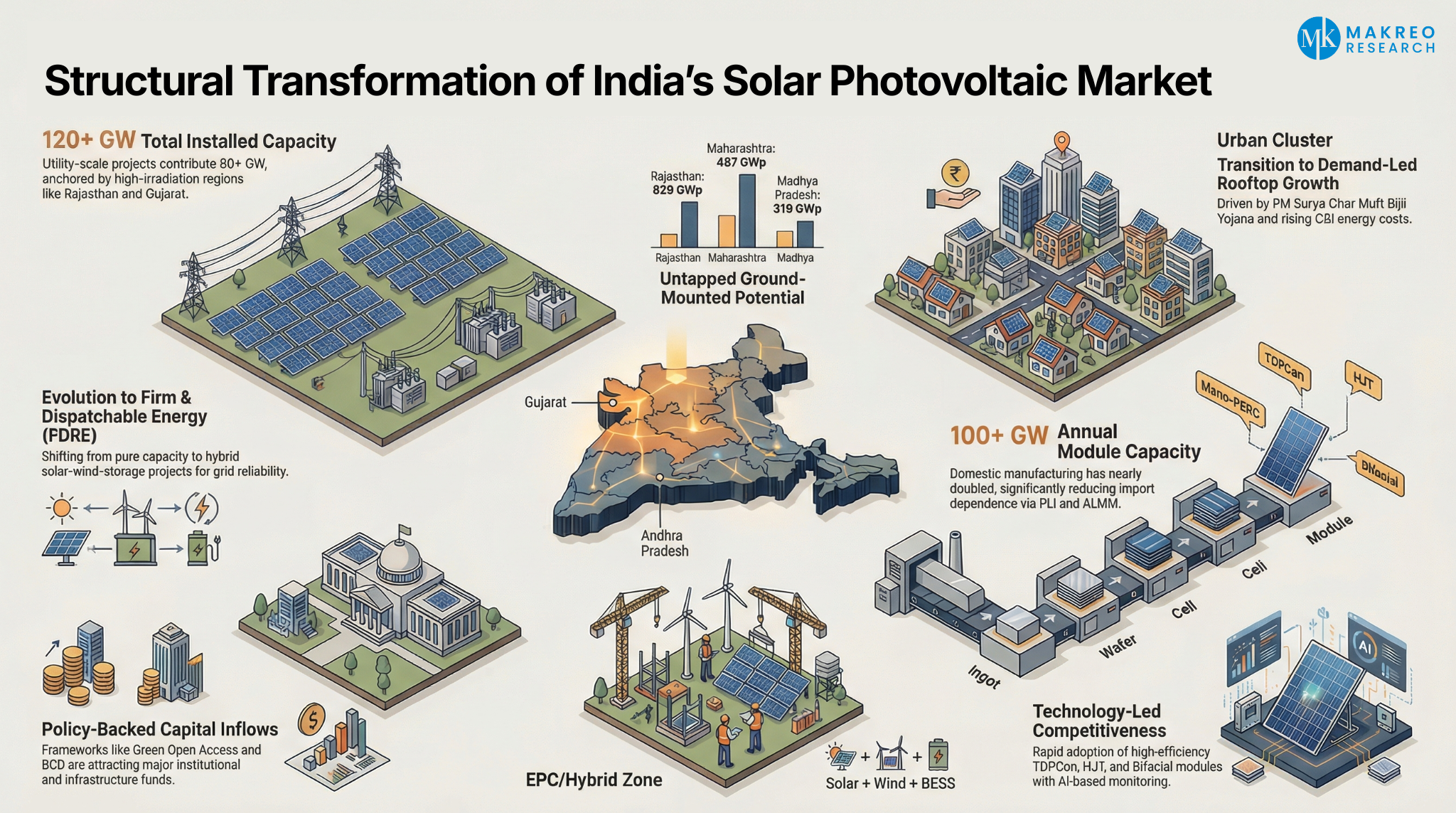
Installed solar capacity has crossed 120 GW, with more than 90 GW contributed by ground-mounted utility-scale projects, reinforcing solar PV as the backbone of India’s clean energy transition. According to Makreo Research, this momentum is expected to sustain through the decade as India advances toward its 500 GW non-fossil fuel capacity target by 2030, positioning solar PV as a central pillar of the country’s long-term energy mix.
What distinguishes the current phase of market evolution is the convergence of policy-backed manufacturing expansion, rapid deployment of advanced PV technologies, and rising institutional capital inflows, collectively transforming India from a high-growth solar deployment market into an increasingly integrated global solar manufacturing and project execution hub.
Ground-Mounted Solar Dominance Is Anchoring Capacity Growth
India’s solar deployment landscape remains firmly anchored in ground-mounted utility-scale projects, which continue to account for the majority of annual capacity additions due to their cost efficiency, scalability, and faster execution timelines. This dominance is further reinforced by India’s vast land availability and exceptionally high solar irradiation levels across western, central, and southern regions.
A recent assessment by the National Institute of Solar Energy estimates India’s ground-mounted solar potential at 3,343 GWp, derived from just 6.7% of identified wasteland, underscoring the depth of untapped capacity still available for large-scale deployment. Rajasthan alone accounts for nearly 829 GWp, followed by Maharashtra (487 GWp), Madhya Pradesh (319 GWp), Andhra Pradesh (299 GWp), and Gujarat (243 GWp).
This geographic concentration is shaping investment flows toward large-format solar parks and utility-scale installations, particularly in Rajasthan, Gujarat, and Maharashtra, where land contiguity and grid connectivity offer strong project economics.
Rooftop and Distributed Solar Are Gaining Structural Momentum
While utility-scale solar remains the market’s foundation, rooftop and distributed solar systems are transitioning from policy-driven adoption to demand-led growth. Residential subsidies under the PM Surya Ghar Muft Bijli Yojana, alongside rising electricity costs for commercial and industrial (C&I) users, are steadily improving rooftop solar economics.
Despite slower-than-targeted adoption to date, only 16 lakh rooftop installations completed against a target of one crore households, policy recalibration, simplified approvals, and improved financing access are expected to accelerate uptake over the next five years. Rooftop solar is increasingly viewed not merely as a decentralized power solution, but as a strategic lever for grid decongestion and demand-side energy security.
Manufacturing Self-Reliance Is Redefining Competitive Dynamics
India’s solar PV market is undergoing a decisive manufacturing-led inflection point, driven by the Production Linked Incentive (PLI) Scheme, Approved List of Models and Manufacturers (ALMM), and Basic Customs Duty (BCD) framework. Between FY2024 and FY2025, domestic solar module manufacturing capacity nearly doubled, while solar cell capacity expanded sharply, reducing import dependence and strengthening supply chain resilience.
India has now built over 100 GW per annum of solar PV module manufacturing capacity, with rapid scale-up underway across cells, wafers, and upstream components. Manufacturers are increasingly deploying Mono-PERC, TOPCon, HJT, and bifacial technologies, while investing in R&D, automation, and export-oriented capacity.
Recent developments, including large-scale investments in integrated manufacturing facilities, high-efficiency TOPCon module supply agreements, and the expansion of heterojunction and n-type technologies, signal India’s transition from volume-driven production to technology-led competitiveness.
EPC Activity and Utility Projects Signal Execution Depth
The surge in EPC contracts and turnkey solar project awards reflects growing execution maturity across India’s solar ecosystem. Large grid-interactive projects in Maharashtra, Rajasthan, and Gujarat continue to attract investments exceeding INR 350 crore per project, underscoring investor confidence in India’s solar execution capabilities.
At the same time, the rise of hybrid solar projects combining solar, wind, and battery energy storage systems (BESS) is reshaping procurement strategies. Utilities and corporate buyers increasingly prioritize firm and dispatchable renewable energy (FDRE), shifting market focus from pure capacity addition to reliability, peak-hour supply, and grid stability.
Policy Architecture Is Accelerating Market Integration
India’s solar PV expansion is underpinned by one of the most comprehensive policy frameworks globally. Instruments such as Green Open Access Rules, PM-KUSUM, and solar park development schemes have materially improved project bankability and market access across residential, agricultural, and industrial segments.
At the same time, parliamentary reviews and regulatory evaluations are highlighting the need for single-window clearance mechanisms, faster land acquisition processes, and improved coordination between central agencies, states, and DISCOMs. Addressing these structural bottlenecks is increasingly viewed as critical for sustaining deployment momentum beyond headline capacity growth.
Strategic Capital Is Accelerating Scale Across India’s Solar PV Value Chain
Investment momentum is reinforcing long-term confidence in India’s solar ecosystem, spanning manufacturing, EPC execution, and utility-scale deployment.
-
Reliance Industries is building one of India’s largest fully integrated solar manufacturing hubs in Jamnagar, Gujarat, with solar cell production set to begin in Q3 2025, strengthening end-to-end domestic supply chains.
-
RenewSys India secured a 125 MWp TOPCon module supply agreement with ENGIE for a utility-scale solar project in Rajasthan, reflecting rising demand for high-efficiency, India-manufactured modules.
- Insolation Energy Limited expanded its project pipeline by setting up 16 new SPVs, enabling faster execution, focused project management, and easier project financing.
- Vikran Engineering won an INR 354 crore EPC contract for a 100 MW AC solar project in Maharashtra, highlighting strong investor confidence in India’s solar EPC and execution capabilities.
Together, these developments signal a shift in capital flows toward scale, manufacturing integration, and execution strength, reinforcing India’s long-term leadership in the global solar PV market.
Technology Adoption Is Becoming the Primary Growth Lever
The next phase of India’s solar PV growth is increasingly technology-driven. Deployment of high-efficiency modules, glass-to-glass designs, advanced inverters, digital monitoring systems, and storage-linked configurations is improving plant-level yields and long-term asset performance.
Declining system costs, improved temperature coefficients for high-irradiance regions, and better grid integration are accelerating adoption across residential, C&I, and government segments. Solar PV is no longer positioned solely as the lowest-cost power source, but as a strategic infrastructure asset supporting energy security, decarbonization, and industrial competitiveness.
The Long-Term Outlook: From Capacity Expansion to Integrated Solar Ecosystem
India’s Solar Photovoltaic (PV) market is transitioning from capacity-led growth to an integrated ecosystem defined by manufacturing depth, execution capability, and technology sophistication. According to Makreo Research, the market’s next growth cycle through 2030 will be shaped by:
- Scaling domestic manufacturing across the PV value chain
- Accelerating rooftop and C&I solar adoption
- Strengthening grid infrastructure and storage integration
- Expanding hybrid and firm renewable power solutions
- Advancing next-generation PV technologies
As policy stability, manufacturing self-reliance, and technology adoption converge, India is emerging not only as one of the world’s largest solar deployment markets, but as a strategic global hub for solar manufacturing, EPC execution, and clean energy innovation.
Makreo Research’s study, “India Solar Photovoltaic (PV) Market Size and Forecast (2021–2030) – Analysis by Application, Deployment Model, Grid Type, Components, and Competitive Landscape”, provides a comprehensive assessment of market size, segmentation, competitive dynamics, and long-term strategic outlook shaping this transformation.
The question is no longer whether India’s solar PV market will scale, but how efficiently it can integrate manufacturing, deployment, and grid intelligence to sustain leadership through the next decade.
Email us at [email protected] to explore this study in detail and discuss how Makreo Research can support your strategic, investment, and market intelligence requirements.
Explore our Custom Research & Market Survey Capabilities
India solar PV market, India solar photovoltaic market growth, utility-scale solar India, ground-mounted solar projects India, rooftop solar market India, C&I solar adoption India, India solar manufacturing capacity, solar module manufacturing India, PLI scheme solar India, TOPCon and HJT solar modules India, solar EPC market India, hybrid renewable energy India, battery energy storage systems India, India renewable energy target 500 GW, solar policy framework India, grid integration solar India, India clean energy transition