
Pharmaceutical Market Survey in India - Understanding Drug Adoption, New Launches, Competition and Market Opportunities
Evaluate a pharmaceutical market survey company in India for drug launches, adoption, competition and market entry. Explore Makreo Research’s pharma market research expertise.
India's pharmaceutical industry is entering a phase where market opportunity can no longer be assessed simply by looking at market size, prescription volumes or historical growth.
The more important questions are becoming:
-
Which therapeutic areas are attracting investment?
-
Which new drugs are gaining physician and patient acceptance?
-
How quickly are new therapies moving from launch to adoption?
-
Why does one brand outperform another despite similar indications?
-
And what prevents an approved or launched drug from achieving its expected potential?
These questions are becoming particularly relevant as India's pharmaceutical industry moves beyond its traditional strength in generics toward complex formulations, biologics, biosimilars, specialty medicines, innovative therapies and contract research and manufacturing. The Government of India estimates India's domestic pharmaceutical market at around US$60 billion, with projections to reach US$130 billion by 2030. India is also the world's largest supplier of generic medicines by volume, while policy initiatives are increasingly pushing the industry toward biologics, biosimilars and higher-value pharmaceutical products.
At the same time, investment is moving beyond conventional manufacturing capacity. In 2026, the government introduced Biopharma SHAKTI with a proposed ₹10,000 crore outlay over five years, targeting a stronger biologics and biosimilars ecosystem. India is also attracting greater interest in CRDMO activities, with ICRA highlighting the country's opportunity in contract research, development and manufacturing as global pharmaceutical companies diversify supply chains.
Key Insights - India Pharmaceutical Market 2026
-
Deal activity is accelerating: Sun Pharmaceutical Industries’ $11.75 billion acquisition of Organon, announced in April 2026, marks India’s largest overseas pharmaceutical acquisition to date.
-
Pharma M&A remains active: India’s pharma and healthcare sector recorded 65 deals worth $13.9 billion in Q2 2026, with outbound transactions accounting for 96% of total deal value.
-
Licensing activity continues: Specialty therapies, diabetes and biologics remain active areas for licensing and portfolio expansion.
For pharmaceutical companies, the challenge is therefore not simply accessing more information. It is identifying which regulatory developments, competitive movements, stakeholder behaviours and market signals require a strategic response. This is where pharma market intelligence in India becomes increasingly important for companies assessing investment, launches, expansion and competitive positioning.
New Drug Launches Are Creating a Different Research Requirement
India's pharmaceutical pipeline is also becoming increasingly diverse. The Central Drugs Standard Control Organisation (CDSCO) continues to record approvals across new drugs, biologics, vaccines and clinical-trial categories. Recent 2026 records, for example, include products involving areas such as oncology, neurology, metabolic disease, vaccines and biologics.
For a pharmaceutical company preparing to launch or expand a product, the critical question is therefore not merely:
“How big is the therapeutic market?”
It is:
“What will determine whether our product gets adopted?”
That requires understanding the market at several levels.
A new drug launch assessment in India can help companies move beyond projected market potential to understand whether physicians, patients and other stakeholders are likely to accept and adopt a new therapy.
A meaningful adoption study should distinguish between:
Awareness → Consideration → Trial → Prescription → Repeat Prescription → Continuation
For example, a physician survey for pharmaceutical companies could help understand: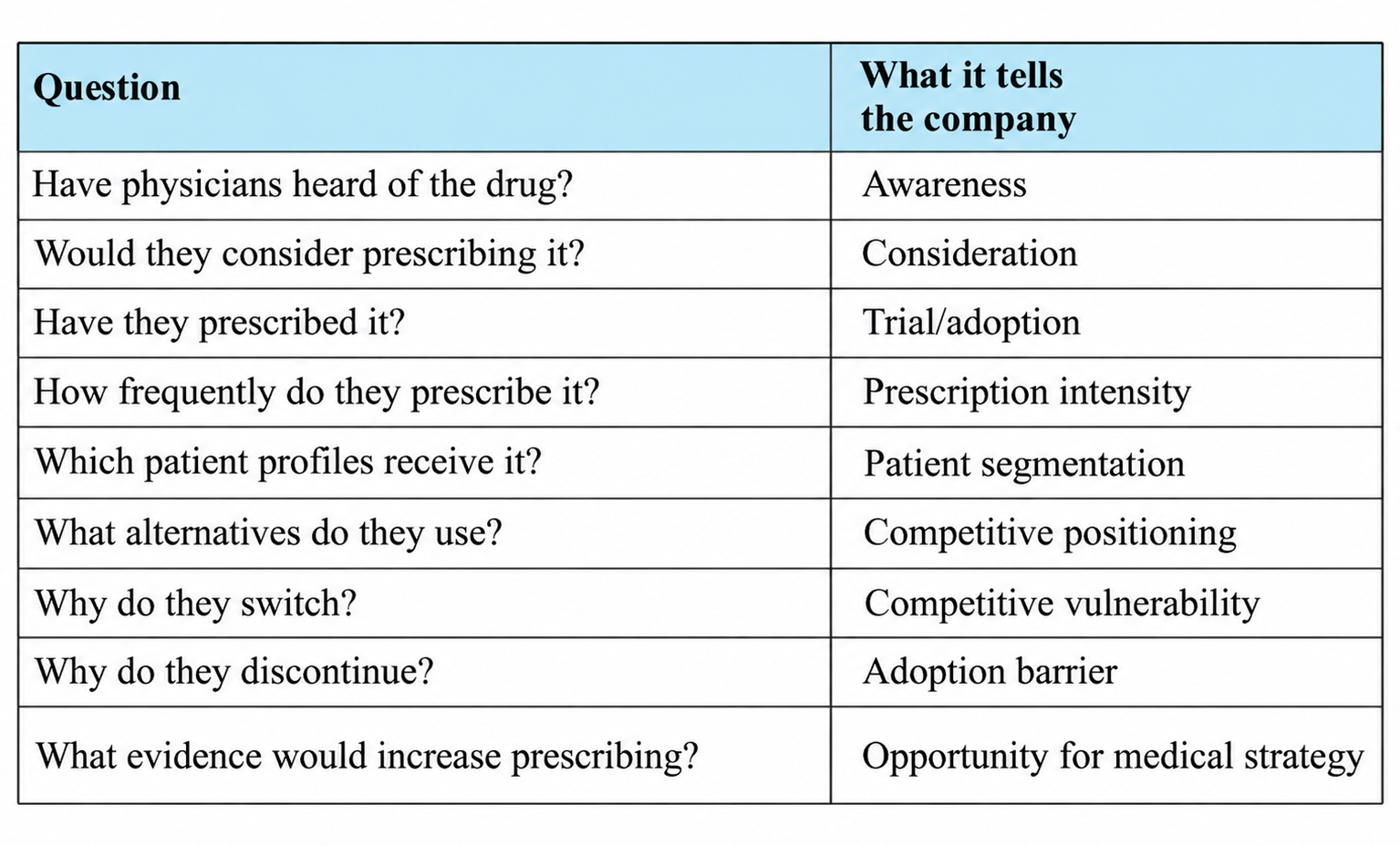
Other Areas Pharma Companies Commonly Need to Assess
A comprehensive pharmaceutical market survey can address a much wider set of commercial questions depending on the business objective.
Competitive Intelligence
Pharma competitive intelligence can help companies understand:
-
Competitor portfolio
-
New launches
-
Pipeline assessment
-
Brand positioning
-
Pricing strategy
-
Promotional strategy
-
Competitive strengths and weaknesses
Prescriber Mapping
A prescription behaviour study can assess:
-
Specialist vs. general physician behaviour
-
High-potential prescribers
-
Prescription drivers
-
KOL influence
-
Treatment pathway
Patient Journey
A patient survey in pharma can examine:
-
Diagnosis
-
Treatment initiation
-
Product selection
-
Compliance
-
Discontinuation
-
Switching
-
Out-of-pocket expenditure
Launch Readiness
A launch-readiness assessment can examine:
-
Market awareness
-
Physician willingness to prescribe
-
Expected uptake
-
Competitive response
-
Pricing acceptance
-
Distribution expectations
-
Key launch barriers
Post-Launch Assessment
A post-launch study can assess:
-
Actual vs. expected adoption
-
Brand perception
-
Physician satisfaction
-
Patient feedback
-
Switching behaviour
-
Reasons for underperformance
-
Opportunities for growth
From “What Is the Market Size?” to “What Will Make the Product Win?”
This is where pharmaceutical market research in India is becoming increasingly important.
A company investing in a new molecule, entering a new therapeutic area, launching a specialty product, evaluating a competitor or assessing an emerging therapy needs more than published market statistics. It needs to understand the behaviour behind the numbers.
For instance, a secondary report may estimate the size of the obesity-drug market. But a pharmaceutical primary research programme can investigate:
How many physicians know the product? → How many are prescribing it? → Which patients receive it? → Why are physicians choosing it? → What competing product was considered? → What causes switching? → What prevents wider adoption? → What could change prescribing behaviour?
That is the difference between knowing the market and understanding the market.
How Makreo Can Help
Makreo Research offers customised pharmaceutical market surveys designed around the specific business question rather than a standardised report format.
As a pharma market research company in India, Makreo can design primary research programmes around specific therapies, products, geographies, stakeholder groups and commercial objectives.
Research methodology can combine physician interviews, patient research, pharmacist inputs, and distributor/channel perspectives, depending on the study objective.
Makreo combines direct fieldwork with market intelligence to help clients understand not only what is happening in a market, but why it is happening and what it may mean for their next decision. This approach is built around transparency, structured research and decision-ready insight, supporting pharmaceutical companies across clinical, commercial and regulatory environments.
Pan-India Weight-Loss Drug Adoption Market Survey - The Weight-Loss Drug Market Shows Why Adoption Matters
The entry of Mounjaro (tirzepatide) and Wegovy (semaglutide) into India changed the conversation around obesity treatment. Eli Lilly launched Mounjaro in India in March 2025, followed by Novo Nordisk's Wegovy later that year. By 2026, the market had become significantly more competitive, with Indian pharmaceutical companies entering with semaglutide products following the expiry of Novo Nordisk's Indian patent.
As the weight-loss drug landscape evolves rapidly, understanding the factors driving actual adoption becomes increasingly important. Market size and launch activity alone do not reveal how consumers are responding to these therapies, what influences their choice, or which barriers may limit wider adoption. This need for a deeper, ground-level understanding formed the basis of Makreo's Drug Adoption Study in India on Understanding India's Weight-Loss Drug Adoption. The assignment examined real-world adoption of next-generation weight-loss therapies through a structured consumer survey of 3,000 respondents and pharmacy-level intelligence across 300 pharmacies in six Indian cities.
Study at a Glance
-
3,000 consumers surveyed across India
-
300 pharmacies assessed across 6 cities: Mumbai, Delhi NCR, Chandigarh, Bengaluru, Hyderabad and Ahmedabad
-
Competitive benchmarking of leading branded therapies, including Ozempic and Mounjaro
-
Review of physician-prescribing patterns through pharmacy and consumer touchpoints
What the Research Revealed
-
Affordability and availability shape adoption. Consumer decisions were influenced strongly by price, product availability, physician confidence and treatment perceptions, showing that adoption extends beyond clinical outcomes.
-
Pharmacy intelligence added a critical market-level view. Differences in stock consistency across cities helped distinguish actual market availability from consumer interest alone.
-
Physician confidence remains an important adoption gate. Prescribing behaviour varied across cities, affecting how quickly awareness translated into treatment.
-
Delivery format influences treatment acceptance. With the Indian market heavily centred on injectable GLP-1 therapies, format preference emerged as an important consideration for patients resistant to injections.
-
Pricing dynamics are changing the category. Patent expiry and expected generic competition are likely to influence affordability and the wider accessibility of weight-loss therapies.
-
Competitive momentum is reshaping the market. The rapid uptake of newer therapies such as Mounjaro highlights how quickly competitive positions can change in an emerging pharmaceutical category.
-
The study demonstrates how consumer behaviour, HCP influence, pharmacy availability and competitive dynamics can be examined together to provide a more complete picture of pharmaceutical market adoption.
Read the full case study: Understanding India's Weight-Loss Drug Adoption - How Makreo Helped a Global Pharma Company Decode Consumer, Pharmacy and Prescription Intelligence.
Makreo's Pharmaceutical and Healthcare Market Survey Capabilities in India
A pharmaceutical market survey in India is only as useful as the quality of the stakeholders reached and the depth of insight extracted from their responses. Makreo combines primary field research, quantitative surveys, and qualitative interviews to understand how healthcare products are perceived, adopted, prescribed, purchased, and used across the market.
Makreo’s healthcare research experience extends across pharmaceuticals, medical devices, consumer health and related healthcare categories, with studies designed around specific commercial questions rather than standardised survey templates. Its research approach can connect consumer behaviour with healthcare professional perspectives, pharmacy-level observations, product performance and competitive conditions. Makreo’s capability deck also documents experience across quantitative and qualitative methods, including CATI, personal interviews, focus groups and online surveys.
Proven Pharmaceutical & Healthcare Market Research Experience
Advanced Wound Care Bandage Market in India - Healthcare Professionals & Doctors Research
Makreo has conducted doctor-led research to understand clinical perceptions, product concerns, usage practices and unmet needs. In its Advanced Wound Care Bandage Market in India study, Makreo assessed 7–8 distinct bandage categories and conducted in-depth interviews with doctors from reputed hospitals and institutions, alongside analysis of hospital and retail pharmacy consumption patterns.
India Protein Supplements Market - Consumer & Product Research
Consumer research is used to quantify awareness, adoption, purchase behaviour, preferences, affordability and barriers. In the India protein supplements market-entry study for a US brand, Makreo conducted 1,800+ consumer surveys to assess awareness, usage, product preferences, purchase drivers, price sensitivity, trust and authenticity considerations.
Palm Oil in India - Clinician & Scientific Research
Makreo has also undertaken healthcare research where consumer perceptions are examined alongside scientific evidence and clinical perspectives. Its recent palm oil research incorporated clinician interviews across four healthcare specialisations - cardiology, gastroenterology, neurology and nutrition science - and reviewed evidence including the ICMR–INDIAB study covering 18,090 participants to examine nutritional patterns, medical perspectives and health-related misconceptions.
From Survey Responses to Market Intelligence
The value of pharma market intelligence lies beyond collecting responses. Makreo's research process combines data collection, methodology development, validation, analysis and interpretation to convert fragmented stakeholder inputs into commercially relevant findings. Its capability framework describes primary data collection from industry experts and consumers, data filtration and validation, followed by structured assessment and report formulation.
This enables pharmaceutical and healthcare companies to investigate questions such as:
-
How do customers, healthcare professionals or other relevant stakeholders perceive the product or brand?
-
What price points are acceptable to the target market, and what factors influence willingness to pay?
-
Which markets, cities, channels or customer segments should be prioritised for expansion?
-
What barriers could affect product adoption, market entry or commercial performance?
-
What gaps in the existing market could inform product development, positioning or differentiation?
A Research Approach Built Around the Business Question
Whether the requirement is a pharmaceutical consumer survey, HCP research, pharmacy study, product perception assessment, pharmaceutical market entry study, or healthcare demand assessment, Makreo structures the research around the decision the client needs to make.
The result is not simply a dataset or survey report. It is a ground-level evidence base connecting stakeholder behaviour with market dynamics, competitive conditions, and commercial decisions.
The sections below set out how this evidence translates into a decision, and what a pharmaceutical market survey in India typically covers.
Get Your Research Scoped in 48 Hours
If a business decision depends on what customers, physicians, pharmacies, distributors, or other market participants actually think and do, the practical starting point is defining what evidence would change the decision, not commissioning a survey first and working out the question afterwards.
Makreo Research works from the business question backwards: given the objective, what respondent profile, methodology, fieldwork approach, and sample design would produce a decision-ready answer, and on what timeline. A scoped research plan covering respondent definition, methodology, and expected deliverables is typically ready within 48 hours of sharing the objective.
Contact Makreo Research directly with the objective to receive a scoped research plan.
Frequently Asked Questions
1. Which company provides pharmaceutical market research in India?
Makreo Research & Consulting provides pharmaceutical market research in India, combining primary research, quantitative surveys, qualitative interviews and market intelligence. Studies can be designed around specific business requirements such as drug adoption, physician behaviour, patient insights, competitive assessment, market entry, product launches, pricing and therapeutic-area assessment.
2. How can I conduct a pharmaceutical market survey in India?
A pharmaceutical market survey in India typically starts by defining the business objective, target stakeholders and geographic scope. Depending on the requirement, research may involve physician surveys, patient surveys, pharmacist interviews, distributor research, KOL interviews or consumer surveys, supported by secondary market intelligence. The methodology and sample are then designed around the decision the company needs to make.
3. How can pharmaceutical companies assess a new drug before launch?
A new drug launch assessment in India can evaluate the market opportunity, competitive landscape, physician awareness, treatment pathway, unmet needs, expected prescription behaviour, pricing considerations and potential adoption barriers before launch. The findings can help companies refine product positioning, identify priority physician segments and anticipate competitive challenges.
4. Can pharmaceutical market research measure patient preferences and treatment behaviour?
Yes. A patient survey in pharma can examine awareness, treatment experience, product preferences, affordability, adherence, satisfaction, switching and discontinuation. Patient research can be particularly useful in therapy areas where treatment acceptance, administration method, cost or patient experience have a significant influence on adoption.
5. How much does a pharmaceutical market survey cost in India?
The cost of a pharmaceutical market survey in India depends on factors such as sample size, respondent profile, methodology, number of cities, therapy area and research complexity. A physician or KOL study, for example, may require a different approach from a large patient survey or pharmacy audit. A research agency can provide a more accurate estimate after understanding the business objective and required respondent profile.
Pharmaceutical Market Survey, Pharmaceutical Market Research, Pharma Market Intelligence, Pharmaceutical Industry India, Drug Adoption Research, New Drug Launch Research, Pharmaceutical Competitive Intelligence, Physician Research, Pharma Competitive Intelligence, Pharmaceutical Market Entry, Pharma Primary Research, Healthcare Market Research, Drug Adoption Study India, Pharmaceutical Market Research Company, Pharma Market Survey Company India, Pharmaceutical Research Company India, Pharmaceutical Market Assessment India, Pharma Market Intelligence Company India, Healthcare Consulting in India