Global Probiotics Market Size and Forecast (2021–2030) – Analysis by Product Type (Food & Beverages, Dietary Supplements, Animal Feed, Pharmaceuticals), Application, End User, Distribution Channel, and Geography Report
Global Probiotics Market Size
The Global Probiotics Market has witnessed substantial expansion, recording a CAGR of 9.37% during the period 2021–2025. This growth trajectory reflects rising consumer awareness of gut health and its integral role in maintaining overall well-being. The increasing adoption of functional foods, probiotic dietary supplements, and digestive health products that support immunity, metabolism, and digestive balance continues to accelerate market development. As the Global Probiotics Industry evolves, the sector has emerged as a cornerstone of the global health and wellness industry.
Key Drivers Shaping the Global Probiotics Market Growth
-
Increasing consumer emphasis on preventive healthcare and holistic wellness continues to drive the demand for probiotic-enriched products across global markets.
-
The growing prevalence of digestive health issues, antibiotic-related gut imbalances, and lifestyle-induced diseases continues to strengthen the adoption of probiotic dietary products across global markets.
-
Innovation in strain formulation, encapsulation technologies, and product formats is expanding applications beyond traditional dairy-based foods.
-
Growing awareness of the gut–immune axis and consumer inclination toward natural and clinically proven solutions are propelling market growth, particularly in the Asia-Pacific and European probiotics markets.
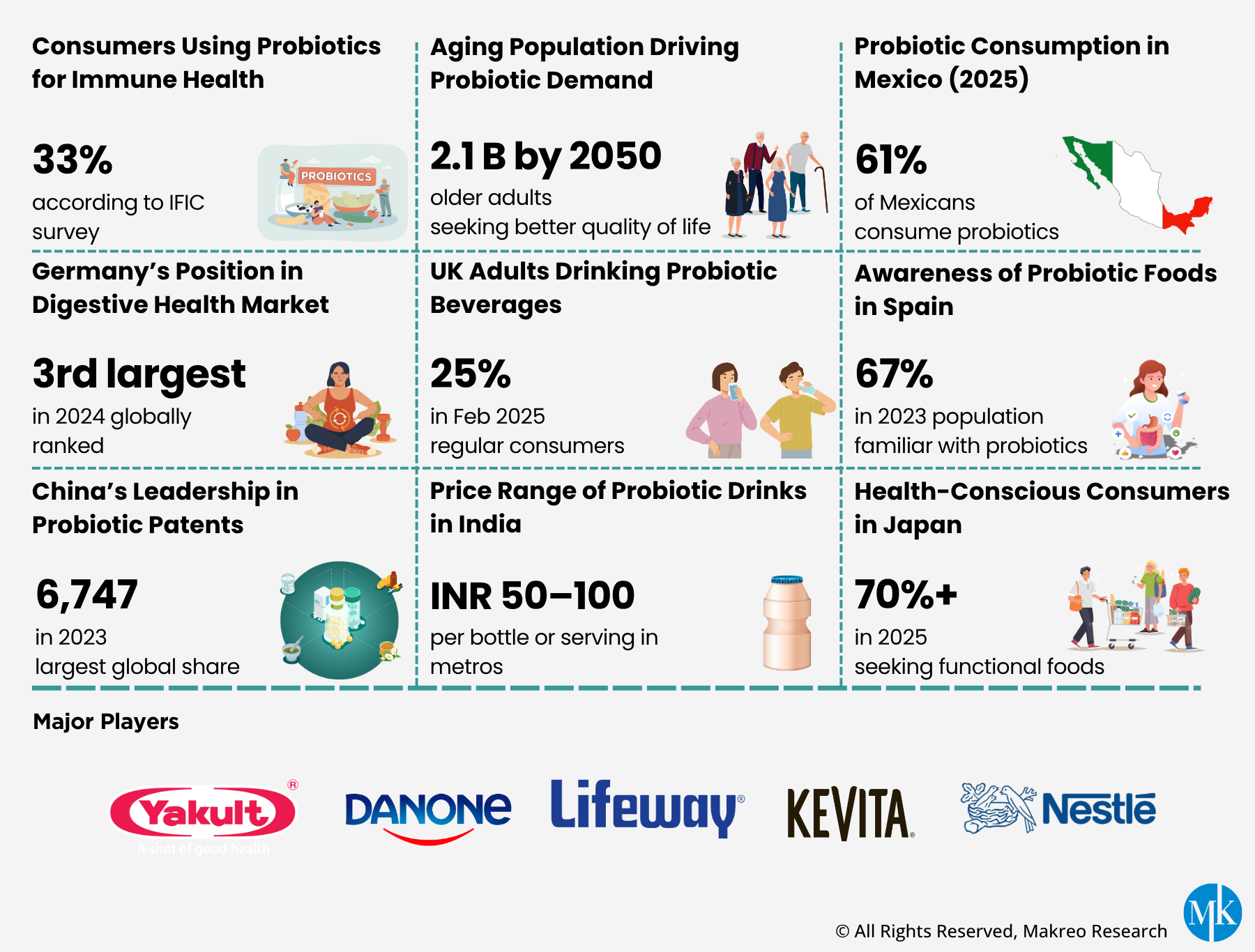
Global Probiotics Industry Insights
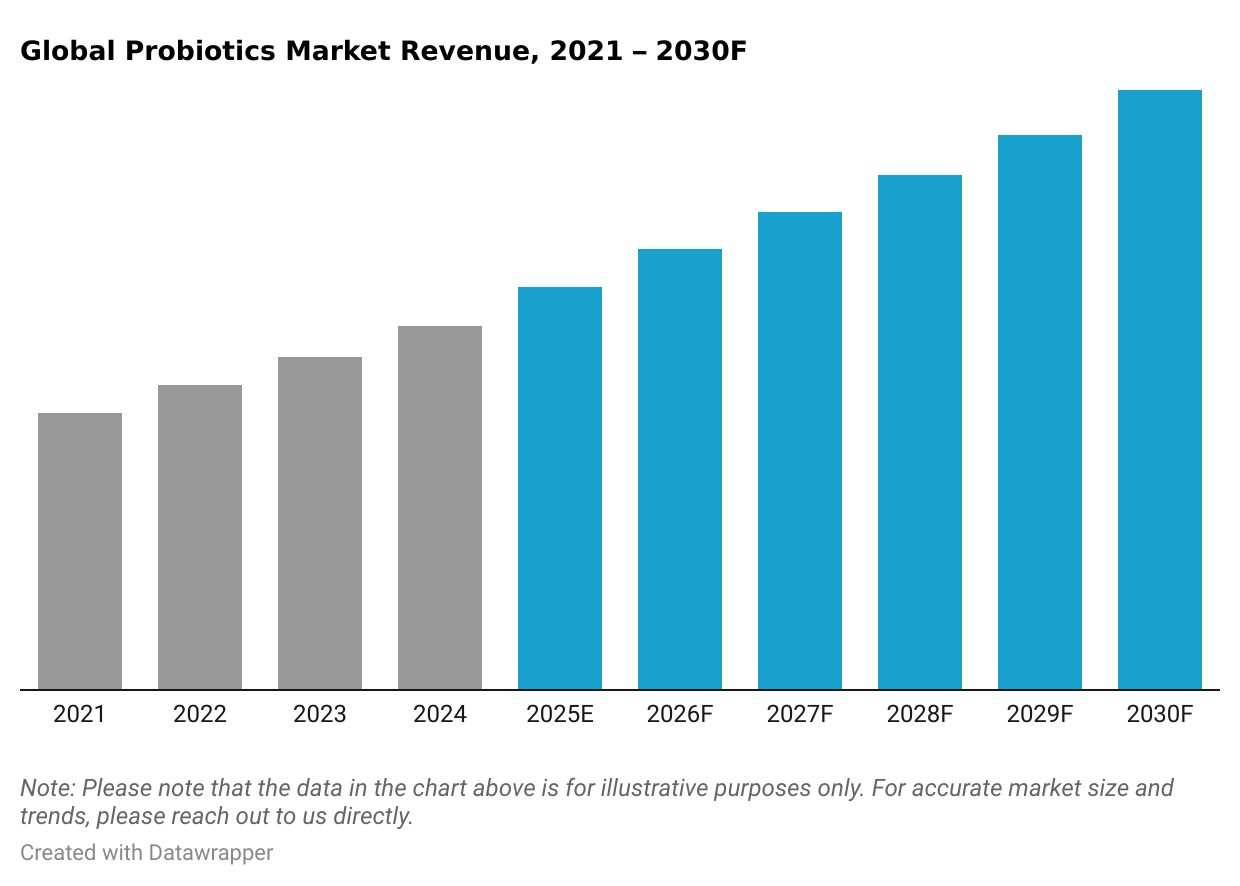
Global Probiotics Market Recent Developments, Investments, and Innovations
-
Danone: In 2025, Danone acquired The Akkermansia Company (TAC), a Belgian firm specializing in microbiome-based health products. This acquisition aligns with Danone's broader strategy to expand into next-generation gut-health science and research.
-
Curious Cheese: In 2025, Launched India’s first probiotic cheese brand. Offers three varieties: Mozzarella, Oaxaca, Edam; made using A2 cow’s milk and live probiotics. Initial retail partner is NaO Grocery, will expand offline & online.
-
Meliha: In 2025, Meliha introduced a packaged organic laban (fermented milk drink) in three sizes (2 L, 1 L, 180 ml) via Sharjah Co-operative Society outlets to meet the growing demand for organic dairy products in UAE.
-
Ostia Sciences Inc.: In 2024, Ostia Sciences Inc. developed SALI-10 probiotic using phosphorylated lantibiotic technology that inhibits disease-associated bacteria while supporting the healthy oral microbiome.
-
Bio-K+ (a Kerry company): Expanded its Pro line of probiotic supplements (products like IBS Pro and Antibio Pro) in the Canadian pharmacy channel outside Quebec. Also awarded Quebec’s 1st most pharmacist-recommended probiotic brand of 2023.
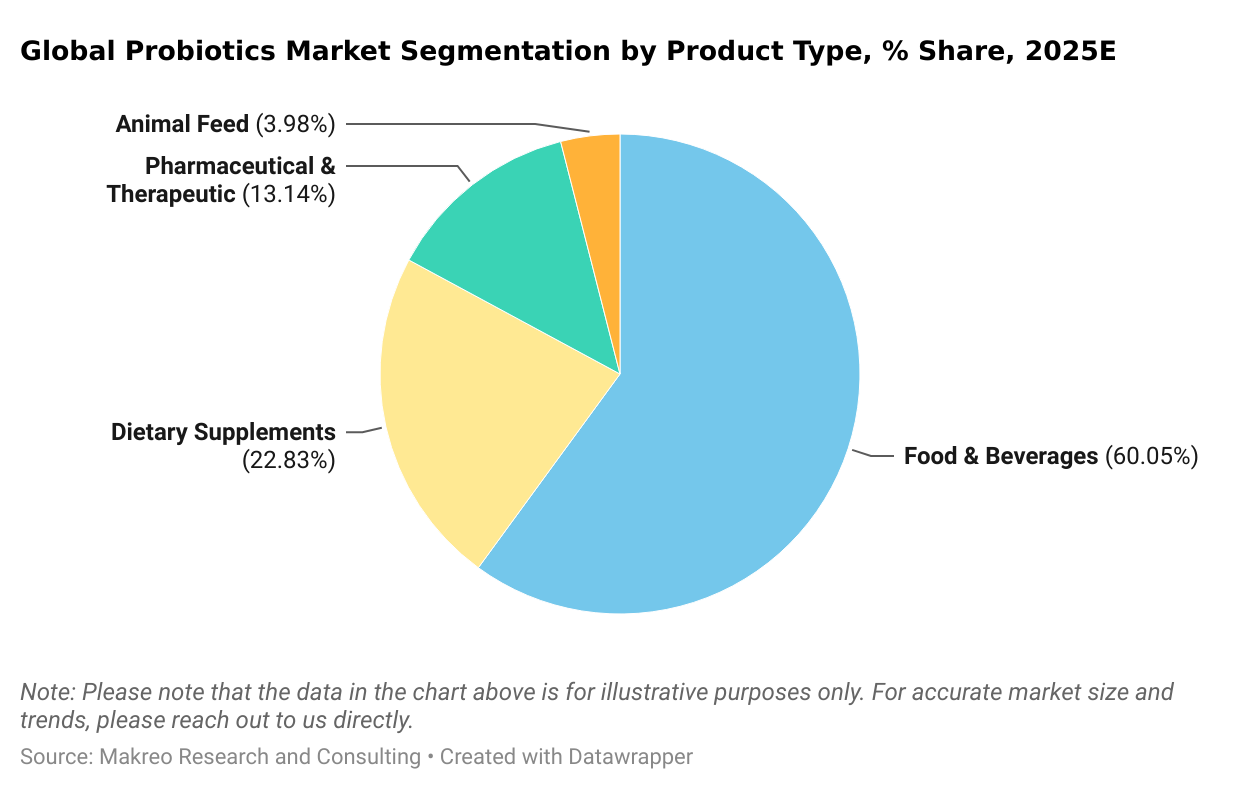
Global Probiotics Market Segmentation by Product Type and Application
The global probiotics market is primarily driven by the food & beverages segment, as consumers prefer daily intake through products such as yogurt and fermented drinks. The dietary supplements segment ranks second, fueled by increasing demand for probiotics offering targeted benefits for gut health and immunity, particularly in convenient formats like capsules and gummies. The pharmaceutical segment focuses on clinically supported probiotic strains used for managing conditions such as IBS. Although small, the animal feed segment is growing, with probiotics primarily used as natural growth enhancers for livestock.
Global Probiotics Market Companies Future Plans and Strategies
-
Yakult Honsha Co., Ltd.: The company’s Medium-Term Plan ("Shape Our Own Future") for 2025–2030 focuses on expanding its business domains, region-specific R&D, optimizing its channel mix, building a healthcare platform, and driving digital transformation to enhance its probiotics offerings.
-
Danone S.A.: Post-2025, Danone plans to intensify its focus on protein & gut health, medical nutrition, away-from-home channels, and geographic expansion. Key pillars of their strategy include science & innovation, portfolio discipline, and effective execution across markets.
Scope of the Study for Global Probiotics Market
Makreo Research has recently published a comprehensive report titled "Global Probiotics Market Size and Forecast (2021–2030) – Analysis by Product Type (Food & Beverages, Dietary Supplements, Animal Feed, Pharmaceuticals), Application, End User, Distribution Channel, and Geography Report", providing an in-depth evaluation of the rapidly evolving probiotics landscape across major regions, including Asia Pacific, North America, Europe, South America, and the Middle East & Africa.
The study begins by examining the historical and current performance of the probiotics market, focusing on key factors driving industry growth such as:
-
Evolving regulatory frameworks and product approval processes that shape innovation, product formulation, and global market entry.
-
Continuous technological advancements in probiotic strain development, formulation, and delivery systems that enhance product efficacy and drive higher consumer adoption.
-
Expanding probiotic applications across food and beverage, dietary supplements, and animal nutrition segments, reinforcing the sector’s role within the broader health and wellness industry.
Regional Insights and Global Probiotics Market Trends
The report presents an extensive regional and country-level analysis of the Global Probiotics Market, covering North America, Europe, Asia Pacific, the Middle East & Africa, and South America. It delivers a detailed evaluation of consumer behaviour, regulatory frameworks, market drivers, and competitive dynamics shaping regional growth.
-
Across key regions, the study highlights country-specific developments such as innovation in probiotic formulations, patent activity, pricing patterns, and the impact of evolving health awareness on probiotic consumption trends.
-
Further, it examines how dietary habits, disease prevalence, and consumer lifestyle shifts influence market performance in leading countries, including the United States, China, Japan, India, Germany, and Brazil.
Global Probiotics Market Competition and Strategies
The report provides an in-depth analysis of the competitive landscape within the Global Probiotics Market, profiling leading players across the value chain, including ingredient developers, formulation specialists, probiotic beverage manufacturers, and consumer goods companies.
-
Each company profile offers comprehensive insights into business models, product portfolios, R&D strengths, financial performance, and strategic initiatives driving competitive differentiation.
-
The study also explores the global mergers and acquisitions (M&A) environment, investment and funding patterns, and strategic partnerships that continue to redefine the Global Probiotics Industry structure and market positioning.
Future Outlook and Strategic Considerations
The report concludes with forward-looking insights on the structural shifts and strategic imperatives shaping the global probiotics market through 2030. It provides detailed projections of the market's revenue performance across key regions, including Asia Pacific, North America, Europe, South America, and the Middle East & Africa. The analysis highlights expected growth trends and regional demand variations that will influence the financial outlook of the probiotics industry throughout the forecast period.
-
2021 - 2025: Past and Present Scenario
-
2025: Base year of study
-
2026– 2030: Future Outlook
Global Probiotics Market Segmentation
-
Food & Beverages
-
Dietary Supplements
-
Animal Feed
-
Pharmaceutical & Therapeutic
-
Digestive Health
-
Immune System Support
-
Weight Management & Metabolism
-
Women’s Health (UTI, Vaginal Health)
-
Mental Health & Cognitive Function
-
Others
-
Infants & Children (Formula, Yogurts, Supplements)
-
Adults
-
Elderly
-
Pets & Livestock
-
Supermarkets & Hypermarkets
-
Specialty Stores / Health Stores
-
Pharmacies & Drugstores
-
E-commerce / Online Retail
-
Direct-to-Consumer / Subscription Models
Geography Assessed
-
North America: United States, Canada, Mexico.
-
Europe: Germany, France, United Kingdom, Spain, Italy.
-
Asia-Pacific: China, India, Japan, South Korea, Australia.
-
Middle East & Africa: Saudi Arabia, UAE, Qatar, Egypt, South Africa.
-
South America: Brazil, Argentina
-
Competition
-
Mergers, Acquisitions, and Investments
-
Funding Timeline
-
Company Profiles
Companies Covered in the Global Probiotics Market
-
Yakult Honsha CO. Ltd
-
Lifeway Foods Inc.
-
PepsiCo Inc. (Kevita)
-
Danone S.A.
-
Nestlé S.A.
There are 12 players covered in this report. To know more, please reach out to [email protected]
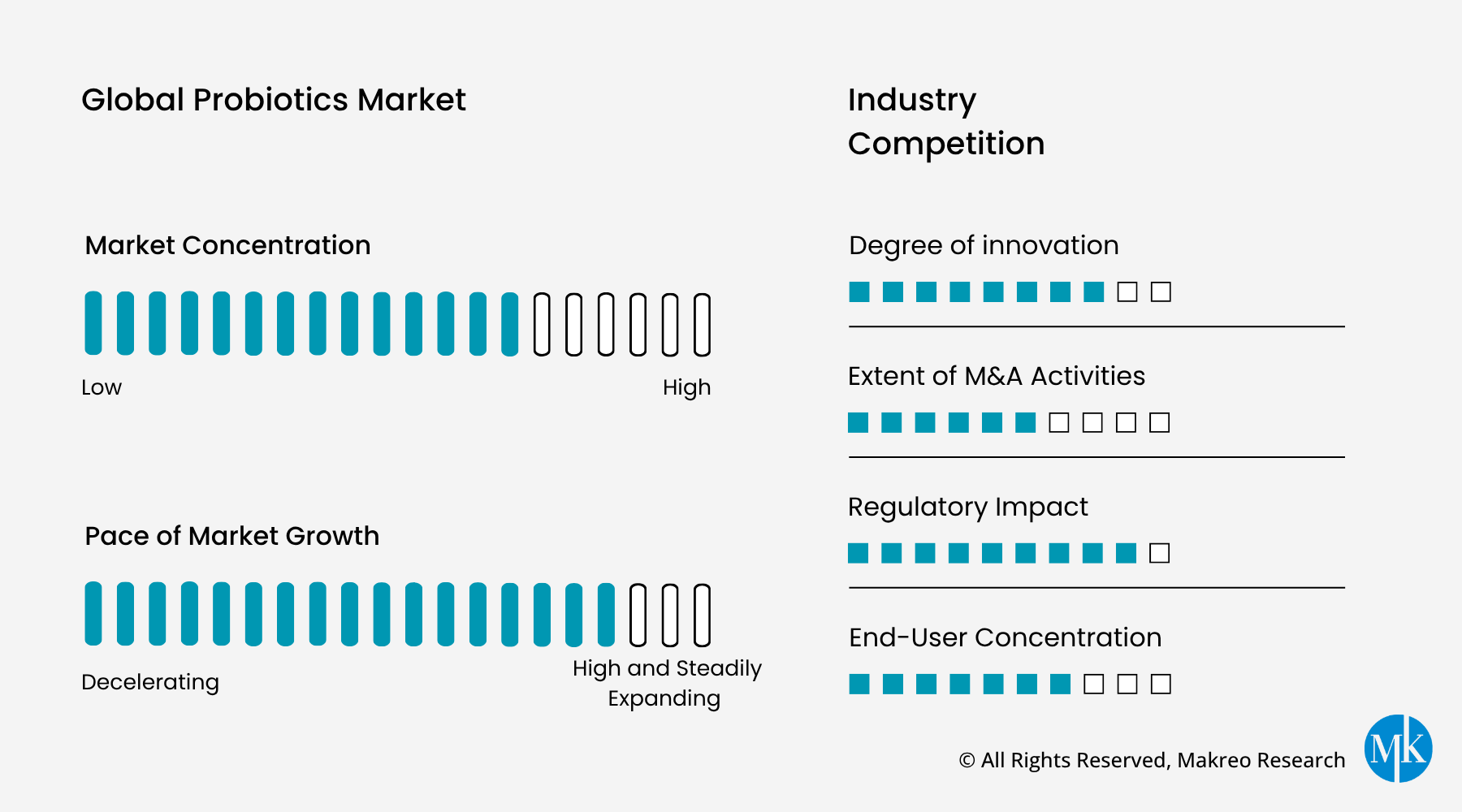
Looking for a Section from Report? Start your Partial Purchase Request
Table of Contents
- 1.Research Methodology
- 1.1.Research Objective
- 1.2.Global Probiotics Market Definitions
- 1.3.Research Design and Procedure
- 1.4.Data Collection Methods
- 1.5.Research Methodology
- 1.6.Analytical Framework
- 2.Global Probiotics Market Performance
- 2.1.Global Probiotics Market: An Overview
- 2.2.Key Government Regulations Concerning Global Probiotics Market
- 2.3.Technological Advancements in Global Probiotics Market
- 2.4.Application of Probiotics in Food Industries
- 2.5.Global Probiotics Market Performance
- 3.Global Probiotics Market Segmentation
- 3.1.Global Probiotics Market Segmentation
- 3.1.1.Global Probiotics Market Segmentation by Product Type
- 3.1.2.Global Probiotics Market Segmentation by Application / Health Benefit
- 3.1.3.Global Probiotics Market Segmentation by End User
- 3.1.4.Global Probiotics Market Segmentation by Distribution Channel
- 3.1.5.Global Probiotics Market Segmentation by Geography
- 3.1.Global Probiotics Market Segmentation
- 4.North America Probiotics Market Analysis
- 4.1.North America Probiotics Market Performance
- 4.2.North America Probiotics Market Segmentation
- 4.2.2.North America Probiotics Market Segmentation by Distribution Channel
- 4.2.3.North America Probiotics Market Segmentation by Geography
- 4.3.Recent Developments in the United States Probiotics Market
- 4.4.Recent Developments in Canada Probiotics Market
- 4.5.Recent Developments in Mexico Probiotics Market
- 5.Europe Probiotics Market Analysis
- 5.1.Europe Probiotics Market Performance
- 5.2.Europe Probiotics Market Segmentation
- 5.2.1.Europe Probiotics Market Segmentation by Product Type
- 5.2.2.Europe Probiotics Market Segmentation by Distribution Channel
- 5.2.3.Europe Probiotics Market Segmentation by Geography
- 5.3.Recent Developments in Europe Probiotics Market
- 5.4.Recent Developments in Germany Probiotics Market
- 5.5.Recent Developments in France Probiotics Market
- 5.6.Recent Developments in United Kingdom Probiotics Market
- 5.7.Recent Developments in Spain Probiotics Market
- 5.8.Recent Developments and Innovations in Italy Probiotics Market
- 6.Asia Pacific Probiotics Market Analysis
- 6.1.Asia Pacific Probiotics Market Performance
- 6.2.Asia Pacific Probiotics Market Segmentation
- 6.2.1.Asia Pacific Probiotics Market Segmentation by Product Type
- 6.2.2.Asia Pacific Probiotics Market Segmentation by Distribution Channel
- 6.2.3.Asia Pacific Probiotics Market Segmentation by Geography
- 6.2.3.1.Asia Pacific Probiotics Market by Geography
- 6.3.Recent Developments in China Probiotics Market
- 6.4.Recent Developments in India Probiotics Market
- 6.5.Recent Developments in Japan Probiotics Market
- 6.6.Recent Developments in South Korea Probiotics Market
- 6.7.Recent Developments in Australia Probiotics Market
- 6.8.Recent Developments in Probiotics Market in Other Asia Pacific Countries
- 7.Middle East and Africa and South America Probiotics Market Analysis
- 7.1.Middle East and Africa and South America Probiotics Market Performance
- 7.1.1.Middle East and Africa Probiotics Market Performance
- 7.1.2.South America Probiotics Market Performance
- 7.2.Middle East and Africa and South America Probiotics Supplement Market by Geography
- 7.3.Recent Developments and Innovations in Saudi Arabia Probiotics Market
- 7.4.Recent Developments and Innovations in UAE Probiotics Market
- 7.5.Recent Developments and Innovations in Qatar Probiotics Market
- 7.6.Recent Developments and Innovations in Egypt Probiotics Market
- 7.7.Recent Developments and Innovations in South Africa Probiotics Market
- 7.8.Regulations Concerning Probiotics Market in Middle East & Africa
- 7.9.Recent Developments in Brazil Probiotics Market
- 7.10.Recent Developments and Innovations in Argentina Probiotics Market
- 7.11.Regulations Concerning Probiotics Market in South America
- 7.1.Middle East and Africa and South America Probiotics Market Performance
- 8.Global Probiotics Market Competitive Landscape
- 9.Global Probiotics Market Mergers /Acquisitions/ Investments/ Divestments
- 9.1.Mergers /Acquisitions/ Investments/ Divestments
- 10.Global Probiotics Market Funding Timeline
- 10.1.Funding Timeline
- 11.Global Probiotics Market Beverage Focused Brands Company Profiles
- 11.1.Player 1 – Business Overview
- Company Timeline
- Business Highlights
- Business Financials
- 11.2.Player 2 – Business Overview
- Company Timeline
- Business Highlights
- Business Financials
- 11.3.Player 3 – Business Overview
- Company Timeline
- Business Highlights
- Business Financials
- 12.Global Probiotics Market Dairy and Consumer Products Company Profiles
- 12.1.Player 1 - Business Overview
- Business Highlights
- Business Financials
- 12.2.Player 2 - Business Overview
- Business Highlights
- Business Financials
- 12.3.Player 3 - Business Overview
- Business Highlights
- Business Financials
- 12.4.Player 4 - Business Overview
- Business Highlights
- Business Financials
- 13.Global Probiotics Market Ingredient Innovators/Suppliers Company Profiles
- 13.1.Player 1 - Business Overview
- Business Highlights
- Business Financials
- 13.2.Player 2 - Business Overview
- Business Highlights
- Business Financials
- 13.3.Player 3 - Business Overview
- Business Highlights
- Business Financials
- 13.4.Player 4 - Business Overview
- Business Highlights
- Business Financials
- 13.5.Player 5 - Business Overview
- Business Highlights
- Business Financials
- Limitations of the Study
Related Reports - Healthcare