
Europe Probiotics Market Size and Forecast (2019–2030) – Analysis by Product Type, Distribution Channel and Geography Report
Europe Probiotics Market Growth
The Europe probiotics market continues to exhibit strong growth, driven by increasing consumer awareness of gut health, a rising ageing population, and escalating demand for functional foods and dietary supplements. Europe’s well-defined regulatory environment, advanced food and beverage industries, and significant R&D investments have supported consistent innovation in probiotic formulations across multiple formats, including foods, drinks, and supplements. Key markets including Germany, France, the United Kingdom, Spain, and Italy dominate regional adoption, each reflecting distinct consumer patterns shaped by regulatory transparency, healthcare orientation, and shifting lifestyle trend.
Key Drivers Influencing Europe Probiotics Market Growth
-
Rising Emphasis on Preventive Healthcare and Wellness: European consumers are increasingly incorporating probiotics into their daily routines as part of a broader focus on preventive healthcare, gut health, and metabolic wellness.
-
Supportive Regulatory Environment and Market Acceptance: Regulatory flexibility across key markets such as France, Italy, and Spain now permit controlled use of the term “probiotic” on food and supplement labels.
-
Growing Demand for Personalized and Functional Probiotics: The market is witnessing a shift toward targeted probiotic solutions addressing specific conditions such as IBS, lactose intolerance, and skin health, driving strong adoption of premium probiotic adoption.
-
Ageing Population and Prevalence of Lifestyle Diseases: Europe’s ageing demographics and rising incidence of digestive disorders and lifestyle-related ailments are fostering greater consumption of probiotic-rich foods and dietary supplements
Europe Probiotics Industry Insights
Recent Developments and Strategic Investments in the Europe Probiotics Market
-
Lallemand Health Solutions – Launch of Cerenity (2025): At Vitafoods Barcelona 2025, Lallemand Health Solutions unveiled Cerenity, a next-generation multi-strain probiotic formulation designed to modulate the gut–muscle axis, supporting mobility, muscle strength, and healthy aging.
-
Naturacare – Product Portfolio Expansion (2024): Naturacare introduced four new probiotic formulations, Vital Extend, Bacti Serenity, Electrolytes, and Ovo Immune, during Vitafoods Europe 2024. The launch showcased the company’s comprehensive contract manufacturing and probiotic innovation capabilities.
-
Bioprox Healthcare – EUR 30 Million Capacity Expansion (2024): Bioprox Healthcare invested EUR 30 million for 100% increase in fermentation capacity, 65% increase in overall productivity and a state-of-the-art technology for bioreactors.
-
HeiQ – Probiotic Textile Innovation (2023): Swiss-based HeiQ launched a probiotics-infused textile concept for skin-microbiome benefits, an innovation that crosses probiotics into personal care / wearable delivery relevant to German retailers and cosmetics players.
-
Lac2Biome – Probiotic Skincare and B2B Blends (2021): Italian startup Lac2Biome developed a white-label skincare blend featuring live probiotics and custom B2B microbiome formulations for cosmetics and women’s health.
Consumer Behaviour Trends in the Europe Probiotics Market
-
Germany: German consumers exhibit high health consciousness but moderate awareness of probiotic benefits. The growing influence of e-commerce adoption and premium product preference.
-
France: Supported by probiotic-friendly regulations and clear labeling standards, France is witnessing steady market growth. The country shows increasing demand for lactose-free and metabolic-health-oriented probiotics.
-
United Kingdom: Social media influence and rising wellness awareness are significantly shaping consumer purchasing behavior in the United Kingdom probiotics market, with probiotic beverages witnessing strong growth as part of daily nutrition and gut health routines.
-
Spain: High consumer familiarity but moderate product differentiation remains a challenge. The prevalence of obesity and irritable bowel syndrome (IBS) continues to drive long-term demand in the Spain probiotics market.
-
Italy: A strong supplement culture and active involvement of healthcare professionals in recommending probiotics are key drivers of the Italy probiotics market. Rising lactose intolerance rates are further accelerating the shift toward non-dairy and plant-based probiotic products.
Digestive and Metabolic Health Driving Growth in the Europe Probiotics Market
Across Europe, the primary driver of probiotic consumption is the rising incidence of digestive disorders, obesity, and metabolic health issues. Conditions such as Irritable Bowel Syndrome (IBS), affecting nearly one in five adults in the United Kingdom and around 7–8% of Spain’s population, along with high lactose intolerance rates (up to 72% in Italy and 37% in France) have positioned gut health at the centre of consumer wellness priorities.
Consumers are increasingly turning to probiotics to manage bloating, digestive discomfort, and metabolic imbalances, while also supporting weight control and nutrient absorption.
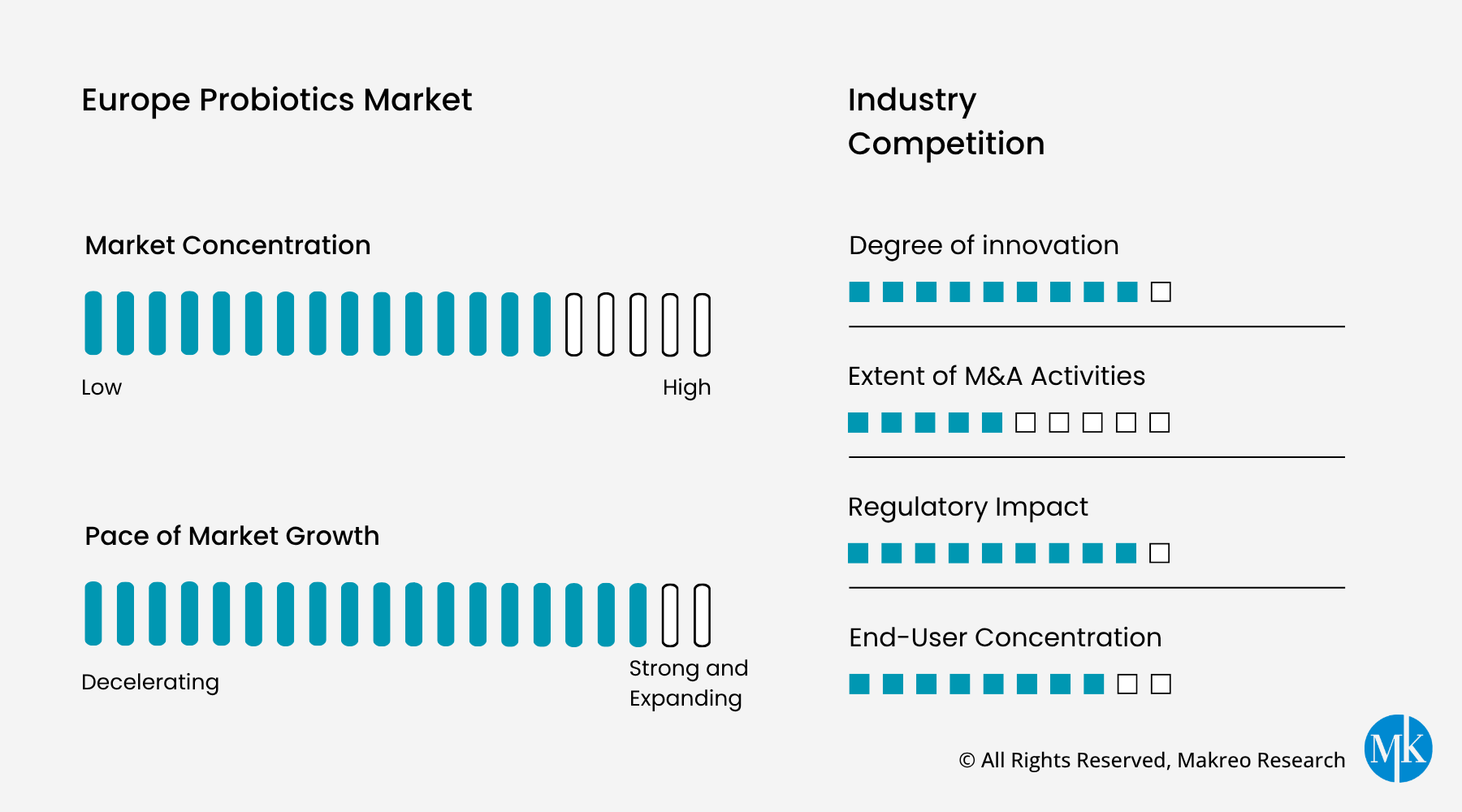
Scope of the Study for Europe Probiotics Market
Makreo Research has recently published a report titled “Europe Probiotics Market Size and Forecast (2019–2030) – Analysis by Product Type, Distribution Channel and Geography Report”, offering a comprehensive evaluation of the probiotic industry across major European economies like Germany, France, the United Kingdom, Spain, and Italy.
The study covers country-level market performance, segment analysis, and regulatory landscapes shaping growth dynamics through 2030, presenting insights into:
-
Recent Developments: Expansion of probiotic foods, beverages, and supplements across major European markets. Multi-strain formulations and functional probiotics targeting gut, immune, and metabolic health are increasingly common.
-
Government Regulations: The EU and national authorities have introduced structured regulations governing probiotic strain use, labelling, and permissible claims, enhancing consumer protection and ensuring compliance.
-
Innovations: New product formats, such as chewables, gummies, shelf-stable powders, and topical applications, are gaining traction. Dual-function and synbiotic formulations are particularly prominent in France, Germany, and Italy.
-
Patent Trends: Patent activity centers on novel probiotic strains for gut and skin health, encapsulation techniques, and plant-based food applications, with key filings by Biocodex and Chr. Hansen.
-
Pricing Trends: Probiotic supplements retail between EUR 12–30 per pack, while probiotic beverages typically range from EUR 1–3.5 per unit. Premium, clinically validated formulations command higher margins.
-
Consumer Behaviour: Europeans increasingly associate probiotics with daily wellness, digestive comfort, and immunity. However, awareness–action gaps persist, especially in Western markets like Germany and the UK.
-
Health Conditions Driving Demand: Obesity, IBS, lactose intolerance, and ageing-related gut microbiota imbalances are major drivers across the region.
Future Outlook for the Europe Probiotics Market
The Europe probiotics market is projected to sustain steady, innovation-driven growth through 2030, driven by personalized probiotics, sustainability trends, and the rise of non-dairy and vegan formulations are expected to define the next phase of market evolution.
-
2021 - 2025: Past and Present Scenario
-
2025: Base year of study
-
2026– 2030: Future Outlook
Europe Probiotics Market Segmentation
-
Food & Beverages
-
Dietary Supplements
-
Animal Feed
-
Supermarkets / Hypermarkets
-
Online (E-Commerce)
-
Pharmacies / Health Stores
-
Specialty / Other Stores
Geography Assessed
-
Western Europe
-
Eastern Europe
-
Northern Europe
-
Southern Europe
Looking for a Section from Report? Start your Partial Purchase Request
Table of Contents
- 1.Research Methodology
- 1.1.Research Objective
- 1.2.Europe Probiotics Market Definitions
- 1.3.Research Design and Procedure
- 1.4.Research Methodology
- 1.5.Analytical Framework
- 2.Europe Probiotics Market Analysis
- 2.1.Europe Probiotics Market Performance
- 2.2.Europe Probiotics Market Segmentation
- 2.2.1.Europe Probiotics Market Segmentation by Product Type
- 2.2.2.Europe Probiotics Market Segmentation by Distribution Channel
- 2.2.3.Europe Probiotics Market Segmentation by Geography
- 2.3Recent Developments in Europe Probiotics Market
- 3.Germany Probiotics Market Analysis
- 3.1.Recent Developments in Germany Probiotics Market
- 3.2.Regulations Concerning Probiotics Market in Germany
- 3.3.Recent Innovations in Germany Probiotics Market
- 3.4.Patent Trends in Germany Probiotics Market
- 3.5.Consumer Behavior Trends in Germany Probiotics Market
- 3.6.Consumer Nutrition Trends in Germany Probiotics Market
- 3.7.Animal Probiotics Trends in Germany Probiotics Market
- 4.France Probiotics Market Analysis
- 4.1.Recent Developments in France Probiotics Market
- 4.2.Regulations Concerning Probiotics Market in France
- 4.3.Recent Innovations in France Probiotics Market
- 4.4.Patent Trends in France Probiotics Market
- 4.5.Pricing Trends in France Probiotics Market
- 4.6.Consumer Behavior and Health Conditions Driving Probiotics Demand in France
- 4.7.Animal Probiotics Trends in France Probiotics Market
- 5.United Kingdom Probiotics Market Analysis
- 5.1.Recent Developments in United Kingdom Probiotics Market
- 5.2.Regulations Concerning Probiotics Market in United Kingdom
- 5.3.Recent Innovations in United Kingdom Probiotics Market
- 5.4.Patent Trends in United Kingdom Probiotics Market
- 5.5.Consumer Behavior Trends in the United Kingdom Probiotics Market
- 5.6.Health Conditions and Disease Correlation Driving Probiotics Demand in United Kingdom
- 6.Spain Probiotics Market Analysis
- 6.1.Recent Developments in Spain Probiotics Market
- 6.2.Regulations Concerning Probiotics Market in Spain
- 6.3.Recent Innovations in Spain Probiotics Market
- 6.4.Patent Trends in Spain Probiotics Market
- 6.5.Consumer Behavior Trends in the Spain Probiotics Market
- 6.6.Health Conditions and Disease Correlation Driving Probiotics Demand in Spain
- 7.Italy Probiotics Market Analysis
- 7.1.Recent Developments and Innovations in Italy Probiotics Market
- 7.2.Regulations Concerning Probiotics Market in Italy
- 7.3.Patent Trends in Italy Probiotics Market
- 7.4.Consumer Behavior Trends in the Italy Probiotics Market
- 7.5.Health Conditions and Disease Correlation Driving Probiotics Demand in Italy
- Limitations of the Study
Related Reports - Healthcare