India Co-living Market Performance and Future Outlook to 2025-An Impact Assessment of COVID-19
Overview
Executive Summary
The Co-living market in India has witnessed a sharp decline after the virus outbreak however the sector has recovered greatly and is looking more optimistic since the infection rate has decreased and restrictions have been eased. The rate of vaccination is one of the most important factors in the recovery, as more than 70% of the adult population has been fully vaccinated so far, and over 93% of the adult population has received at least one dose. The unemployment rate, on the other hand, fell to 7% in November 2021 from 11.84% in May 2021. India co-living market size crossed USD 200 Million in 2021 and is expected to grow at a double-digit rate in the coming years.
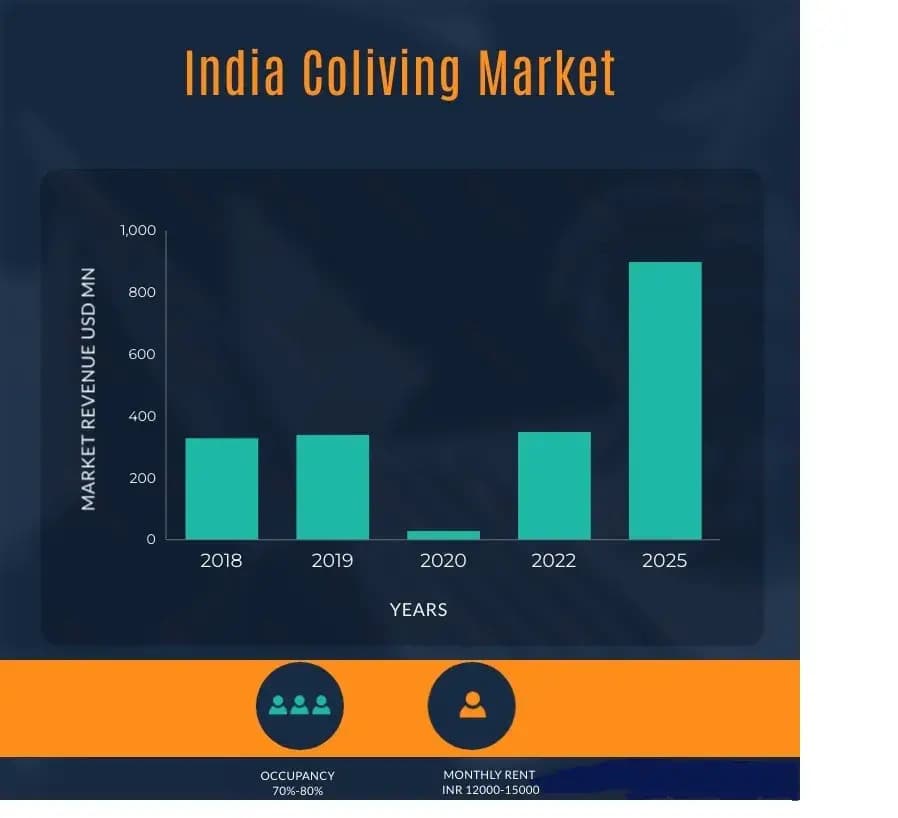
Impact of COVID-19: In 2020, the Co-living industry in India witnessed negative growth due to the implication of the lockdown but the market witnessed a gradual recovery during the end of 2020. Between December 2020 and March 2021, the Indian co-living market occupancy rate increased to 45-50% and 60-70% in Q4 2021.
But the second wave again had a negative impact on the market, however, the country's co-living sector is expected to recover completely by 2023.
Active Involvement of Real Estate Developers: Purchasing properties and then keeping them vacant for a long period of time was traditionally a standard practice among real estate market players. As a result, real estate prices have risen over the years, making housing unaffordable for people and forcing them to settle for substandard housing. This problem is largely being solved by companies who operate co-living spaces in India, and their partnerships with realty builders. Most players in the co-living business model in India generally operate on an asset-light model, in which realty developers set up built-to-suit properties which are further managed by the co-living spaces companies.
Implementation of Technology to Energize Co-living Market in India
The implementation of data analytics is being considered by industry players to find out the best products and services to match consumers’ needs and preferences. Feedback and behavioral patterns collected from mobile applications are being taken into account for making improvements in the operations and services provided. This leads to an enhanced user experience on mobile applications designed by the co-living spaces providers, enabling potential tenants to find the most suitable properties in significantly less time.
Emerging Model of Senior Housing
With a rise in demand for retirement homes, which is expected to rise exponentially in the next three decades due to a rise in the aging population of the country, Senior Living Housing will likely become an important residential asset class. The COVID-19 pandemic has further pushed the demand for housing for senior citizens. These factors are boosting the demand for co-living spaces in India.
Long-pending Infrastructure Projects Impacting India’s Co-living Market Growth
The co-living segment in India, including public sector projects or private sector housing colonies, has a large share of infrastructure projects that have exceeded their time and cost constraints. Major factors driving the delay in co-living developments in India are uneven funding and insufficient technologies, along with the protracted approval process being a huge challenge in the sector. Due to the lack of a single-window clearance option, the time taken for project approvals in the country ranges from days to years, resulting in time and cost escalations.
Scope of the Study
The following synopsis is based on the report "India Co-living Market- COVID-19 Impact and Outlook to 2027" published by Makreo Research and Consulting firm. The co-living market report delves deeply into various parameters such as India's co-living market size, segmentation, value chain analysis, and industry cause and effect analysis. The study includes market dynamics that provide an understanding of industry opportunities, driving forces, major challenges impeding growth, and an analysis of future opportunities in Co-living India that may help market players capitalize on untapped business potential in the specific geography.
The co-living market report helps the reader to gain information on the following areas:
- How India’s Co-living market has performed during the pre-covid scenario and what is the current state of the co-living industry in India?
- India's co-living market size has been assessed.
- What is the role of students in the Co-living market in India and what is the gap in the market for student accommodation?
- What all major factors are driving industry demand and how the Co-living market in India is shaping up?
- What was the impact of COVID-19 on the Co-living market in India?
- How Indian economy is performing after the virus outburst?
- What all challenges are present in the Co-living segment in India?
- What is the expected future of the Co-living market in India?
- What is the investment scenario in the Indian co-living market?
- Who are the major players in India’s Co-living market and their key performance areas?
Looking for a Section from Report? Start your Partial Purchase Request
Table of Contents
- Report Synopsis
- India Co-living Industry – An Overview
- 1.Research Methodology
- Objective of the Study
- Research Process
- Data Collection Methods
- Analytical Framework
- 2.India Co-living Space Market – EPTD Analysis
- EPTD Analysis - Economic Overview
- EPTD Analysis - Political Overview
- EPTD Analysis - Technological Overview
- EPTD Analysis - Demographic Overview
- 3.India Co-living Space Market – Macro Factors
- 4.India Co-living Space Market Analysis and Forecast
- India Co-living Space Market Evolution and History
- India Co-living Space Market Structure
- India Co-living Space Market – Key Facts
- India Co-living Space Market – Key Services Offered
- India Co-living Space Market Rentals
- Co-living Space vs Traditional Rental Space
- India Co-living Space Market Performance
- Impact of COVID-19 over India Co-living Space Market
- India Co-living Space Supply Facts
- India Co-living Space Market – Pre & Post COVID Scenario
- India Co-living Space Market Revenue & Forecast
- India Co-living Space Market –Increasing Investments
- India Co-living Space Market Potential
- 5.India Co-living Space Market- Competitive Landscape
- India Co-living Space Market – Key Players
- Presence of Co-living Space Companies by Major states in India
- India Co-living Space Market – Funding Timeline
- 6.India Co-living Space Market – Industry Dynamics
- Recent Trends & Developments
- Present & Future Opportunities
- Driving Forces
- Industry Challenges
- 7.Limitations of the Study
Related Reports - Services