India Fruit Pulp Market and Forecast to 2031 - Analysis by Fruit Type (Mango, Strawberry, Guava and Apple), Product Type (Frozen, Canned, Concentrated and Fresh Pulp), Application and Geography
India Fruit Pulp Market Size
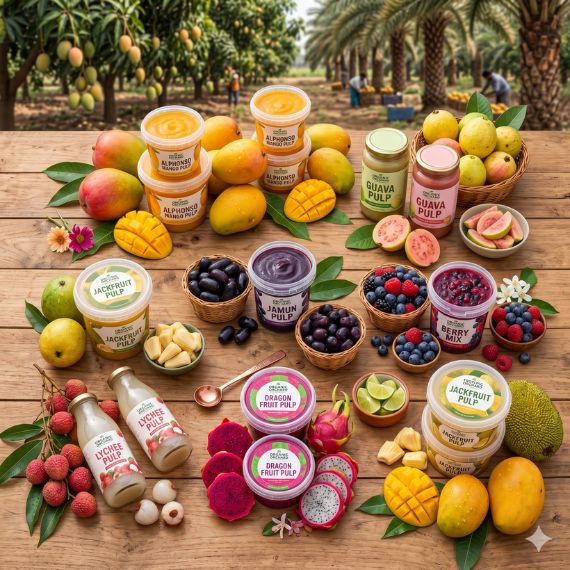
The India fruit pulp market has recorded robust growth in recent years, underpinned by abundant fruit production, rising demand from the beverage and dairy processing industries, and expanding export opportunities. India's position as one of the world's largest fruit producers has enabled the country to emerge as a significant supplier to both domestic and global food processing industries.
The market continues to benefit from increasing consumption of fruit-based beverages, desserts, and convenience food products, alongside growing investment in fruit processing infrastructure and value-added product development.
Key Drivers Shaping the India Fruit Pulp Market
Several structural, agricultural, and demand-side factors are accelerating growth across the India fruit pulp market, spanning raw material availability, export competitiveness, domestic consumption, and processing infrastructure development.
-
Abundant Fruit Production Underpinning India's Fruit Processing Industry - India ranks among the world's largest producers of fruits, with mangoes, bananas, and guavas forming the backbone of the country's raw material supply for the fruit pulp industry. Annual mango production exceeding 20 million tonnes ensures consistent feedstock availability for processors, supporting large-scale fruit pulp manufacturing across key production clusters and reinforcing the supply-side foundation of the India fruit pulp market.
-
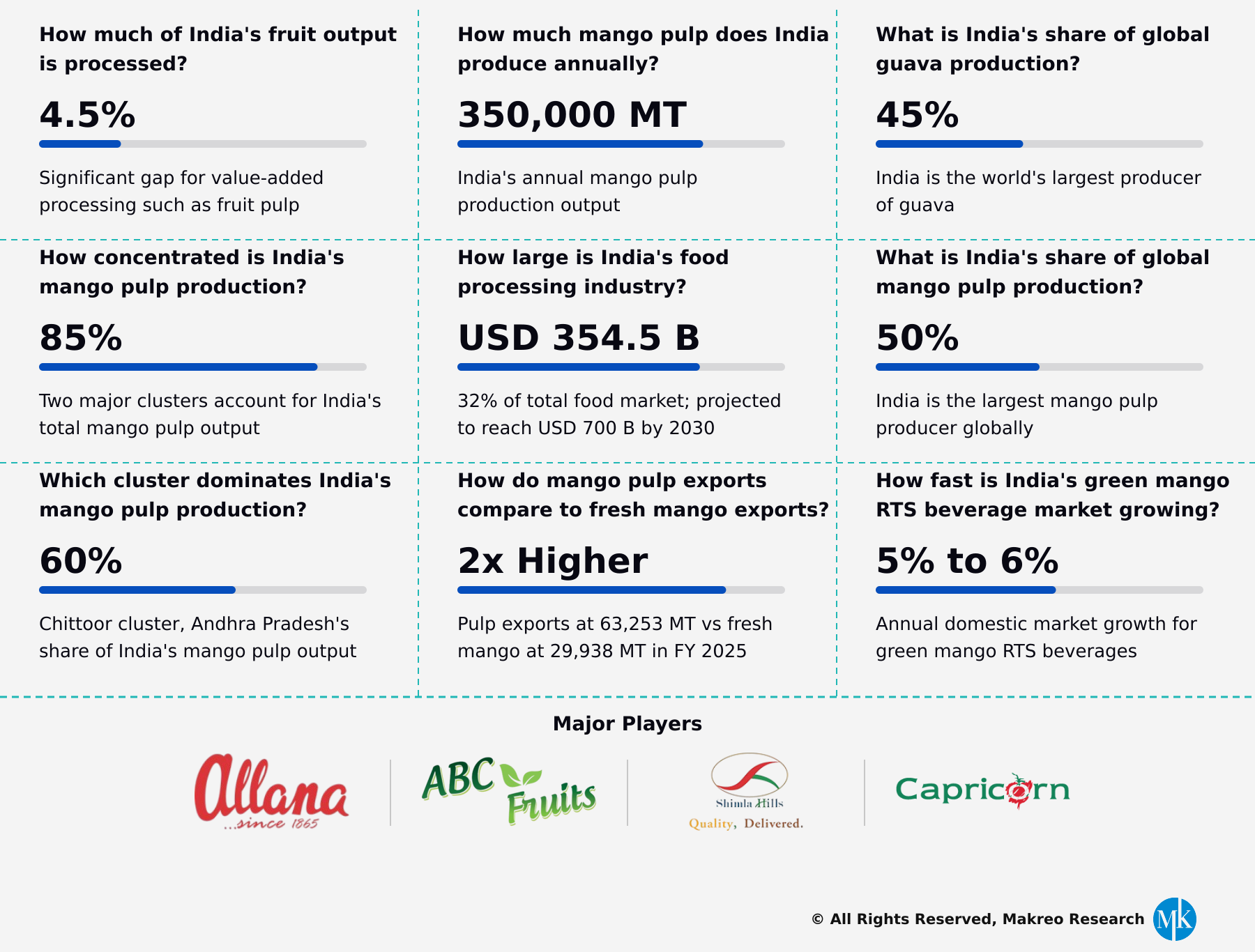
India's Dominance in Mango Pulp Production Driving Export Competitiveness - India accounts for nearly 50% of global mango pulp production. This dominant position has enabled the country to emerge as a leading exporter, with Indian mango pulp witnessing strong demand across the Middle East, Europe, North America, and Southeast Asia.
-
Rising Demand from Beverage and Processed Food Industries Boosting Domestic Consumption - Growing consumption of fruit-based beverages, dairy products, bakery items, confectionery, and ready-to-eat foods is significantly boosting domestic demand for fruit pulp. The expanding food processing industry is increasingly utilizing fruit pulp as a key ingredient in value-added product formulations.
-
Government Initiatives and Processing Infrastructure Investment Strengthening Market Development - Government initiatives under schemes such as the Pradhan Mantri Kisan SAMPADA Yojana and the Mega Food Parks programme are encouraging investments in fruit processing infrastructure. These initiatives are improving cold chain facilities, reducing post-harvest losses, and enhancing value addition across India's fruit processing ecosystem.
Scope of the Study for India Fruit Pulp Market
Makreo Research has published a comprehensive report "India Fruit Pulp Market and Forecast to 2031 - Analysis by Fruit Type (Mango, Strawberry, Guava and Apple), Product Type (Frozen, Canned, Concentrated and Fresh Pulp), Application and Geography" The study delivers an in-depth evaluation of India's fruit pulp industry, covering market evolution, structural demand trends, and forward-looking growth prospects through FY 2031.
The report opens by assessing the overall development of the India fruit pulp market, with particular focus on the structural elements and demand-side forces shaping industry trajectory, including:
India Fruit Pulp Market Revenue and Demand Analysis
-
The study provides a comprehensive analysis of India fruit pulp market revenue, covering both historical and current market performance.
-
Detailed segmentation is presented across fruit type, application, and product type, highlighting structural demand patterns and growth opportunities across major market segments.
-
Each segment is evaluated based on consumption trends, end-use applications, and evolving customer preferences across domestic and export markets.
India Mango Pulp Processing Industry Analysis
-
A dedicated section focuses on India's mango pulp processing industry, the largest segment within the broader fruit pulp market.
-
The report examines major mango processing clusters, including Chittoor, Krishnagiri, and the Konkan region, assessing production capacities, processing infrastructure, and regional competitive advantages.
-
Special attention is given to the rising popularity of green mango ready-to-serve beverages, which are increasingly supporting domestic mango pulp demand.
India Fruit Pulp Trade Performance and Export Analysis
-
The report provides a detailed assessment of India's processed fruit and juice exports, with a particular focus on fruit pulp trade.
-
It analyzes mango pulp export trends by volume and value, identifying key international markets and export destinations.
-
Country-wise export analysis highlights India's competitive positioning in the global fruit pulp trade and emerging market opportunities.
Competitive Landscape and Key Market Participants
-
A dedicated competitive benchmarking section compares leading fruit pulp producers based on production capacity, fruit variant portfolio, export reach, product offerings, and quality certifications.
-
Detailed company profiles provide insights into business operations, financial performance, strategic initiatives, and market positioning.
-
The report also examines recent mergers, acquisitions, investments, disinvestments, and capacity expansion activities shaping the competitive environment.
India Fruit Pulp Market Challenges and Opportunities
-
The study identifies key challenges affecting market growth, including seasonality in fruit availability, raw material price volatility, fragmented supply chains, and cold chain infrastructure limitations.
-
Simultaneously, it highlights emerging opportunities in aseptic processing, premium fruit variants, export market expansion, and value-added fruit ingredient applications.
India Fruit Pulp Market Future Outlook
-
The report concludes with detailed revenue forecasts for the India fruit pulp market through FY 2031.
-
Forecasts are presented by fruit type, application, and product type, supported by scenario analysis and market outlook assessments.
-
FY 2023 – FY 2026: Past and Present Scenario
-
FY 2026: Base year of study
-
FY 2026 – FY 2031: Future Outlook
India Fruit Pulp Market Segmentation
-
Mango
-
Strawberry
-
Guava
-
Apple
-
Others
-
Food
-
Beverage
-
Frozen pulp
-
Canned pulp
-
Concentrated pulp
-
Fresh pulp
-
Competition
-
Mergers, Acquisitions, and Investments
-
Company Profiles
India Fruit Pulp Industry Insights
India Fruit Pulp Market Revenue, FY 2023 – FY 2026
CAGR FY 2023 - FY 2026: 8.29%
Makreo Research
India Fruit Pulp Market - Rising Processed Food Demand and Export Expansion
The India fruit pulp market has recorded strong and consistent growth in recent years, driven by increasing demand from the beverage, dairy, bakery, and food processing industries alongside rising export shipments to global markets. Growing consumer preference for fruit-based ingredients, combined with expanding applications across packaged foods and ready-to-drink beverages, continues to reinforce market expansion. This growth trajectory is reflected in a CAGR of 8.29% during FY 2023–FY 2026, underscoring the sector's robust near-term growth potential.
India's strong fruit production base, leadership in global mango pulp exports, and ongoing investments in fruit processing infrastructure are further consolidating the market's long-term outlook and reinforcing the country's competitive positioning within the global fruit pulp and processed fruit ingredients market.
India Fruit Pulp Market Segmentation by Fruit Type, by Value, FY 2026
Makreo Research
Mango - Leading Fruit Type in the India Fruit Pulp Market
Mango holds the largest share of the India fruit pulp market by value, a position underpinned by India's vast mango production base, well-established processing infrastructure, and strong year-round demand from domestic and international food and beverage manufacturers.
India produces more than 20 million tonnes of mangoes annually, ranking as the world's largest mango producer. While only a relatively small proportion of total production undergoes processing, mango remains the most commercially significant fruit for pulp manufacturing due to its superior processing characteristics, broad industrial applications, and strong consumer preference across end-use categories. Robust export demand from key markets including the Middle East, the United States, and Europe further consolidates mango's leadership position within India's fruit pulp industry and mango pulp export market.
India Fruit Pulp Market Key Players by Production Capacity
Makreo Research
Companies Covered in the India Fruit Pulp Market
-
Allanasons Private Limited
-
ABC Fruits
-
Shimla Hills Offerings Pvt. Ltd.
-
Capricorn Food Products India Limited
-
Varun Agro Processing Foods Limited
The study covers a total of 14 India Fruit Pulp Market Company Profiles. To know more, please reach out to [email protected]
What are the major growth drivers of the India fruit pulp market? +
What are the key trends in India's mango pulp processing industry? +
Who are the key players in the India fruit pulp market? +
How is the fruit pulp market structured in terms of processing, distribution, and export? +
What is the India fruit pulp market outlook through FY 2031? +
Looking for a Section from Report? Start your Partial Purchase Request
Table of Contents
- 1.Research Methodology
- 1.1.Research Objective
- 1.2.Research Design and Procedure
- 1.3.Data Collection Methods
- 1.4.Research Methodology
- 1.5.Analytical Framework
- 2.India Fruit Pulp Market Analysis
- 2.1.India Fruit Pulp Market Overview
- 2.2.India Fruit Pulp Market Past and Present Performance
- 2.3.Government Interventions Supporting India Fruit Processing Sector in India
- 2.4.India Fruit Pulp Market Segmentation
- 2.4.1.India Fruit Pulp Market Segmentation by Fruit Type
- 2.4.2.India Fruit Pulp Market Segmentation by Application
- 2.4.3.India Fruit Pulp Market Segmentation by Product Type
- 3.India Mango Pulp Processing Industry Analysis
- 3.1.India Mango Pulp Processing Industry Insights
- 3.2.India Mango Pulp Processing Industry Key Clusters Analysis
- 3.3.Green Mango RTS Beverages Driving Domestic Mango Pulp Demand in India
- 4.India Fruit Pulp Trade Performance
- 4.1.India Export of Processed Fruits and Juices
- 4.1.1.India’s Fruit Pulp or Fruit Juice Based Drinks Trade Trends
- 4.1.2.India’s Mango Pulp Exports by Volume and Value
- 4.1.2.1.India Mango Pulp Exports by Countries/Regions
- 4.1.India Export of Processed Fruits and Juices
- 5.India Fruit Pulp Market Competitive Landscape
- 5.1.India Fruit Pulp Market Players Comparison by Production Capacity
- 5.2.India Fruit Pulp Market Players Comparison by Fruit Variant Portfolio
- 5.3.Global Export Reach of Leading India Fruit Pulp Producers
- 5.4.India Fruit Pulp Market Players Comparison by Fruit Pulp Portfolio
- 5.5.India Fruit Pulp Market Players Certifications
- 6.India Fruit Pulp Market Mergers /Acquisitions/ Investments/ Disinvestments
- 6.1.Mergers /Acquisitions/ Investments/ Disinvestments
- 7.India Fruit Pulp Market Company Profiles
- 7.1.Player 1 - Business Overview
- 7.1.1.Business Financials
- 7.2.Player 2 - Business Overview
- 7.2.1.Company Timeline
- 7.2.2.Business Financials
- 7.3.Player 3 - Business Overview
- 7.3.1.Company Timeline
- 7.3.2.Business Highlights
- 7.3.3.Business Financials
- 7.4.Player 4 - Business Overview
- 7.5.Player 5 - Business Overview
- 7.6.Player 6 - Business Overview
- 7.6.1.Business Highlights
- 7.7.Player 7 - Business Overview
- 7.7.1.Business Financials
- 7.8.Player 8 - Business Overview
- 7.8.1.Company Timeline
- 7.9.Player 9 - Business Overview
- 7.9.1.Business Financials
- 7.10.Player 10 - Business Overview
- 7.11.Player 11 - Business Overview
- 7.11.1.Business Financials
- 7.12.Player 12 - Business Overview
- 7.12.1.Business Financials
- 7.13.Player 13 - Business Overview
- 7.14.Player 14 - Business Overview
- 7.14.1.Company Timeline
- 7.1.Player 1 - Business Overview
- 8.India Fruit Pulp Market Challenges
- 8.1.India Fruit Pulp Market Challenges Overview
- 8.1.1.India Fruit Pulp Market Challenges
- 8.1.India Fruit Pulp Market Challenges Overview
- 9.India Fruit Pulp Market Opportunities
- 9.1.India Fruit Pulp Market Opportunities Overview
- 9.1.1.India Fruit Pulp Market Opportunities
- 9.1.India Fruit Pulp Market Opportunities Overview
- 10.India Fruit Pulp Market Future Outlook
- 10.1.India Fruit Pulp Market Future Outlook
- 10.1.1.India Fruit Pulp Market Revenue Forecast by Fruit Type
- 10.1.2.India Fruit Pulp Market Revenue Forecast by Application
- 10.1.3.India Fruit Pulp Market Revenue Forecast by Product Type
- 10.2.India Fruit Pulp Market Scenario Analysis
- 10.1.India Fruit Pulp Market Future Outlook
- Limitations of the Study
Related Reports - Food and Beverages