
Australia Battery Energy Storage Market Surges 233% as Global BESS Demand Tops 315GWh - Why Grid Reliability Is Fueling Investment
Australia's rise as a top-three BESS market highlights the growing role of battery storage in grid stability, energy security, and renewable integration.
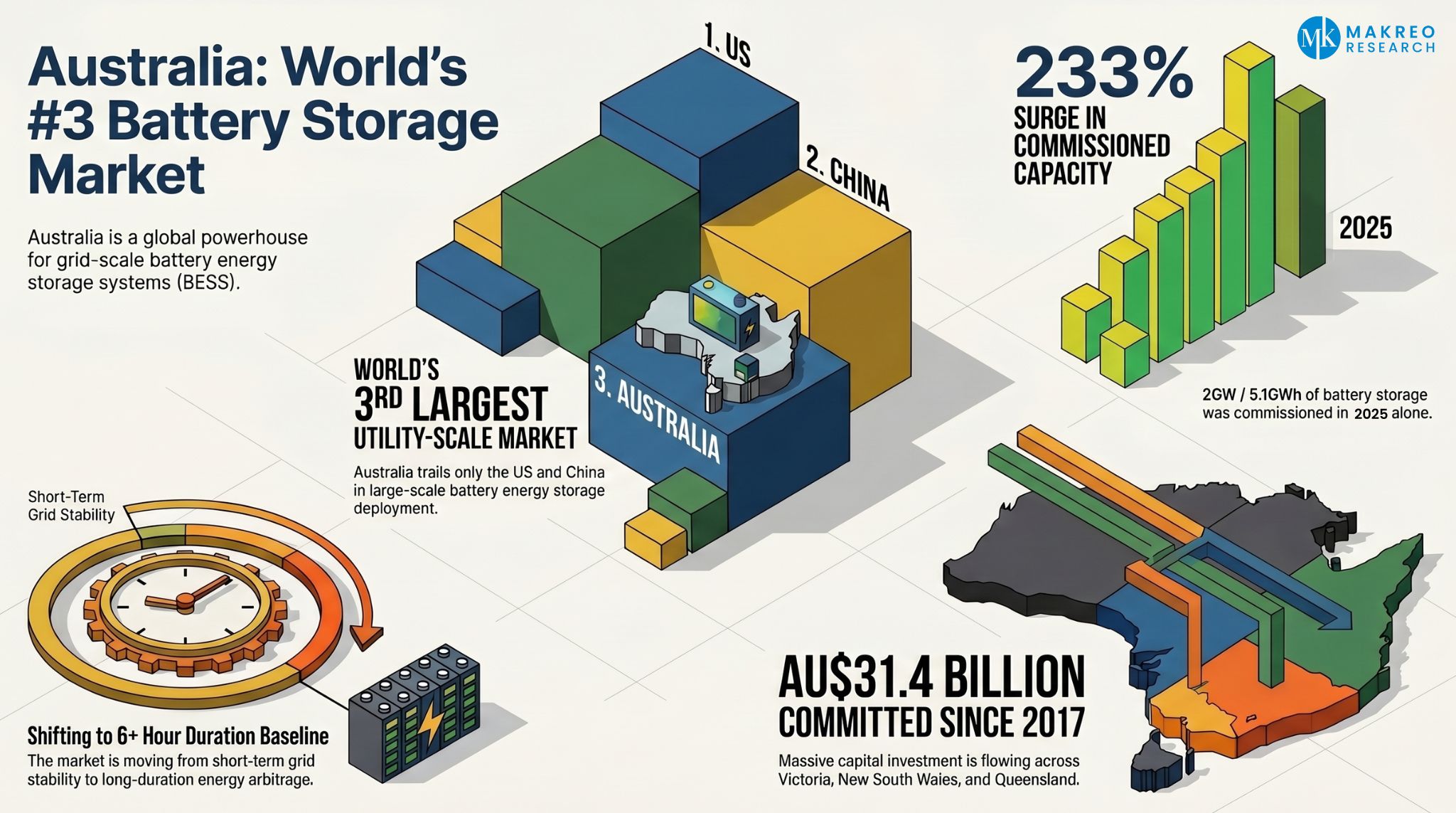
Australia has become one of the world's most important battery storage markets. By the end of 2025, the country ranked third globally for utility-scale battery energy storage deployment, behind only China and the United States. Yet Australia's battery boom is no longer being driven solely by renewable energy targets.
The real driver is far more fundamental: grid survival.
As coal-fired power stations retire, renewable penetration accelerates, and fuel security concerns intensify, battery energy storage systems (BESS) have become critical infrastructure for maintaining electricity reliability, system stability, and long-term energy security.
The numbers reflect this shift. Australia commissioned 2GW/5.1GWh of battery storage capacity in 2025 alone, representing a 233% year-on-year increase, while large-scale battery investment commitments reached 4.3GW during the year.
Why Australia's Grid Now Depends on Battery Storage
Australia's electricity market is undergoing one of the fastest energy transitions anywhere in the world.
Renewables now account for approximately 43% of electricity generation across Australia's grid, while coal-fired power stations continue to retire. While renewable energy provides cleaner electricity, it also changes the way power systems operate.
Historically, coal and gas generators supplied not only electricity but also the synchronous inertia needed to maintain voltage and frequency stability. As these assets leave the system, grid operators must find alternative ways to maintain reliability.
This is where battery storage has become indispensable.
Modern Battery Energy Storage Systems equipped with grid-forming inverter technology can establish and regulate voltage and frequency independently, allowing electricity systems to operate securely with significantly lower levels of conventional generation online.
According to industry estimates, approximately 74% of battery projects currently in the National Electricity Market (NEM) pipeline are expected to incorporate grid-forming capabilities. Increasingly, batteries are being commissioned before associated solar and wind assets because they provide the system support required for renewable projects to operate effectively.
South Australia provides one of the clearest examples of this transformation. In 2024, renewable sources supplied 100% of the state's electricity demand for approximately one-third of the year. Achieving higher levels of renewable penetration has required significant investments in storage infrastructure, including a 700MW long-duration storage tender aimed at supporting future grid reliability.
Battery storage is no longer being deployed because renewables need support. Increasingly, renewables are being deployed because battery storage can provide the stability needed for them to operate.
The Numbers Behind Australia's Battery Storage Expansion
The deployment figures illustrate how rapidly the market is scaling.
The Clean Energy Council's 2026 industry data shows that Australia commissioned 2GW/5.1GWh of battery storage capacity in 2025, representing a 233% year-on-year increase. Large-scale BESS commitments reached 4.3GW during the same year.
Investment activity has been spread across multiple states:
-
Victoria attracted AU$8.4 billion across 4,256MW.
-
New South Wales secured AU$7.3 billion across 6,100MW.
-
Queensland recorded AU$7.1 billion across 4,910MW.
-
Western Australia attracted AU$4.6 billion across 2,246MW.
-
South Australia secured AU$3.4 billion across 2,769MW.
Operational records established during early 2026 demonstrate how deeply battery systems are now integrated into electricity markets.
Queensland became the first NEM state to discharge more than 100GWh from battery storage within a single month. On 9 May 2026, Western Australia's battery fleet supplied 37.2% of peak demand, representing one of the highest battery penetration levels ever recorded in an isolated grid. Meanwhile, New South Wales reached 1,240MW of charging power, reflecting a 72.5% year-on-year increase.
These milestones illustrate that battery storage is transitioning from a supporting technology into a core component of electricity system operations.
AEMO Data Shows Batteries Are Already Reshaping the Grid
The impact of battery deployment is no longer theoretical.
The Australian Energy Market Operator's (AEMO) Q3 2025 data demonstrates how battery storage is already changing market dynamics, reducing emissions, and improving grid reliability.
Between Q3 2024 and Q3 2025:
-
2,936MW of new battery capacity entered the NEM.
-
Storage capacity increased by 6,482MWh.
-
Average battery discharge rose by 150% year-on-year.
-
Evening peak battery output increased by 177%.
-
Battery dispatch reduced gas generation by 11%.
-
Hydro generation declined by 3.5% during peak periods.
Battery systems also became increasingly dominant within ancillary service markets, accounting for as much as 77% of Frequency Control Ancillary Services (FCAS) volumes in some regions.
The broader market impact has been equally significant.
Average wholesale electricity prices fell to AU$87/MWh, representing a 27% decline compared with Q3 2024. Price volatility also declined sharply, while emissions intensity reached record lows.
At the same time, solar curtailment continued increasing, highlighting a new challenge. Daytime renewable generation is growing faster than existing storage capacity can absorb, reinforcing the need for additional battery deployment across the system.
How Australia's Battery Business Model Is Evolving
Australia's battery market has evolved considerably since its early development phase.
The first generation of utility-scale battery projects was largely built around Frequency Control Ancillary Services (FCAS). These markets provided attractive revenue opportunities and helped justify initial investments in large-scale storage assets.
However, as battery deployment increased, FCAS markets matured and competition intensified.
Today's investment case increasingly revolves around energy arbitrage.
Developers are using batteries to store excess solar generation during low-price daytime periods and discharge electricity during evening demand peaks when prices are significantly higher. This shift is encouraging the deployment of larger and longer-duration battery assets capable of capturing value across multiple market windows.
As a result, the industry is moving beyond traditional two-hour systems.
Four-hour storage assets have become the new standard, while projects offering six hours or more of duration are increasingly being viewed as the preferred configuration for project financing and long-term revenue optimization.
Three Battery Storage Segments Reshaping Australia's Energy Market
Australia's battery storage market is evolving across three distinct segments, each driven by different commercial and operational dynamics.
Utility-Scale Grid Storage: The Shift to Longer Duration
Utility-scale projects account for the majority of installed storage capacity. As FCAS revenues decline, developers are increasingly focusing on energy arbitrage, driving a shift from 2-hour systems to longer-duration assets. While 4-hour batteries became the industry standard in recent years, projects with 6 hours or more of storage are now emerging as the preferred option for securing project finance.
This trend is also encouraging technology diversification beyond lithium-ion, including sodium-ion, flow batteries, liquid air storage, and modular pumped hydro. However, industry experts caution that Australia's project pipeline remains heavily concentrated in lithium-ion technology. The country's largest operational battery project, Synergy's 2.4GWh Collie BESS in Western Australia, reflects the growing scale of utility-scale deployments.
Distributed Storage: The Rise of Virtual Power Plants
Australia's distributed energy market continues to expand, supported by more than 3.6 million rooftop solar installations and over 6.3GWh of residential battery capacity. Around 400,000 households with solar-plus-storage systems are already achieving substantial reductions in electricity costs.
When aggregated through virtual power plants (VPPs), residential batteries can participate in wholesale electricity markets, often supplying power at near-zero marginal cost. This growing distributed resource base is increasing competition for utility-scale assets while attracting significant institutional investment, as demonstrated by the AU$2 billion Aware Super–Birdwood transaction.
Battery-Led Hybrid Projects: A New Development Strategy
A third model is gaining momentum: battery-led hybrid development. Rather than constructing solar and storage assets simultaneously, developers are building battery systems first, typically with 4–6 hours of duration, supported by tolling agreements that improve project bankability. Solar generation is added later once cost assumptions and wholesale power market conditions become clearer.
The strategy reflects ongoing uncertainty around future electricity pricing as storage penetration increases. By prioritizing battery deployment, developers can capture immediate market opportunities while retaining flexibility for future renewable expansion.
Although regional market conditions differ, Australia remains the clearest indicator of how battery storage economics, technology requirements, and revenue models are likely to evolve across Asia-Pacific over the coming decade.
Battery Storage Is Becoming an Energy Security Asset
Battery storage is increasingly being viewed as a strategic response to Australia's energy security vulnerabilities.
Australia imports more than 90% of its refined fuels, leaving the country highly exposed to geopolitical disruptions, shipping constraints, and global oil market volatility. In early 2026, petrol prices reached 253.4 cents per litre while diesel prices exceeded AU$3 per litre, creating significant economic pressure for consumers and businesses.
Renewable energy combined with battery storage is beginning to reduce this exposure.
According to Climate Council estimates, renewable energy and battery storage had displaced approximately 30 petajoules of gas consumption in Australia's main electricity grid by February 2026. During the recent summer period, solar, wind, and battery resources also contributed to a 30% reduction in wholesale electricity prices compared with the previous year.
The impact extends beyond electricity generation.
Australia now has approximately 1.3 million electric and hybrid vehicles on the road, reducing fuel consumption by nearly 15 million litres per week. During the March fuel price spike, EV and hybrid owners collectively avoided approximately AU$50 million in additional fuel expenses.
As energy security concerns intensify, batteries are increasingly being viewed as strategic infrastructure rather than simply renewable energy assets.
What Australia's Experience Means for Asia-Pacific
Australia has become the most mature utility-scale battery storage market in the Asia-Pacific region.
As a result, it is increasingly serving as a reference point for other markets undergoing similar transitions.
Industry participants across India, Japan, the Philippines, China, and other regional markets are studying Australia's experience as they expand battery deployment and integrate higher levels of renewable generation. According to industry leaders, project sizes have expanded rapidly, with developments evolving from early-stage 10–30MWh systems to projects exceeding 500MWh.
Australia is also ahead of many regional markets in terms of revenue evolution. While several countries continue to rely heavily on ancillary service revenues, Australian developers have already shifted toward energy arbitrage and long-duration storage business models.
The lessons emerging from Australia today are likely to shape battery deployment strategies across Asia-Pacific over the coming decade.
Australia's Role in the Next Phase of Global BESS Growth
Australia's battery expansion is taking place within a rapidly growing global market.
According to Benchmark Mineral Intelligence, approximately 315GWh of battery energy storage capacity was deployed globally in 2025, representing nearly 50% year-on-year growth. Grid-scale projects accounted for almost 240GWh of total deployments, while 46 giga-scale projects were commissioned during the year. More than 150 additional giga-scale projects are expected to enter development or operation during 2026.
China and the United States continue to dominate global deployment volumes, but Australia has firmly established itself among the world's leading battery storage markets alongside emerging leaders such as Saudi Arabia and Chile.
Benchmark Mineral Intelligence expects global BESS additions to exceed 450GWh during 2026, supported by expanding manufacturing capacity and growing project pipelines. Demand from stationary storage applications is now growing faster than EV battery demand, highlighting the sector's increasing importance within the broader battery value chain.
Australia's BESS Market Outlook Through 2031
The direction of Australia's BESS market is not in question. What remains open is whether policy and transmission infrastructure can keep pace with commercial and grid-driven demand that is already materialising.
The Global BESS Market is estimated to record a CAGR of 31.50% during 2023–2026, according to Makreo Research, with approximately 108GW of new storage capacity added globally in 2025. Australia is positioned to capture a sustained share of this global growth through a combination of genuine grid necessity, maturing regulatory frameworks, and one of the deepest BESS project pipelines outside China and the US.
Through 2031, the market will be shaped by:
- Continued shift to 6-hour-plus storage duration as the commercial standard
- Technology diversification beyond lithium-ion as longer durations improve the economics of alternatives
- Hybrid project structures becoming the standard NEM development model
- Consolidation among IPPs around low-cost institutional capital
- Transmission expansion determining which pipeline projects actually proceed
Tasmania's 98.3% renewable energy penetration in 2025 shows what is achievable. Whether the rest of the NEM can replicate it at larger scale, and on what timeline - is the question that will define Australia's electricity system through the decade.
Australia's battery storage market is moving faster than syndicated data can track. Decisions around technology selection, project positioning, offtake structures, grid connection strategy, investment timing, and geographic expansion require research that is current, primary, and tailored to specific business objectives.
Makreo Research and Consulting works with utility-scale developers, battery technology suppliers, private equity investors, grid operators, and energy strategy teams across the BESS and broader clean energy ecosystem.
Our custom research engagements support:
- Market Entry and Opportunity Assessment
- Competitive Landscape Benchmarking
- Capacity Investment Scheme (CIS) Impact Analysis
- Offtake and Revenue Model Research
- Long-Duration Storage Technology Assessment
- Go-to-Market Strategy Development
- Primary Market Surveys and Stakeholder Interviews
We also publish related reports in the Solar PV and Energy Storage space, including studies on the Asia Pacific Solar PV Market, Global Solar PV Market, India Solar PV Market, Malaysia Solar Energy Market, and China Solar PV Market. For a full list, visit the Makreo Energy and Utilities Report Store.
If the decisions your organisation is making in Australia's BESS market matter, the research informing them should be built around those decisions specifically.
Contact our research team to discuss your requirements:
Custom Research | Market Surveys
Makreo Research and Consulting provides global market intelligence reports, custom research, and consumer market surveys across energy, utilities, clean technology, and adjacent sectors. To discuss your market entry, expansion strategy, or competitive benchmarking needs, contact us at [email protected].
Australia Battery Energy Storage Market, Australia BESS Market, Australia Battery Storage Market, Battery Energy Storage System Market, Australia Energy Storage Market, Global BESS Market, Global Battery Energy Storage Market, Battery Storage Market Size, Battery Storage Market Growth, Battery Storage Market Forecast, Battery Storage Industry Outlook, Utility Scale Battery Storage Market, Grid Scale Battery Storage Market, Long Duration Energy Storage Market, Energy Storage Market Trends, Battery Storage Investment, Battery Storage Project Development, Renewable Energy Storage Market, Australia Renewable Energy Market, Grid Reliability Australia, Energy Security Australia, National Electricity Market Australia, Distributed Energy Resources Australia, Virtual Power Plants Australia, Grid Forming Inverters, Energy Storage Infrastructure, Battery Storage Competitive Landscape, Battery Storage Market Analysis, Battery Storage Market Research, Australia Energy Transition Market