
How Vision Care Demand, Smart Eyear Innovation, and Digital Retail Are Transforming India’s Eyewear Market
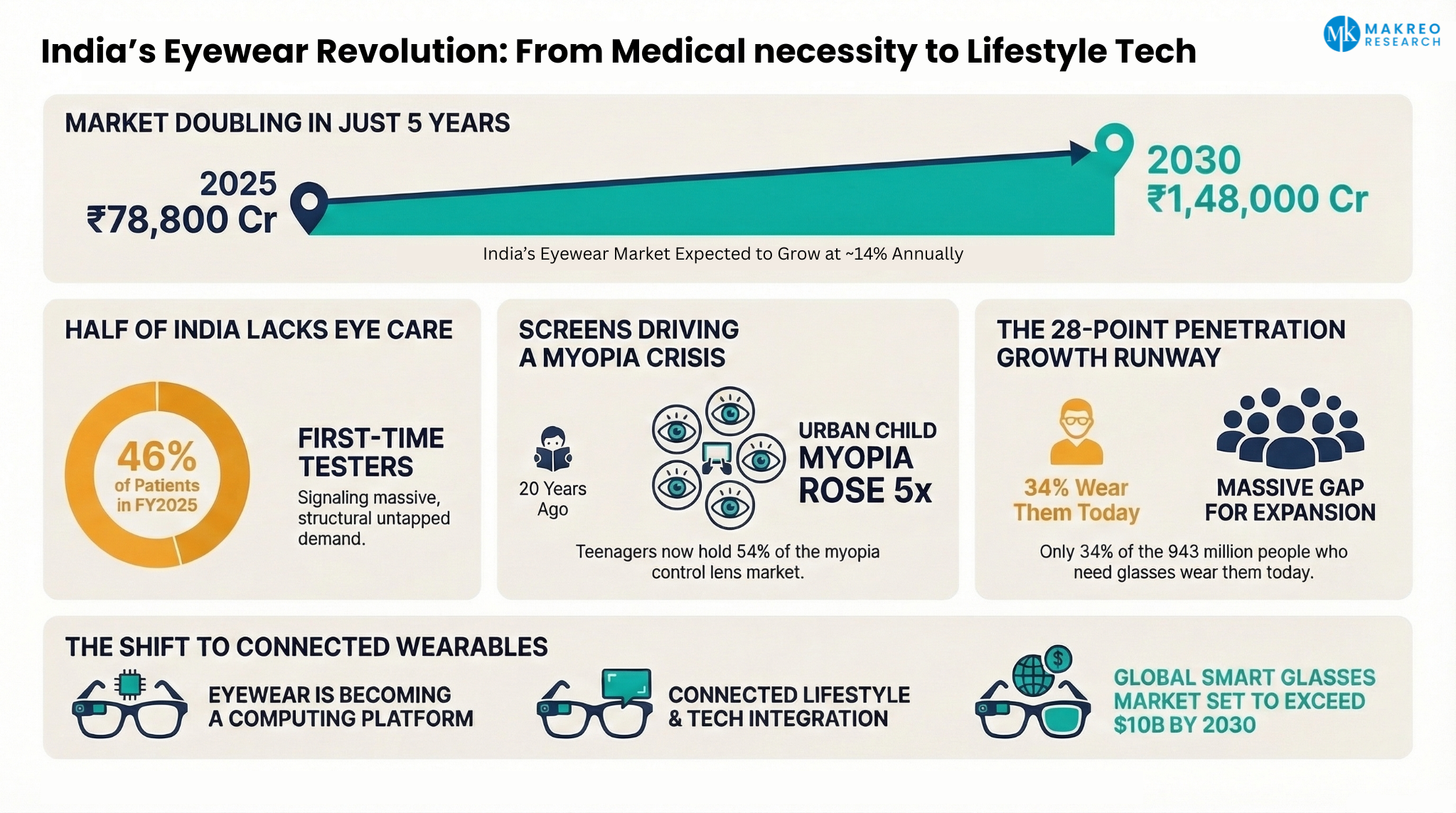
India’s eyewear market is projected to grow ~14% annually, driven by rising vision care needs, screen exposure, smart glasses innovation, and the rapid expansion of e-commerce retail.
India’s Eyewear Market Transformation
For decades, eyewear in India was largely viewed as a functional healthcare product, purchased when vision deteriorated and replaced only when necessary. That perception is now changing rapidly.
Eyewear is evolving into a hybrid category that sits at the intersection of healthcare, fashion, and consumer technology. Prescription glasses are no longer simply corrective devices; they are increasingly lifestyle accessories, digital health tools, and, in some cases, connected wearable devices. This transformation is supported by strong market expansion.
Industry estimates suggest that India’s eyewear market, valued at approximately ₹78,800 crore in 2025, is projected to grow at an annual rate of around 14% through 2030. Rising screen exposure, greater awareness of vision health, and growing adoption of fashion eyewear are collectively accelerating demand across both prescription and non-prescription segments.
What is clear, however, is that the next phase of India’s eyewear market will be shaped by three powerful forces:
healthcare-driven demand, smart eyewear innovation, and digitally enabled retail models.
Increasing Vision Problems Drive India’s Eyewear Market Growth
Despite the increasing role of fashion and technology, the eyewear industry remains fundamentally driven by healthcare demand. Rising cases of refractive errors, including myopia, hyperopia, and astigmatism, continue to expand the need for vision correction across the country.
By 2030, India’s population is expected to reach 1.516 billion, with roughly 62% of individuals requiring some form of vision correction. This would translate into nearly 943 million people potentially needing corrective eyewear.
However, a significant portion of this demand remains undiagnosed.
Data from Lenskart reveals that 46% of eye tests conducted by the company in FY2025 were first-time examinations. In other words, nearly half of those tested had never undergone a vision check before.
This indicates that market expansion is not solely driven by brand competition or product upgrades. Instead, it reflects the creation of entirely new consumers entering the eyewear ecosystem for the first time.
As access to optical clinics, diagnostic equipment, and retail eye-testing facilities expands across India, especially in Tier-2 and Tier-3 cities, eyewear adoption is expected to accelerate further.
Digital Devices Are Reshaping Vision Health and Eyewear Demand in India
One of the strongest behavioural shifts shaping India’s eyewear market is the rapid increase in screen exposure.
Smartphones, laptops, digital classrooms, and streaming devices now dominate both professional and personal environments. Extended screen usage has been linked to digital eye strain and increasing myopia prevalence, particularly among younger consumers.
Teenagers constitute 54% of the myopia control lens market share, reflecting early intervention strategies, with optical stores commanding over 45% of global distribution channels due to personalized fitting services and professional expertise.
-
Epidemic Scale: Myopia in urban Indian children has increased 5-fold over two decades, with digital devices as the primary accelerant
-
Market Growth: The myopia control lens market is expanding at 12-18% annually, driven by rising prevalence and increased medical awareness
-
Product Innovation: Peripheral defocus and multifocal technologies now demonstrate 40-60% myopia progression reduction a material health outcome
-
Demographic Shift: Children and adolescents represent the highest-growth, highest-value segment as parents increasingly adopt preventive vision strategies.
Leading Brands Are Shaping the Competitive Landscape of India’s Eyewear Market
India’s eyewear industry is increasingly influenced by a combination of digital-first domestic brands and established global optical companies. While traditional optical retailers still dominate distribution, online-first players and vertically integrated brands are expanding access, improving affordability, and accelerating product innovation.
Established Domestic Players
-
Lenskart: One of India’s largest eyewear retailers, Lenskart operates 2,000+ stores across India and international markets. The company follows a vertically integrated model covering design, manufacturing, and omnichannel retail. Backed by investors including SoftBank, Lenskart has been valued at over USD 4.5 billion, and its product portfolio spans prescription eyewear, sunglasses, and smart glasses collaborations.
-
Titan Eye+ (Titan Company Ltd.): Part of the Tata Group, Titan Eye+ has built a strong presence with 900+ stores across India. The brand focuses on prescription eyewear, sunglasses, and eye testing services, positioning itself at the intersection of optical healthcare and premium retail. Titan’s eyewear division benefits from the company’s broader retail expertise and strong consumer trust.
-
Lawrence & Mayo: One of India’s oldest optical retailers, founded in 1877, Lawrence & Mayo operates 100+ optical stores nationwide. The company is known for professional eye examinations and premium eyewear offerings, maintaining a strong reputation in clinical-grade optical services and high-end brands.
Smart Glasses Are Transforming the Future of the Eyewear Industry
While vision correction remains the primary driver of the eyewear market, smart eyewear is emerging as a new innovation segment. Smart glasses integrate traditional frames with cameras, microphones, sensors, and AI-powered software, turning eyewear into a wearable digital device. The global smart glasses market is expected to exceed USD 10 billion by 2030, driven by growing demand for wearable technology and augmented reality.
-
Meta Platforms has introduced Ray-Ban smart glasses with built-in cameras, voice assistant capabilities, and open-ear speakers for music and calls. The device is available in India at around ₹30,000, representing one of the first mainstream efforts to integrate consumer electronics with eyewear.
-
EssilorLuxottica, the manufacturing partner behind Ray-Ban smart glasses, plans to expand smart glasses production capacity to around 10 million units annually by 2026 to meet rising global demand.
India is also entering the segment. In 2026, AI startup Sarvam AI launched the Sarvam Kaze smart glasses at the India AI Impact Summit, highlighting the country’s growing interest in domestically developed wearable technology.
Although still in its early stages, smart eyewear could gradually transform the industry by integrating AI assistance, augmented information overlays, navigation, and health monitoring, shifting eyewear toward multifunctional wearable technology platforms.
India’s Eyewear Market Set to Expand as Adoption Rates Rise
Despite strong market expansion, eyewear penetration in India remains relatively low compared with developed markets, creating significant growth potential. Currently, only 34% of individuals who require vision correction use corrective eyewear, a figure expected to rise to around 41% by FY2030 as awareness of eye health improves and optical retail networks expand.
At the same time, consumer purchasing behaviour is evolving, supporting higher sales volumes across the market.
-
242 million eyewear pairs were sold in India in FY2025
-
Sales are projected to reach 389 million pairs by FY2030
Purchase frequency is also expected to increase from 0.87 pairs per user annually to about 1.01 pairs, reflecting shorter replacement cycles and growing multi-product adoption. Consumers are increasingly buying multiple types of eyewear including prescription glasses, blue-light protection lenses, and fashion sunglasses positioning eyewear as both a health necessity and a lifestyle accessory.
Strategic Market Intelligence for India’s Eyewear Industry
Makreo Research and Consulting supports companies across the eyewear value chain with custom-built market intelligence and strategic advisory services.
Our work with optical brands, retailers, healthcare providers, investors, and technology companies focuses on answering critical business questions such as:
-
How is demand for prescription eyewear evolving across metro and emerging Indian cities?
-
What role will smart glasses and wearable technologies play in the future of optical retail?
-
How are e-commerce platforms and omnichannel strategies reshaping eyewear distribution?
-
Which demographic segments and product categories offer the strongest growth potential?
Makreo Research delivers custom research solutions, combining industry analysis with on-ground market insights to support informed decision-making.
Our capabilities include:
-
Consumer surveys and intercept interviews across urban and non-metro markets
-
Competitive benchmarking across brands, pricing, and product categories
-
Retail audits and mystery shopping across optical chains and independent stores
-
Market entry and expansion analysis for domestic and international eyewear companies
-
Technology adoption and product innovation tracking within smart eyewear ecosystems
Our research approach is tailored rather than templated, designed around your specific market objectives and strategic priorities.
Whether you are:
-
An eyewear brand expanding across India
-
A technology company exploring smart eyewear opportunities
-
An optical retailer optimizing store and digital performance
-
Or an investor evaluating India’s growing vision care ecosystem
Makreo Research provides the market clarity and strategic insight needed to navigate India’s evolving eyewear industry.
To explore deeper insights into the India Eyewear Market and understand emerging opportunities across vision care, smart eyewear, and optical retail, email us at [email protected].
Explore our Custom Research & Market Survey Capabilities.
India eyewear market, India eyewear market growth, India optical industry, India vision care market, India prescription glasses market, India eyewear industry forecast, India eyewear market size 2030, India optical retail market, India eyewear demand trends, India myopia and vision correction market, digital eye strain India, blue light glasses market India, smart glasses market India, wearable eyewear technology India, India optical retail chains, Lenskart market expansion India, Titan Eye+ optical retail India, omnichannel eyewear retail India, online eyewear market India, India eyewear consumer trends, India optical store expansion, eyewear adoption rate India, India vision health awareness market, fashion eyewear market India, India optical healthcare ecosystem