Saudi Arabia Hyperlocal Delivery Market Size and Forecast (2021-2030) - Analysis by Service Type, Service Models (On-Demand Delivery, Scheduled Delivery, Subscription-Based Delivery, and Geography (Riyadh, Makkah, Eastern Province, Madinah, Others)
Saudi Arabia Hyperlocal Delivery Market Size
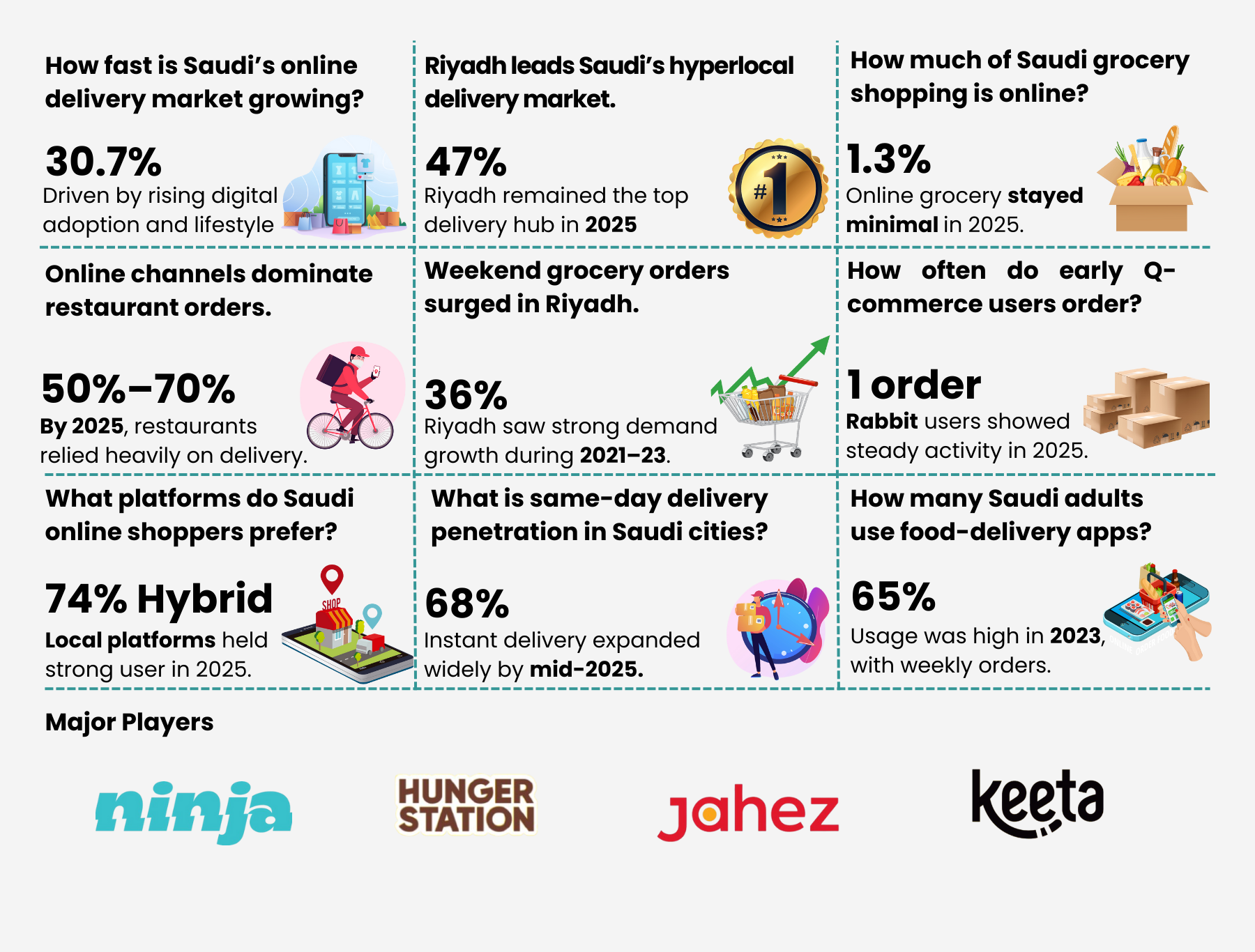
In the Saudi Arabia Hyperlocal Delivery Market, online delivery order volumes increased at a CAGR of approximately 30.7% between 2020 and 2024, underscoring the sector’s rapid expansion.
This market has become a key pillar of the Kingdom’s on-demand economy, supported by rising e-commerce adoption, growing consumer expectations for faster delivery, and continued investment in urban fulfilment infrastructure.
In 2024, the Saudi Arabia hyperlocal delivery industry contributed a substantial share of online order volumes, with food delivery remaining the dominant category, followed by groceries and essential goods. Today, nearly 50%–70% of orders received by traditional restaurants in Saudi Arabia come through online delivery or pick-up channels. While traditional logistics networks continue to support operations, digital-first hyperlocal platforms are witnessing rapid adoption, fuelled by dense urban networks, micro-fulfilment centres, and app-based convenience. Seasonal trends remain prominent, during Ramadan, night-time delivery volumes typically rise by up to 50%, highlighting strong demand fluctuations and consumption patterns unique to the Saudi market.
Key Drivers Shaping the Saudi Arabia Hyperlocal Delivery Market
-
Urbanization and E-commerce Growth: Rapid urban development and increasing e-commerce penetration across major cities such as Riyadh, Jeddah, Dammam, Mecca, and Medina are strengthening demand for fast, reliable, and convenient delivery services within the Saudi Arabia Hyperlocal Delivery Market.
-
Digital and Mobile Adoption: Near-universal smartphone penetration, advanced app-based ordering systems, and integrated digital payment solutions are enabling seamless browsing, tracking, and fulfilment processes. These factors are contributing to higher customer engagement and repeat usage.
-
Infrastructure and Fulfilment Expansion: Sustained investment in dark stores, micro-fulfilment centres, and enhanced last-mile delivery capabilities is improving operational efficiency and supporting the growth of ultra-fast delivery models, typically ranging between 10 and 20 minutes.
-
Changing Consumer Behaviour: A growing preference for convenience, same-day fulfilment, and multi-category purchases is accelerating the expansion of hyperlocal delivery services. This shift continues to reinforce the segment’s role as a crucial component of Saudi Arabia’s evolving digital retail ecosystem.
Saudi Arabia Hyperlocal Delivery Industry Insights
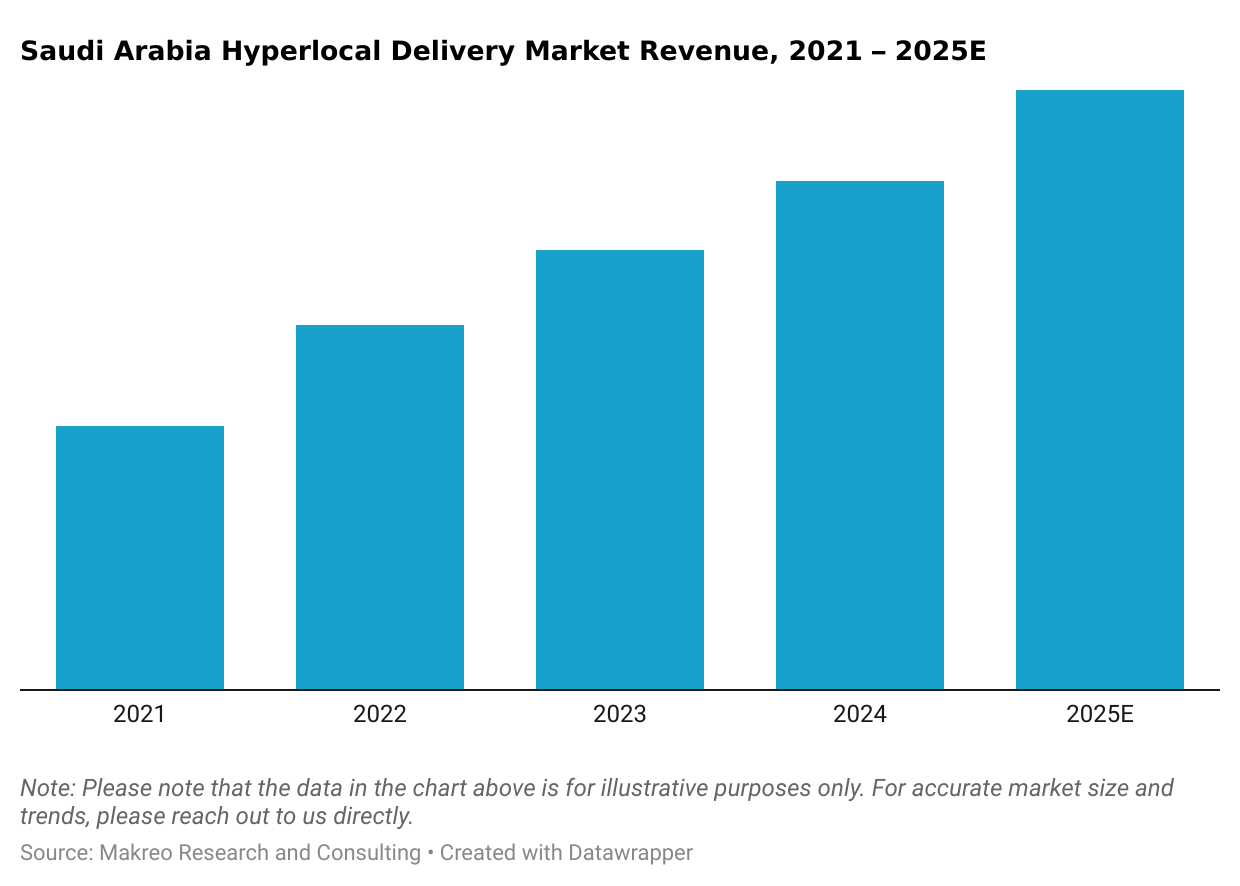
Saudi Arabia’s hyperlocal delivery market has expanded at a CAGR of 22.77% between 2021 to 2025, reflecting strong and sustained growth driven by rising digital adoption, higher online order volumes, and the rapid scaling of leading delivery platforms across major cities.
Scope of the Study for Saudi Arabia Hyperlocal Delivery Market
Makreo Research presents a comprehensive study titled “Saudi Arabia Hyperlocal Delivery Market Size and Forecast (2021–2030) – Analysis by Service Type, Service Models (On-Demand Delivery, Scheduled Delivery, Subscription-Based Delivery), and Geography (Riyadh, Makkah, Eastern Province, Madinah, Others)”, offering an extensive evaluation of the Kingdom’s rapidly evolving hyperlocal delivery ecosystem. The report provides a structured and detailed analysis of market dynamics, operational frameworks, digital infrastructure, and shifting consumer behaviour patterns. It also examines historical market developments and outlines forward-looking growth trajectories shaping the future of the Saudi Arabia Hyperlocal Delivery Market.
Saudi Arabia Hyperlocal Delivery Market Analysis and Industry Assessment
-
The Saudi Arabia Hyperlocal Delivery Market analysis provides a structured evaluation of the sector’s overall framework, encompassing total order volumes, revenue contributions, service-type segmentation, delivery models, and geographic distribution across major urban centres such as Riyadh, Jeddah, Dammam, Mecca, and Medina.
-
The assessment also examines the maturity of operational and digital infrastructure, including micro-fulfilment centres, dark store networks, rider fleet capabilities, mobile application functionalities, and partnerships with logistics service providers.
-
The study outlines recent developments among leading market participants, with particular attention to the expanding presence of cloud kitchens across the Kingdom and their growing influence on hyperlocal delivery operations.
Regional Comparison of the KSA Hyperlocal Delivery Market
-
The report includes a dedicated comparative assessment that benchmarks the Saudi Arabia Hyperlocal Delivery Market against regional counterparts, particularly the UAE and other Middle Eastern markets.
-
Key comparisons cover digital infrastructure maturity, software development costs, operational efficiency, and overall market adoption rates.
Key Industry & Consumer Behaviour Trends Analysis
-
The report evaluates how e-commerce, retail, transport and logistics, and the food & beverage sectors influence hyperlocal delivery adoption and growth.
-
Consumer behaviour trends, including ordering frequency, preferred categories, payment methods, and peak demand periods, are analysed in detail.
Competitive Landscape and Market Positioning
-
The report presents a detailed evaluation of leading hyperlocal delivery platforms and logistics providers in Saudi Arabia, analysing market share, customer reach, fleet capacity, operational footprint, and order volumes.
-
It further outlines company-specific timelines, key financial indicators, strategic initiatives, and planned business expansions.
-
Additionally, the study monitors consolidation patterns, funding activity, and investment flows that are influencing market structure and shaping strategic decisions among major industry participants.
Case Studies
The report features case studies showcasing operational innovations, best practices, ultra-fast delivery models, and strategic approaches implemented by leading hyperlocal delivery and logistics companies.
Challenges and Opportunities in the Saudi Arabia Hyperlocal Delivery Market
-
The analysis evaluates structural, operational, and regulatory challenges influencing the Saudi Arabia Hyperlocal Delivery Market, applying Six Sigma and related assessment frameworks to identify performance gaps and process inefficiencies.
-
It also outlines key opportunities for growth through digital innovation, service diversification, and deeper market penetration, highlighting the factors expected to drive industry advancement through 2030.
Future Growth Outlook for the Saudi Arabia Hyperlocal Delivery Market
The report presents forward-looking projections that assess potential growth pathways, shifts in consumer preferences, and technology-driven innovations expected to influence the Saudi Arabia Hyperlocal Delivery Market over the coming decade.
-
2021 - 2025: Past and Present Scenario
-
2025: Base year of study
-
2026 - 2030: Future Outlook
Saudi Arabia Hyperlocal Delivery Market Segmentation
-
Online Food Delivery
-
Online Grocery Delivery
-
Quick Commerce (Q-Commerce)
-
Pharmacy & Health Product Delivery
-
Hyperlocal Logistics / On-Demand Courier Delivery
-
On-demand Delivery
-
Scheduled delivery
-
Subscription-based Delivery
Geography Assessed
-
Riyadh
-
Makkah
-
Eastern Province
-
Madinah
-
Asir
-
Qassim
-
Tabuk
-
Hail
-
Jazan
-
Other regions
-
Competition
-
Mergers, Acquisitions, and Investments
-
Funding Timeline
-
Company Profiles
Demographic Shifts Strengthening Hyperlocal Delivery Demand in Saudi Arabia
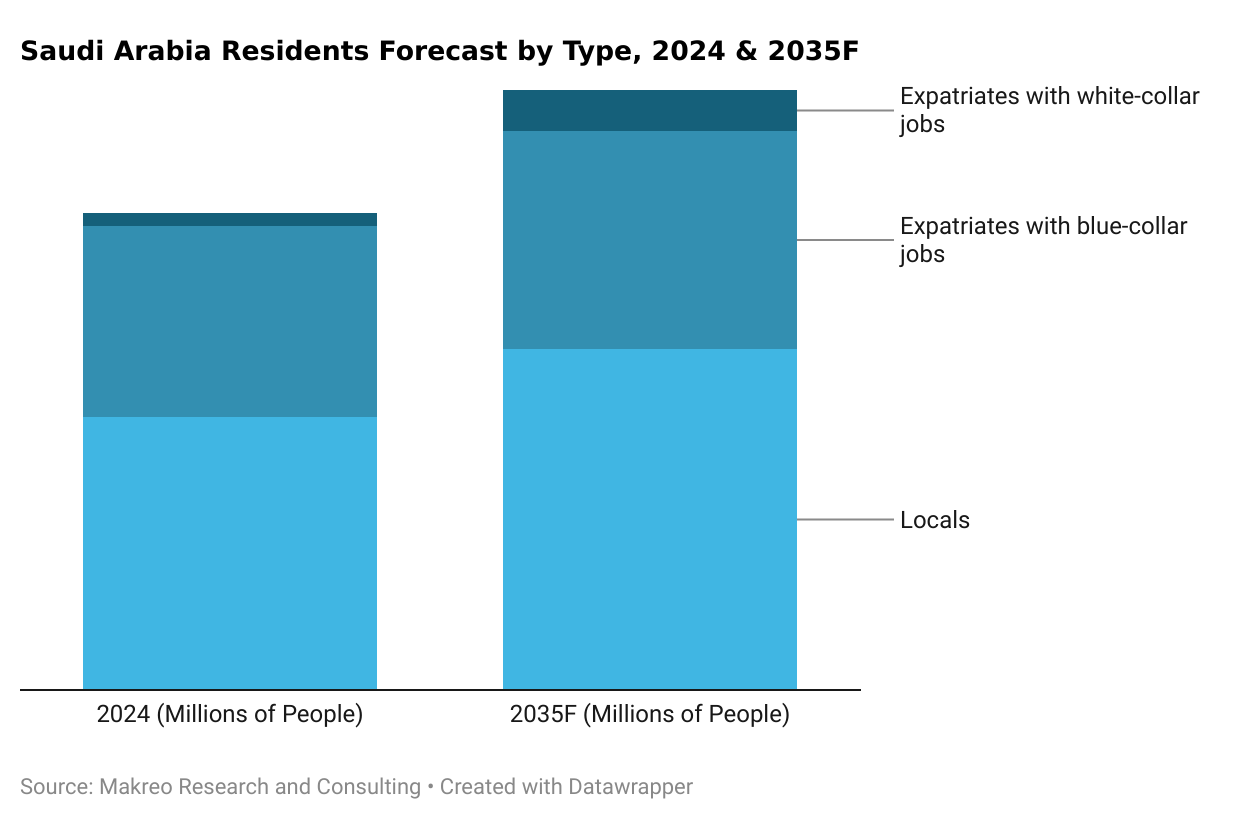
Saudi Arabia’s shifting demographic landscape is poised to substantially reinforce demand within the hyperlocal delivery sector. By 2035, expatriates are expected to represent approximately 36–37% of the total population, while Saudi nationals will account for about 55%. During the same period, the female workforce is projected to double to nearly three million, representing 37% of overall employment.
The Kingdom continues to be a youthful market. In 2024, Gen Z and millennials comprised 65% of all consumers, and by 2035, the emergence of Gen Alpha is anticipated to increase the share of young, digitally fluent consumers to nearly 83%. This expanding, tech-oriented population is likely to drive stronger adoption of food delivery, quick commerce, and on-demand grocery services across Saudi Arabia.
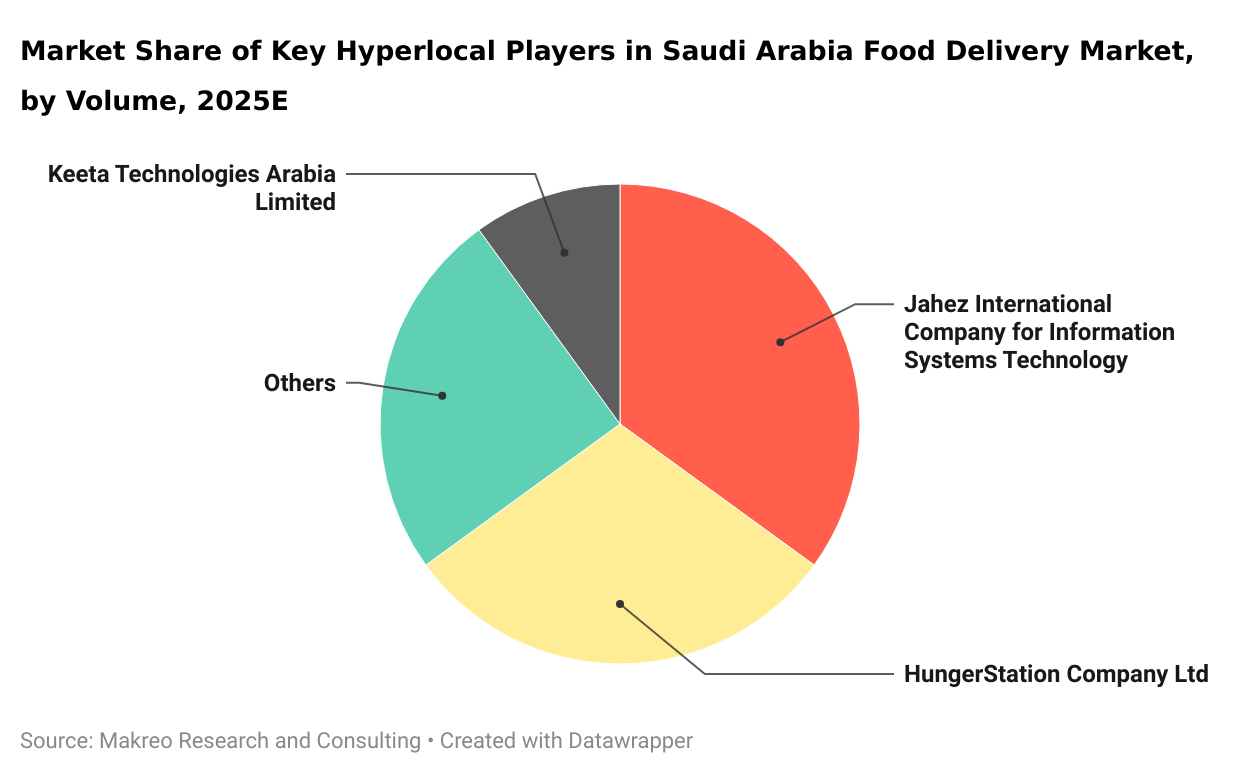
As of 2025, Jahez, HungerStation, and Keeta stand as the three largest players in Saudi Arabia’s hyperlocal delivery market. Within the wider online delivery ecosystem, Jahez remains the overall market leader, capturing around 32% of all registered online orders in the Kingdom as of 2024.
Strategic Investments and Developments in Saudi Arabia Hyperlocal Delivery Market
-
Jahez: In 2025, Jahez made a strategic, undisclosed investment in Doos, a Saudi quick-commerce platform established in 2023. Doos operates cloud stores in Jeddah and Riyadh, offering supermarket essentials, fresh produce, beauty products, gifts, and lifestyle items. This investment enables Jahez to expand beyond food delivery and strengthen its position in Saudi Arabia’s rapidly growing quick-commerce segment.
-
Keeta: In 2024, Keeta announced a planned investment of SAR 1 billion to support its initial expansion in Saudi Arabia. The investment is intended to enhance infrastructure development, talent acquisition, and technology deployment during its early growth phase.
-
HungerStation: In July 2023, Delivery Hero SE acquired the remaining 37% minority stake in HungerStation Company Ltd for approximately EUR 276.8 million. This transaction grants Delivery Hero full ownership of HungerStation’s Saudi operations, supporting its broader regional strategy and enabling tighter integration of technology, operational capabilities, and resources.
Companies Covered in the KSA Hyperlocal Delivery Market
-
Jahez International Company for Information System Technology
-
HungerStation Company Ltd.
-
Keeta Technologies Arabia Limited (Keeta)
-
Aramex Saudi Limited Company
-
DHL Express Saudi Arabia
-
Saudi Post Corporation (SPC)
-
Almajdouie Logistics Company L.L.C.
The study covers a total of 6 hyperlocal delivery platforms and 13 logistics and fulfilment companies. To know more, please reach out to [email protected]
Looking for a Section from Report? Start your Partial Purchase Request
Table of Contents
- 1.Research Methodology
- 1.1.Research Objective
- 1.2.Saudi Arabia Hyperlocal Delivery Market Definitions
- 1.3.Research Design and Procedure
- 1.4.Data Collection Methods
- 1.5.Research Methodology
- 1.6.Analytical Framework
- 2.Saudi Arabia Hyperlocal Delivery Market Past & Present Performance
- 2.1.Saudi Arabia Hyperlocal Delivery Market - An Overview
- 2.2.Recent Developments of Key Players in Saudi Arabia’s Hyperlocal Delivery Market
- 2.3.Rising Adoption of Cloud Kitchens in Saudi Aarbia
- 2.4.Saudi Arabia Hyperlocal Delivery Market Past and Present Performance
- 2.5.Saudi Arabia Hyperlocal Delivery Market Segmentation
- 2.5.1.Saudi Arabia Hyperlocal Delivery Market Segmentation by Services
- 2.5.1.1.Saudi Arabia Online Food Delivery Services Revenue
- 2.5.1.2.Saudi Arabia Online Grocery Delivery Services Revenue
- 2.5.1.3.Saudi Arabia Quick Commerce (Q-Commerce) Services Revenue
- 2.5.2.Saudi Arabia Hyperlocal Delivery Market Segmentation by Nature of Service
- 2.5.3.Saudi Arabia Hyperlocal Delivery Market Segmentation by Regions
- 2.5.1.Saudi Arabia Hyperlocal Delivery Market Segmentation by Services
- 3.Comparative Overview of Saudi Arabia vs Regional Peers in the Hyperlocal Delivery Ecosystem
- 3.1.Online Delivery Trends Comparison: Saudi Arabia V/S Other ME Countries
- 3.2.Digital & Software Development Infrastructure Comparison: UAE V/S Saudi Arabia
- 3.2.1.Cost Comparison of Hyperlocal Delivery Software Development: UAE V/S Saudi Arabia
- 4.Saudi Arabia Hyperlocal Delivery Market Key Industry Analysis
- 4.1.Saudi Arabia E-commerce Industry Analysis
- 4.2.Saudi Arabia Wholesale & Retail Industry Analysis
- 4.3.Saudi Arabia Transport and Logistics Industry Analysis
- 4.4.Saudi Arabia Food and Beverage Industry Analysis
- 5.Consumer Behaviour Trends in Saudi Arabia Food Delivery Segment
- 6.Saudi Arabia Hyperlocal Delivery Market Competitive Landscape
- 6.1.Market Share of Key Hyperlocal Players in Saudi Arabia
- 6.2.Customer Base Comparison of Saudi Arabia’s Key Hyperlocal Market Companies
- 6.3.Geographical Reach Comparison of Major Hyperlocal Companies in Saudi Arabia
- 6.4.Delivery Fleet Comparison of Saudi Arabia’s Key Hyperlocal & Logistics Companies
- 7.Saudi Arabia Hyperlocal Delivery Market Mergers /Acquisitions/ Investments
- 7.1.Mergers /Acquisitions/ Investments/ Disinvestments
- 8.Saudi Arabia Hyperlocal Delivery Market Funding Timeline
- 8.1.Funding Timeline
- 9.Saudi Arabia Hyperlocal Delivery Company Profiles
- Company 1- Business Overview
- Company Timeline
- Business Highlights
- Business Financials
- Company 2. - Business Overview
- Business Highlights
- Business Overview
- Business Highlights
- Company 3 - Business Overview
- Business Highlights
- Company 4.– Business Overview
- Business Highlights
- Business Financials
- Company 5 - Business Overview
- Business Highlights
- Other Major Saudi Arabia Hyperlocal Platforms
- 10.Saudi Arabia Logistics and Fulfilment Market Company Profiles
- Company 1 - Business Overview
- Business Highlights
- Business Financials
- Company 2 - Business Overview
- Business Highlights
- Business Financials
- Company 3 - Business Overview
- Business Highlights
- Key Operational Metrics and Impact
- Company 4 - Business Overview
- Geographical Reach and Company Timeline
- Business Highlights
- Company 5 - Business Overview
- Business Highlights
- Company 6 - Business Overview
- Business Highlights
- Company 7 - Business Overview
- Company Timeline
- Company 8 - Business Overview
- Business Highlights
- Company 9 - Business Overview
- Business Highlights
- Company 10 - Business Overview
- Company 11 - Business Overview
- Business Highlights
- Company 12 - Business Overview
- Company 13.- Business Overview
- 11.Saudi Arabia Hyperlocal Delivery Market Case Studies
- 11.1.Saudi Arabia Hyperlocal Delivery Market Case Studies: 1
- 11.2.Saudi Arabia Hyperlocal Delivery Market Case Studies: 2
- 11.3.Saudi Arabia Hyperlocal Delivery Market Case Studies: 3
- 11.4.Saudi Arabia Hyperlocal Delivery Market Case Studies: 4
- 11.5.Saudi Arabia Hyperlocal Delivery Market Case Studies: 5
- 12.Saudi Arabia Hyperlocal Delivery Market Challenges
- 12.1.Saudi Arabia Hyperlocal Delivery Market Challenges: An Overview
- 12.1.1.Saudi Arabia Hyperlocal Delivery Market Challenges - Six Sigma Analysis
- 12.1.Saudi Arabia Hyperlocal Delivery Market Challenges: An Overview
- 13.Saudi Arabia Hyperlocal Delivery Market Opportunities
- 13.1.Saudi Arabia Hyperlocal Delivery Market Opportunities: An Overview
- 13.1.1.Saudi Arabia Hyperlocal Delivery Market Opportunities
- 13.1.Saudi Arabia Hyperlocal Delivery Market Opportunities: An Overview
- 14.Saudi Arabia Hyperlocal Delivery Market Future Outlook
- 14.1.Saudi Arbia Hyperlocal Delivery Market Future Outlook
- Limitations of the Study
Related Reports - Automotive & Transportation