Philippines Freight and Logistics Market Size and Forecast (2021-2030) - Analysis by Service Type (Freight, Warehousing and Cold Chain), Mode of Transportation (Marine, Air, Road and Rail), End-Use Industry, and Geography (NCR, Luzon, Visayas, Mindanao)
Philippines Freight and Logistics Market Size
The Philippines freight and logistics market expanded at an estimated CAGR of approximately 2.6% during 2021–2025 and is projected to maintain steady, moderate growth through 2030, supported by rising domestic consumption, stable trade volumes, and increasing demand for outsourced logistics services across the country's principal trade corridors.
Market expansion is being reinforced by the rapid growth of e-commerce and courier, express, and parcel shipments, alongside capacity enhancements across ports, airports, and road networks. These developments are improving cargo-handling efficiency and strengthening inter-island connectivity across the Philippines logistics market - a structurally important dynamic given the country's archipelagic geography spanning Luzon, Visayas, and Mindanao.
Continued investment in digital freight platforms, multimodal logistics solutions, and logistics infrastructure is strengthening supply-chain reliability and reinforcing the Philippines freight and logistics market as a critical enabler of trade, manufacturing, and broader economic activity through 2030.
Philippines Freight and Logistics Market Growth Drivers
-
The Philippines freight and logistics market is recording steady growth, underpinned by rising domestic consumption, stable trade flows, and sustained government investment in logistics infrastructure, including port modernization, airport capacity upgrades, and road network improvements.
-
Rapid expansion of e-commerce and courier, express, and parcel (CEP) services is increasing parcel volumes and last-mile delivery requirements, prompting investments in distribution centers, sorting facilities, and express logistics networks.
-
Digitalization and outsourcing of logistics services are gaining traction, with broader adoption of digital freight platforms, real-time tracking systems, and integrated logistics solutions, enhancing operational efficiency and supporting long-term market expansion.
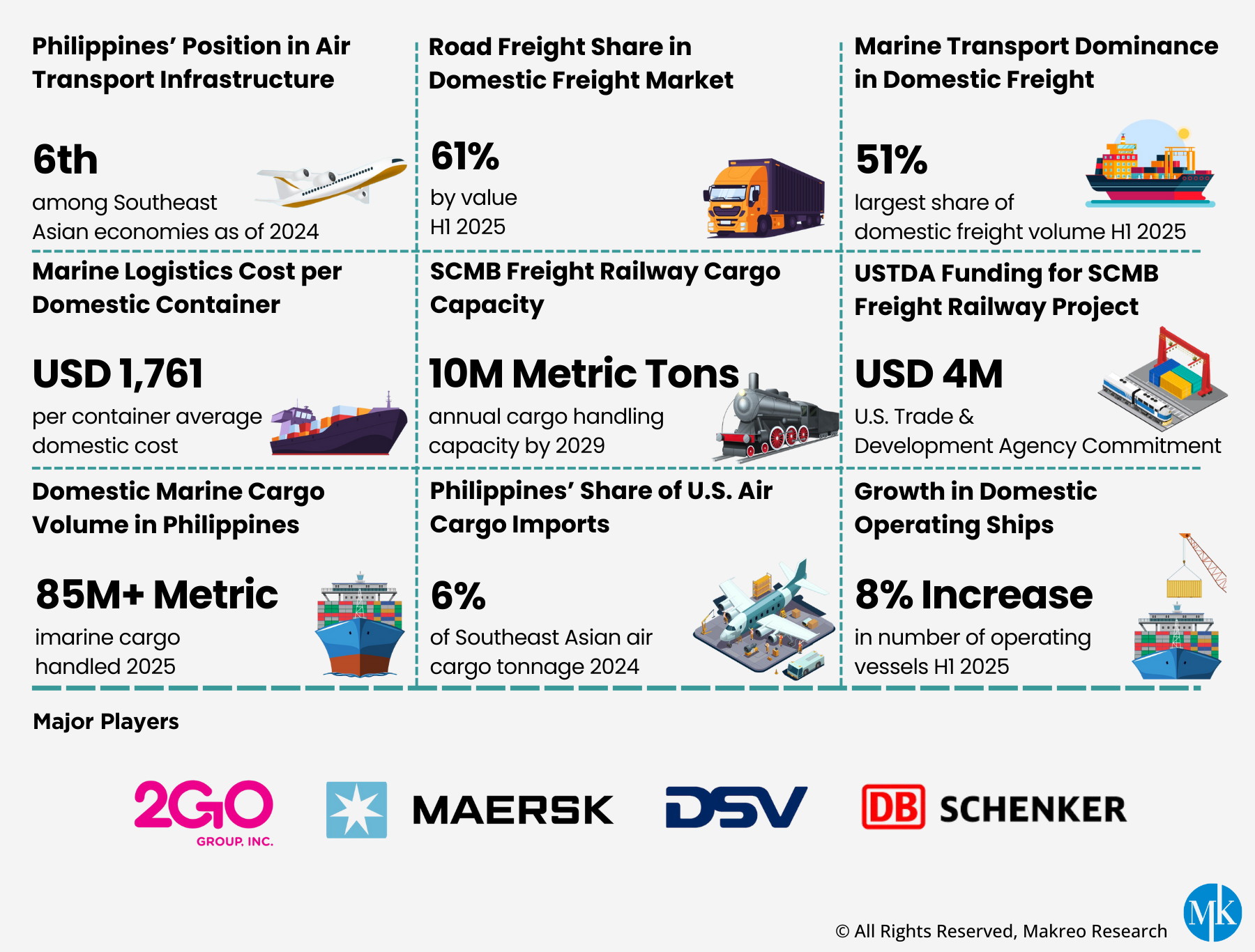
Philippines Freight and Logistics Industry Insights
Steady Growth in the Philippines Freight and Logistics Market
The Philippines freight and logistics market has recorded steady growth in recent years, supported by stable trade activity, rising domestic consumption, and expanding e-commerce volumes. While the sector faced infrastructure constraints and cost pressures during 2021-2024, continued investment in port and airport upgrades, road infrastructure, and inter-island logistics networks has strengthened the market's operational foundation.
Increased adoption of digital freight platforms, shipment tracking systems, and integrated logistics services is improving efficiency and service reliability across the Philippines logistics market, positioning the country for gradual expansion and enhanced competitiveness within the broader Southeast Asian logistics landscape.
Recent Developments in the Philippines Freight and Logistics Market
Recent infrastructure commitments, bilateral agreements, and tariff policy updates reflect accelerating investment and regulatory change across the Philippines freight and logistics market.
Mindanao Railway Project
The Mindanao Railway Project, planned as a multi-phase rail network spanning over 1,000 kilometres, is progressing with the Tagum–Davao–Digos segment identified as the initial phase. Valued at approximately PHP 83 billion, the project was proposed under a public-private partnership framework as of July 2025, targeting a reduction in travel times from four hours to one whilst enabling efficient freight movement for the agriculture and mining sectors.
Philippines and United States Railway Cooperation
In June 2025, the Philippines and the United States signed an agreement to advance development of the Subic–Clark–Manila–Batangas freight railway. The United States Trade and Development Agency committed approximately USD 4 million in technical assistance to support the initiative.
Revised Marine Cargo-Handling Tariff
Under PPA Memorandum Circular No. 008-2024, a 16% tariff increase on marine cargo handling is being implemented in two phases, a 10% increase effective 6 August 2024, followed by a further 6% increase at least six months thereafter.
Philippines Imports by Major International Terminals, H1 2025
Source: Makreo Research
Philippines Freight and Logistics Market Structure and Growth Outlook
The Philippines logistics market remains predominantly freight-driven, reflecting the country’s reliance on inter-island cargo movement, domestic distribution networks, and international trade flows. Warehousing plays a supporting but growing role, driven by rising demand for organized storage, distribution hubs, and e-commerce fulfillment facilities near key consumption and industrial centers. The cold chain logistics market in the Philippines remains comparatively underdeveloped but is strategically significant, underpinned by demand from food processing, pharmaceutical distribution, and export-oriented supply chains. Capacity limitations, high investment costs, and uneven regional coverage continue to constrain growth, indicating significant scope for expansion as infrastructure and standards improve.
Philippines Freight and Logistics Market - Key Business Developments
2GO and EVAP - EV-Ready Vessel Partnership
In 2025, 2GO entered into a partnership with the Electric Vehicle Association of the Philippines to support EV-ready vessel enhancements, positioning the company as an early participant in the adoption of electric mobility solutions within Philippines freight and logistics operations.
ICTSI - USD 800 Million Bauan International Container Terminal
ICTSI announced a USD 800 million investment to develop an international container terminal in Bauan, Batangas, with an annual throughput capacity of 2 million TEUs. The first berth is targeted for completion by end-2027, representing one of the most significant port infrastructure commitments in the Philippines freight market in recent years.
FedEx - Clark International Airport Gateway Facility Expansion
In July 2024, FedEx signed an agreement with LIPAD, the operator of Clark International Airport, to expand and upgrade its gateway facility in Clark, Pampanga. The expansion is designed to enhance air freight handling efficiency and strengthen express logistics connectivity across the Philippines logistics market.
Scope of the Study for Philippines Freight and Logistics Market
Makreo Research has released a detailed report titled "Philippines Freight and Logistics Market Size and Forecast (2021-2030) - Analysis by Service Type (Freight, Warehousing and Cold Chain), Mode of Transportation (Marine, Air, Road and Rail), End-Use Industry, and Geography (NCR, Luzon, Visayas, Mindanao)", providing a comprehensive assessment of the Philippines freight and logistics market and the country's evolving freight, logistics, and express delivery ecosystem. The study evaluates historical market performance, the current industry structure, and the forecast outlook, with a focus on the factors influencing market growth, investment trends, and competitive dynamics across the Philippines freight and logistics industry.
-
Domestic Demand and Logistics Outsourcing - Rising domestic consumption, stable trade activity, and increasing outsourcing of logistics services are strengthening demand across road freight, marine freight, air freight, and integrated logistics segments of the Philippines logistics market.
-
Government Infrastructure Investment - Port modernisation, airport capacity expansion, and road and inter-island connectivity projects are improving cargo movement efficiency and network reliability across the Philippines freight market.
-
Digital Adoption and Technology Integration - Wider deployment of digital freight platforms, real-time shipment tracking systems, and warehouse management systems is enhancing operational efficiency and service transparency across the Philippines logistics competitive landscape.
Philippines Freight and Logistics Market Competitive Landscape
This section provides a comprehensive assessment of the Philippines freight and logistics market competitive landscape, evaluating the operational scale, service coverage, and strategic positioning of leading domestic and international logistics providers. It presents a structured comparison of key players across critical parameters, including transportation mode coverage, cargo volumes handled, fleet size, network reach, digital capabilities, regulatory certifications, and service portfolio diversification, supported by detailed company profiles.
-
Service Offerings and Mode Specialisation covering marine freight, road freight, air freight, sea freight, integrated logistics, and courier, express, and parcel services across the Philippines logistics market
-
Operational Footprint and Network Reach covering presence across Philippine ports, airports, warehouses, logistics hubs, and key regional markets including Luzon, Visayas, and Mindanao
-
Fleet Composition and Asset Structure covering fleet size, asset ownership models, and regulatory certifications relevant to the Philippines freight market
-
Digital Capabilities and Technology Adoption covering logistics platforms, shipment tracking systems, warehouse management systems, and technology-enabled solutions shaping the Philippines logistics competitive landscape
-
Recent Business Developments covering mergers and acquisitions, investments, network expansions, strategic initiatives, and key financial indicators across leading Philippines freight and logistics companies
Philippines Freight and Logistics Market Outlook and Growth Implications
The report concludes with a forward-looking assessment of the key challenges and growth opportunities shaping the Philippines freight and logistics market through 2030. Strategic priorities identified for stakeholders include expanding port and airport capacity, improving inter-island and multimodal connectivity, strengthening last-mile and courier, express, and parcel infrastructure, and accelerating digital adoption across logistics operations.
The outlook further underscores the growing importance of technology-enabled freight platforms, integrated logistics service models, and supply-chain resilience in enhancing operational efficiency and cost competitiveness across the Philippines logistics market. These insights are designed to support investment planning, policy development, and operational strategy, reinforcing the Philippines' position as a key logistics and trade hub within Southeast Asia.
-
2021–2025: Past and Present Scenario
-
2025: Base year of study
-
2026–2030: Market Forecast and Future Outlook
Market Segmentation of Philippines Logistics Market
-
Freight Market
-
Warehousing Market
-
Cold Chain Market (this includes cold transport and scold storage)
-
Luzon
-
Visayas
-
Mindanao
-
Marine
-
Air, Road
-
Rail
Region Assessed
-
Luzon
-
Visayas
-
Mindanao
-
Other / Inter regional
-
Warehousing
-
Cold Chain
-
National Capital Region (NCR)
-
Luzon
-
Visayas
-
Mindanao
-
Market Competition in Phillippines Logistics and warehousing market
-
Mergers, Acquisitions, and Investments
-
Funding Timeline
-
Company Profiles
Companies Covered in the Philippines Freight and Logistics Market
-
2GO Group, Inc.
-
Maersk Filipinas Inc.
-
DSV Logistics Solutions Philippines, Inc.
-
Schenker Philippines, Inc.
There are 12 players covered in this report. To know more, please reach out to [email protected].
What is driving the Philippines freight and logistics market? +
Which transport mode leads freight movement in the Philippines? +
How is the Philippines positioned in Southeast Asian logistics? +
What infrastructure projects are shaping Philippine logistics? +
Who are the key players in the Philippines freight and logistics market? +
Looking for a Section from Report? Start your Partial Purchase Request
Table of Contents
- 1.Research Methodology
- 1.1.Objective of the Study
- 1.2.Market Definitions and Key Terminologies
- 1.3.Research Design and Procedure
- 1.4.Research Methodology
- 1.5.Data Collection Methods
- 2.Philippines Logistics Market Past and Present Performance
- 2.1.Philippines Logistics Market Past and Present Performance
- 2.2.Philippines Logistics Market Segmentation
- 2.2.1.Philippines Logistics Market Segmentation by Services
- 2.2.2.Philippines Logistics Market Segmentation by End User Industry and Regions
- 3.Philippines Freight Market Past and Present Performance and Modal Analysis
- 3.1.Philippines Freight Market Overview
- 3.2.Philippines Freight Market Past and Present Performance
- 3.2.1.Philippines Freight Market by Mode of Transportation Past and Present Performance
- 3.3.Philippines Gross Value-Added in Transportation and Storage
- 3.4.Philippines Gross Capital Formation by Major Type of Equipment
- 3.5.Philippines Comparison of Shipping Options by Mode of Transport
- 4.Philippines Freight Market Segmentation
- 4.1.Philippines Freight Market Segmentation
- 4.1.1.Philippines Freight Market Segmentation by Mode of Transport
- 4.1.2.Philippines Freight Market Segmentation by Major Regions
- 4.1.3.Philippines Freight Market Segmentation by End User Industry
- 4.1.Philippines Freight Market Segmentation
- 5.Philippines Freight Transport (Marine, Air, Road and Rail) Analysis
- 5.1.Philippines Cargo and Container Throughput by Volume
- 5.2.Philippines Marine Cargo Revenue
- 5.3.Philippines Cargo Volume and Port Statistics
- 5.4.Philippines Metro Manila Ports Capacity Utilization & Expansion
- 5.5.Philippines Foreign Cargo Handled by Major International Terminals
- 5.6.Philippines Top Base Ports by Cargo Handled
- 5.7.Philippines Container Traffic
- 5.8.Philippines Air Cargo Overview
- 5.9.Philippines Air Cargo Movement by Volume
- 5.10.Philippines Air Cargo Revenue
- 5.11.Philippines Road Freight Volume & Vehicle Fleet
- 5.12.Philippines Road Freight Revenue
- 5.13.Philippines Rail Freight Overview
- 6.Philippines Warehousing and Cold Chain Market Past and Present Performance
- 6.1.Philippines Warehousing Market Past and Present Performance
- 6.2.Philippines Cold Chain Market Past and Present Performance
- 6.3.Philippines Warehousing and Cold Chain Market Segmentation
- 6.3.1.Philippines Warehousing and Cold Chain Market by Type of Services
- 6.3.2.Philippines Warehousing and Cold Chain Market by Region
- 6.3.3.Philippines Warehousing and Cold Chain Market by End-User Industry
- 7.Philippines Logistics Services Market Past and Present Performance
- 7.1.Philippines 3PL Market Players Recent Developments
- 7.2.Philippines 3PL Market Past and Present Performance
- 7.3.Philippines CEP Volume of Parcels Shipped
- 7.4.Philippines CEP Market Past and Present Performance
- 7.5.Philippines Freight Forwarding Market Past and Present Performance
- 8.Philippines Freight and Logistics Market Competitive Landscape
- 8.1.Philippines Freight Market Key Players by Mode of Coverage
- 8.2.Philippines Freight Market Key Players Performance Scorecard
- 8.3.Philippines Freight Market Top Digital Freight Platforms
- 8.4.Philippines Freight Market Key Startup Players
- 8.5.Philippines Major Freight & Logistics Market Players Volume Handled
- 8.6.Philippines Major Freight & Logistics Market Players Fleet Size and Certifications
- 8.7.Philippines International Air Cargo Market Share & Volume by Airfreight Forwarders
- 8.8.Philippines International Scheduled Air Cargo Traffic Market Share & Volume by Airlines
- 9.Philippines Logistics and Freight Market Mergers / Acquisitions / Investments / Divestments
- 9.1.Mergers / Acquisitions / Investments / Divestments
- 10.Philippines Freight and Logistics Market Funding Timeline
- 10.1.Funding Timeline
- 11.Philippines Freight and Logistics Market Company Profiles
- 11.1.Player 1
- 11.1.1.Business Overview
- 11.1.2.Business Highlights
- 11.1.3.Business Financials
- 11.2.Player 2
- 11.2.1.Business Overview
- 11.2.2.Business Highlights
- 11.2.3.Business Financials
- 11.3.Player 3
- 11.3.1.Business Overview
- 11.3.2.Business Highlights
- 11.3.3.Business Financials
- 11.4.Player 4
- 11.4.1.Business Overview
- 11.4.2.Business Highlights
- 11.4.3.Business Financials
- 11.5.Player 5
- 11.5.1.Business Overview
- 11.5.2.Business Highlights
- 11.5.3.Business Financials
- 11.6.Player 6
- 11.6.1.Business Overview
- 11.6.2.Business Highlights
- 11.6.3.Business Financials
- 11.7.Player 7
- 11.7.1.Business Overview
- 11.7.2.Business Highlights
- 11.7.3.Business Financials
- 11.8.Player 8
- 11.8.1.Business Overview
- 11.8.2.Business Highlights
- 11.8.3.Business Financials
- 11.9.Player 9
- 11.9.1.Business Overview
- 11.9.2.Business Highlights
- 11.9.3.Business Financials
- 11.10.Player 10
- 11.10.1.Business Overview
- 11.10.2.Business Highlights
- 11.10.3.Business Financials
- 11.11.Player 11
- 11.11.1.Business Overview
- 11.11.2.Business Highlights
- 11.11.3.Business Financials
- 11.12.Player 12
- 11.12.1.Business Overview
- 11.12.2.Business Highlights
- 11.12.3.Business Financials
- 11.1.Player 1
- 12.Philippines Freight and Logistics Market Future Outlook
- 12.1.Philippines Logistics Market Revenue Future Outlook
- 12.2.Philippines Freight Market Revenue Future Outlook
- 12.2.1.Philippines Freight Market by Mode of Transportation Revenue Future Outlook
- 12.3.Philippines Warehousing Market Revenue Future Outlook
- 12.4.Philippines Cold Chain Market Revenue Future Outlook
- 12.5.Philippines 3PL Market Revenue Future Outlook
- 12.6.Philippines CEP Market Revenue Future Outlook
- 12.7.Philippines Freight Forwarding Market Revenue Future Outlook
- 13.Philippines Freight and Logistics Market Challenges
- 14.Philippines Freight and Logistics Market Opportunities
- Limitations of the Study
Related Reports - Automotive & Transportation