India Dental Membrane and Bone Graft Substitutes Market to Exceed USD 110 Million by 2032 - High Treatment Costs and Limited Specialist Access Will Shape Growth
India dental membrane and bone graft substitutes market to exceed USD 110 million by 2032. Explore implant demand, treatment affordability and regional growth opportunities.
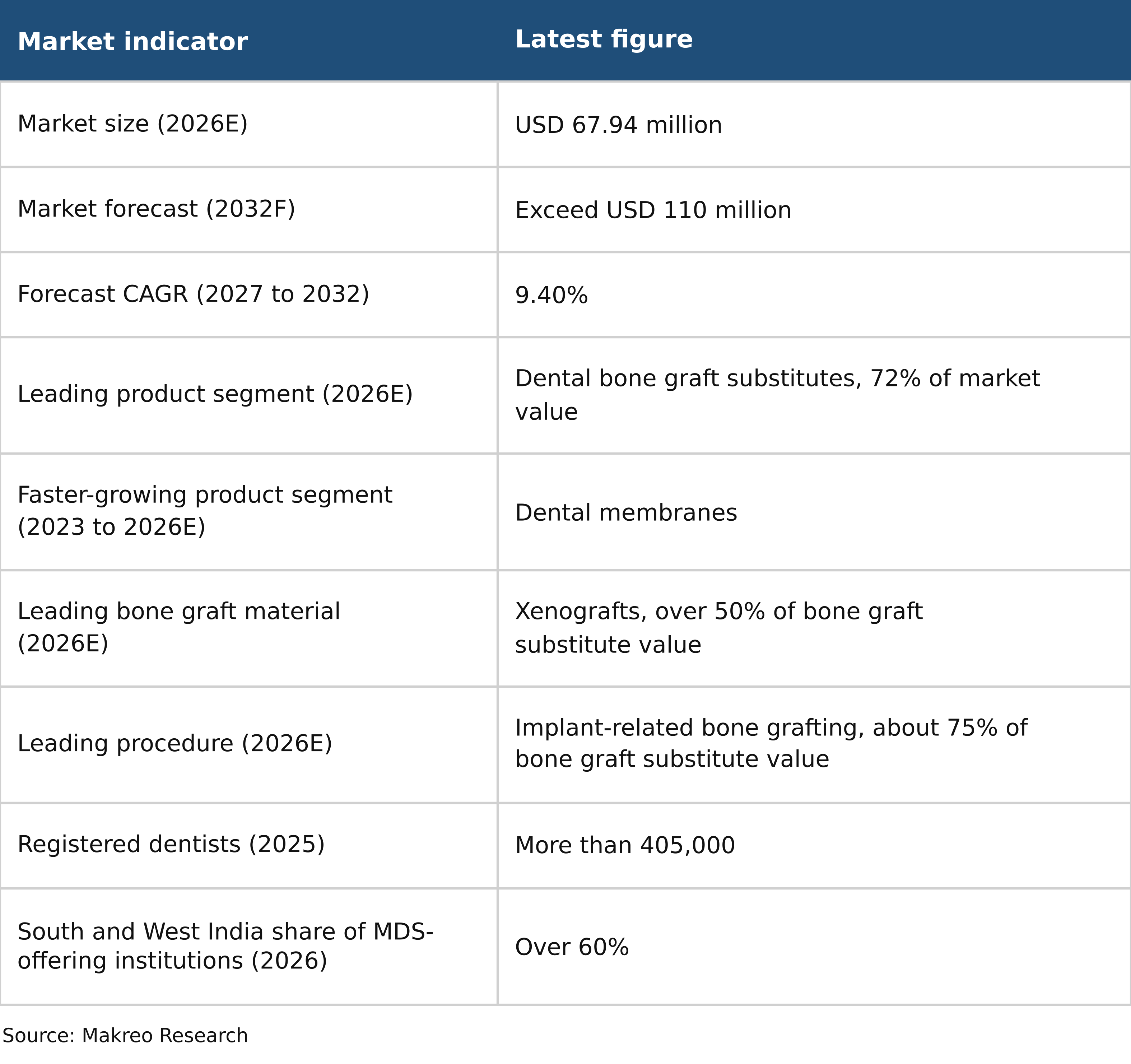
The India dental membrane and bone graft substitutes market is estimated at USD 67.94 million in 2026, according to Makreo Research, and is projected to exceed USD 110 million by 2032, growing at a CAGR of 9.40% during 2027 to 2032.
Despite India having more than 405,000 registered dentists, access to regenerative dental procedures remains uneven. Bone grafting and membrane placement require appropriate clinical expertise, while high treatment costs limit wider patient adoption.
Dental implant procedures account for about 75% of dental bone graft substitute value in India. Organised dental chains are expanding their clinic networks, and implant manufacturers are investing in clinical training. However, rising implant volumes do not automatically translate into proportional growth in bone graft and membrane demand, as material requirements depend on individual clinical needs and patient affordability.
Our analysis identifies four shifts that will shape market growth:
-
Implant demand and treatment cost: Rising implant volumes support demand, but treatment affordability influences wider adoption of bone grafting procedures.
-
Material mix: Xenografts dominate bone graft substitute demand, while dental membranes are recording growing adoption.
-
Specialist geography: Postgraduate dental training remains concentrated in South and West India, creating regional differences in access to regenerative dental procedures.
-
Supply base: Dependence on imported biomaterials exposes suppliers to currency fluctuations, while domestic manufacturing is beginning to develop.
The common challenge is treatment access. For manufacturers, distributors, dental chains and investors, the opportunity lies in identifying where clinical capability, patient affordability and product availability can support market growth through 2032.
India Dental Membrane and Bone Graft Substitutes Market at a Glance
 How Large Is the India Dental Membrane and Bone Graft Substitutes Market?
Growth is supported by increasing dental implant demand, bone augmentation, periodontal regeneration and guided tissue regeneration procedures.
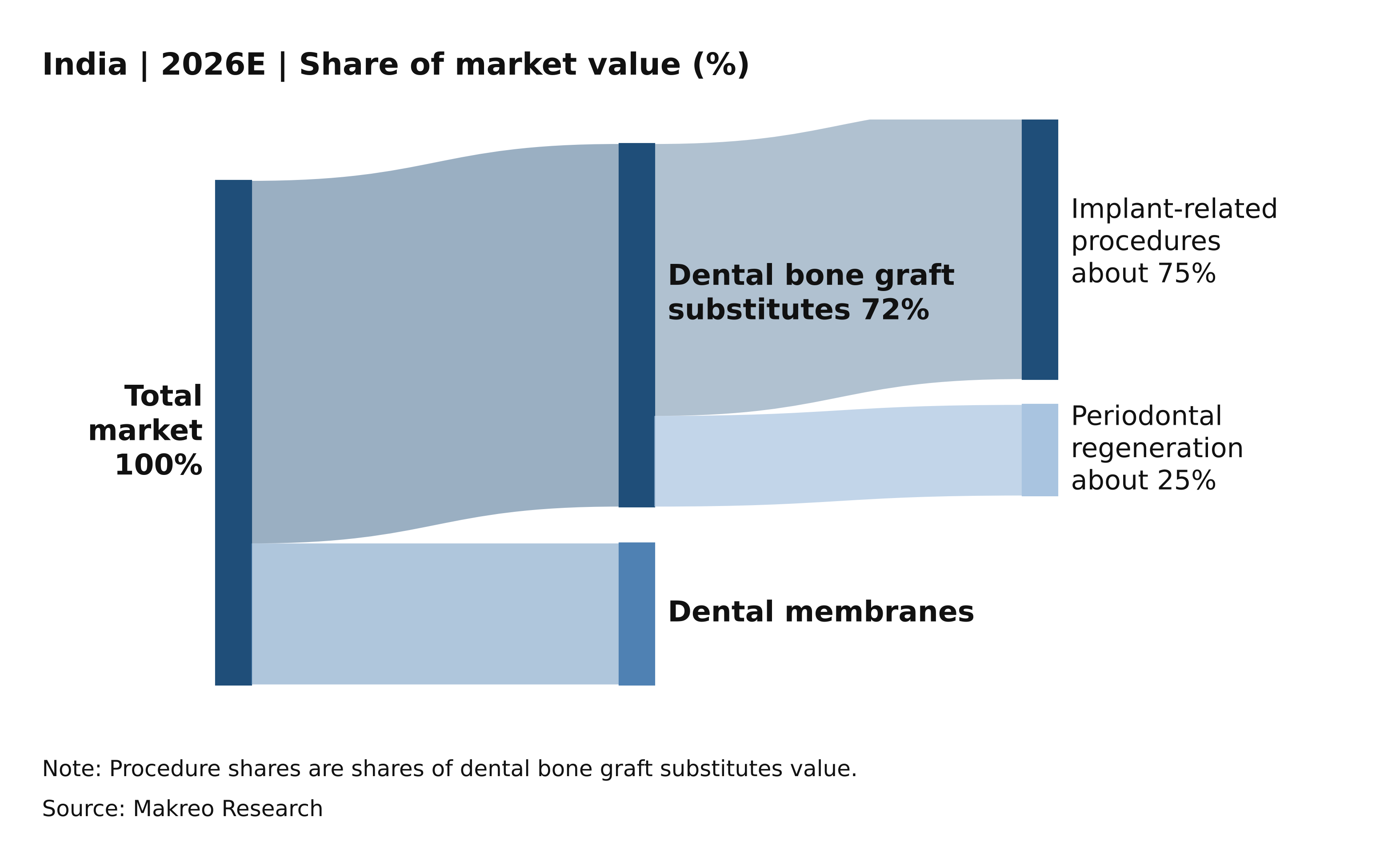
Within the market, dental bone graft substitutes account for an estimated 72% of market revenue in 2026. Their leading position reflects their use across implant-related bone augmentation and periodontal defect regeneration.
Dental membranes complement bone graft materials by acting as a barrier that limits soft tissue intrusion and supports bone regeneration in suitable clinical procedures.
 However, growth across the overall market does not mean uniform demand across products, procedures or clinics. Rising implant sales do not necessarily lead to an equal increase in graft and membrane use, as material requirements depend on each patient's clinical condition. For suppliers, procedure-level demand and treatment affordability matter as much as overall market size.
Why Is Dental Bone Grafting Still Limited Despite India's Large Dental Workforce?
India has more than 405,000 registered dentists, but the size of the dental workforce does not directly reflect the availability of regenerative dental procedures. Bone grafting and membrane placement require appropriate clinical training and are commonly performed by implantologists, periodontists, oral and maxillofacial surgeons and other suitably trained dental practitioners.
Market growth therefore depends on how many patients can reach a trained practitioner and afford the treatment.
The regulatory framework for dental education is also changing. The National Dental Commission was constituted on 19 March 2026, replacing the Dental Council of India, with responsibilities that include regulating dental education, assessing institutions and maintaining professional standards. Over time, this could influence the quality and availability of specialist dental training.
For manufacturers and distributors, more relevant demand indicators include:
-
Availability of practitioners performing implant and periodontal regenerative procedures.
-
Implant and bone augmentation procedures per clinic.
-
Clinic procurement practices and material preferences.
-
Patient affordability and treatment acceptance.
How Are Implant Demand and Treatment Costs Affecting Bone Graft Adoption in India?
Dental implant procedures are the primary driver of bone graft demand in India, accounting for about 75% of dental bone graft substitute value in 2026. Periodontal defect regeneration accounts for the remaining share.
Organised dental chains and implant manufacturers are widening access to implant treatment:
-
Osstem Implant: Osstem Implant India has reported average annual sales of more than 400,000 implants and an estimated 35% share of India's dental implant market, according to the company.
-
Clove Dental: The dental chain opened 48 clinics in a single day in February 2026, expanding its network to 715 centres across 26 cities.
However, treatment affordability remains a significant barrier. Makreo Research's pricing analysis shows a considerable difference in bone grafting costs across clinical settings:
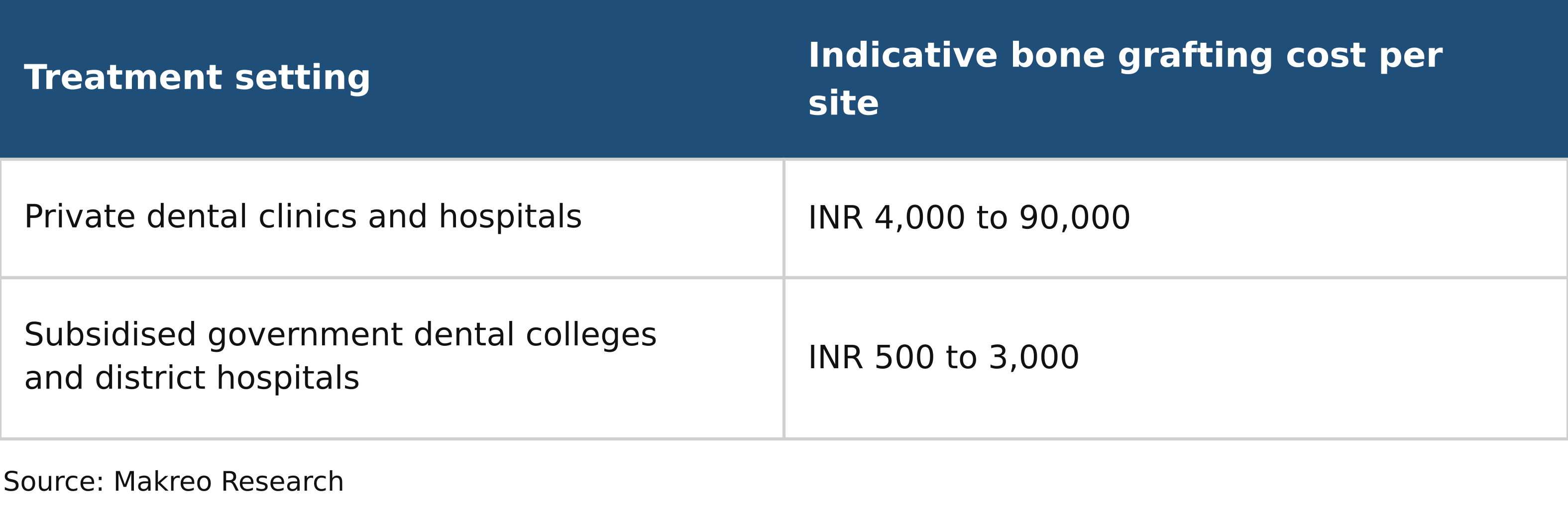
Treatment costs vary depending on procedure complexity, graft material, membrane requirements, clinical setting and applicable subsidies. Material and membrane charges may also be billed separately, depending on the treatment package. The indicative ranges do not necessarily represent clinically equivalent procedures.
The additional cost of bone grafting can influence whether patients proceed with implant-supported treatment, particularly in price-sensitive markets and smaller cities. For manufacturers and distributors, rising implant volumes alone are not sufficient to assess bone graft demand, as patient affordability, material pricing and the availability of trained practitioners influence how many implant cases translate into regenerative procedures.
A clinically suitable product portfolio across different price segments could help suppliers address a wider patient base.
Xenografts Lead Bone Graft Demand While Dental Membrane Adoption Expands
Xenografts account for over 50% of India's dental bone graft substitute market value in 2026, followed by synthetic bone grafts at around 30%, according to Makreo Research. Allografts and autografts represent smaller segments.
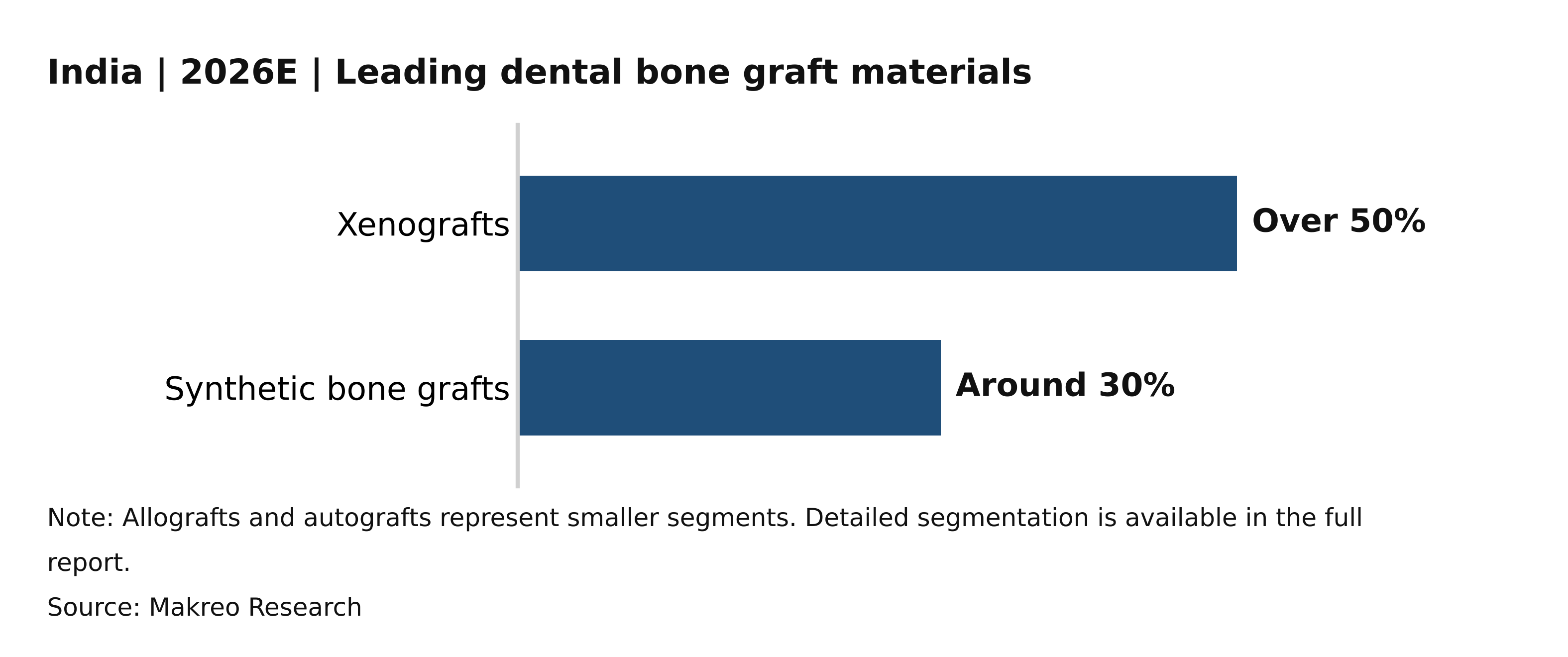
Demand for different bone graft materials is influenced by their clinical applications, material characteristics, practitioner preferences and product availability:
-
Xenografts: Bovine-derived bone graft materials have an established clinical track record and are widely used in dental implant procedures.
-
Synthetic bone grafts: These materials offer an alternative to animal-derived and human-derived grafts and present opportunities for domestic manufacturing.
-
Allografts: Their availability depends on access to appropriately processed donor bone through tissue banks and suppliers.
-
Autografts: Their applications depend on clinical requirements and the availability of bone from the patient's own body, which may involve an additional surgical procedure.
Growing Applications of Dental Membranes in Regenerative Dentistry
Dental membranes are the faster-growing product segment, having recorded higher growth than dental bone graft substitutes during 2023 to 2026E. Their adoption is supported by applications such as:
-
Socket preservation following tooth extraction.
-
Ridge augmentation before implant placement.
-
Guided bone regeneration around implants and bone defects.
Resorbable collagen membranes offer advantages in suitable cases because they degrade within the body and generally do not need a separate removal procedure. However, faster historical growth from a smaller base does not mean dental membranes will overtake bone graft substitutes in market value.
Manufacturers are also investing in clinical education to support the adoption of regenerative dental materials.
-
Dentium: At the IAOI Scientific Conference held in Thiruvananthapuram on 1 and 2 August 2026, the company conducted sessions covering high-density collagen matrices, limited bone width and sinus lift procedures.
-
Dentsply Sirona: The company's DS Academy listed a webinar on post-extraction tissue preservation and regeneration for 24 November 2026.
Clinical evidence for locally developed dental grafts and membranes is still evolving. Further clinical validation, long-term performance evidence and practitioner training could help manufacturers build confidence in newer and domestically developed biomaterials.
Which Regions Offer Stronger Opportunities for Dental Biomaterial Suppliers?
South and West India together account for over 60% of India's dental institutions offering Master of Dental Surgery (MDS) programmes in 2026, according to Makreo Research. The concentration of postgraduate dental institutions creates opportunities for biomaterial suppliers to strengthen distribution networks, establish institutional partnerships and conduct specialist training programmes.
South India accounts for around 43%, supported by established dental education networks in Karnataka, Tamil Nadu and Kerala. West India accounts for nearly 18%, with Maharashtra and Gujarat representing key dental education markets.
In comparison, East and Northeast India together account for less than 7% of institutions offering MDS programmes, highlighting regional differences in postgraduate dental training infrastructure.
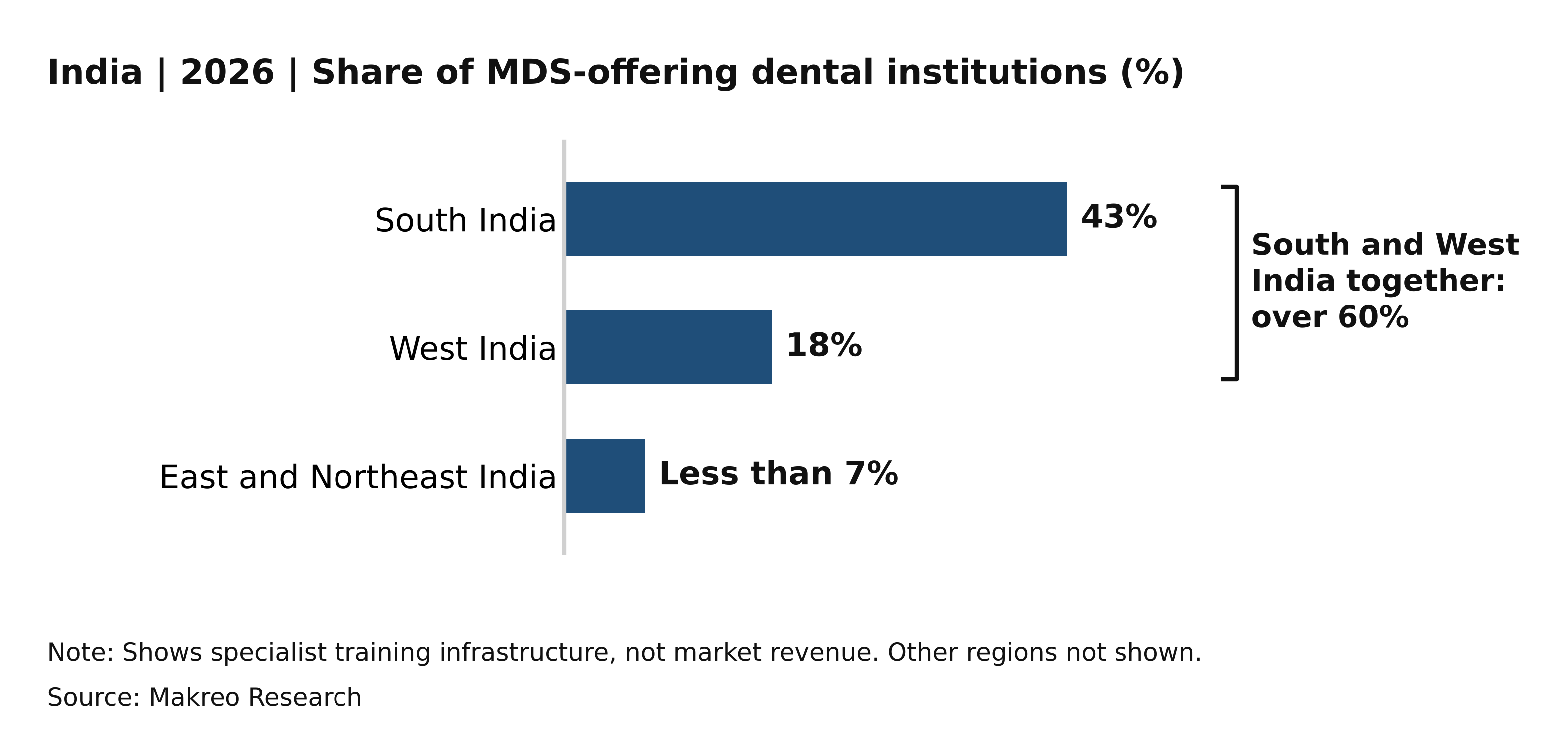 These figures represent the distribution of postgraduate dental institutions rather than regional market revenue, procedure volumes or practising specialist numbers. However, established dental education networks provide an initial indicator for assessing clinical capabilities and regional expansion opportunities.
How Are Dental Biomaterial Companies Strengthening Their Market Presence in India?
Dental biomaterial and implant manufacturers are strengthening their presence in India through clinical education, distribution networks and initiatives that expand access to dental care.
-
Straumann Group: In June 2026, the Straumann Group Foundation and United Way of Mumbai launched the Muskaan Oral Care initiative, operating two mobile dental units in Mumbai and Karjat.
-
Osstem Implant: Conducts more than 100 seminars and training programmes annually across India, supporting professional development in implantology and advanced dental procedures.
-
Dentium: Conducts clinical training programmes covering full-arch rehabilitation, sinus lift procedures and collagen matrices.
-
Geistlich: Maintains its presence in India's regenerative dental biomaterials market through its local subsidiary, supplying bone graft substitutes and dental membranes.
-
Vasa Denticity: Expands product accessibility through its Dentalkart platform, offering imported and domestically manufactured dental products.
-
Clove Dental: Its expanding organised dental clinic network creates potential opportunities for bulk procurement and long-term supplier partnerships.
Clinical education helps manufacturers strengthen product awareness and adoption, while organised dental clinic networks and digital distribution platforms provide additional channels for market expansion.
Product quality, competitive pricing, reliable supply and clinical support will remain important competitive differentiators for dental biomaterial suppliers in India.
How do leading dental biomaterial companies compare in terms of product portfolios, pricing, distribution networks and competitive positioning? Explore Makreo Research's India Dental Membrane and Bone Graft Substitutes Market and Forecast to 2032 for detailed company profiles and competitive benchmarking.
Import Dependence Exposes Suppliers to Cost Pressures as Domestic Manufacturing Develops
India's dental membrane and bone graft substitutes market continues to rely on imported biomaterials across several established product categories. This exposes manufacturers and distributors operating in the country to currency fluctuations and import-related costs. Vasa Denticity reported in its FY2026 investor presentation that rupee depreciation increased the cost of imported products and contributed to pressure on profit margins.
Regulatory Proposals Could Improve Import and Licensing Efficiency
The government has proposed changes that could influence the import and regulatory approval processes for medical devices.
-
Expansion of authorised import entry points: In November 2026, the Ministry of Health proposed adding new authorised entry points for drugs and medical devices. The changes could enable importers to clear products closer to their distribution and warehousing infrastructure.
-
Shorter licensing timelines: A draft amendment to the Medical Devices Rules issued in June 2026 proposes reducing licence decision timelines for higher-risk Class C and Class D medical devices from 45 days to 20 days.
Both measures remain proposals rather than implemented regulations. Their potential benefits will depend on final approval, implementation and applicability to individual medical device categories.
Although these developments could improve operational efficiency, they would not eliminate suppliers' exposure to currency fluctuations.
Domestic Manufacturing and Biomaterial Development
Domestic manufacturing capabilities are beginning to develop, particularly in synthetic bone graft materials and related biomaterial technologies.
-
Domestic synthetic graft manufacturing: In September 2026, the Technology Development Board supported Ceramat, a Palghar-based bioceramic materials manufacturer, in commercialising 3D-printed calcium phosphate bone grafts, including patient-specific designs. The government highlighted that a significant share of advanced bone graft products available in India is imported.
-
Bone and tissue banking infrastructure: King George's Medical University in Lucknow opened Uttar Pradesh's first bone and tissue bank in August 2026, while a bone bank in Leh was sanctioned in November 2026.
These bone banking developments primarily serve orthopaedic and reconstructive surgery. Their ability to support processed dental allograft supply remains to be established.
Domestic manufacturing presents an opportunity to reduce exposure to imported material costs and currency fluctuations. However, its commercial potential will depend on production economics, applicable regulatory approvals, dental-specific clinical evidence and practitioner acceptance.
Key Market Opportunities for Dental Biomaterial Manufacturers, Distributors and Investors
The India dental membrane and bone graft substitutes market presents growth opportunities supported by rising implant procedures, expanding clinical applications and developing domestic manufacturing capabilities. However, the ability to capture this growth will vary across products, geographic markets, pricing segments and distribution channels.
Makreo Research identifies five strategic priorities for manufacturers, distributors, dental chains and investors.
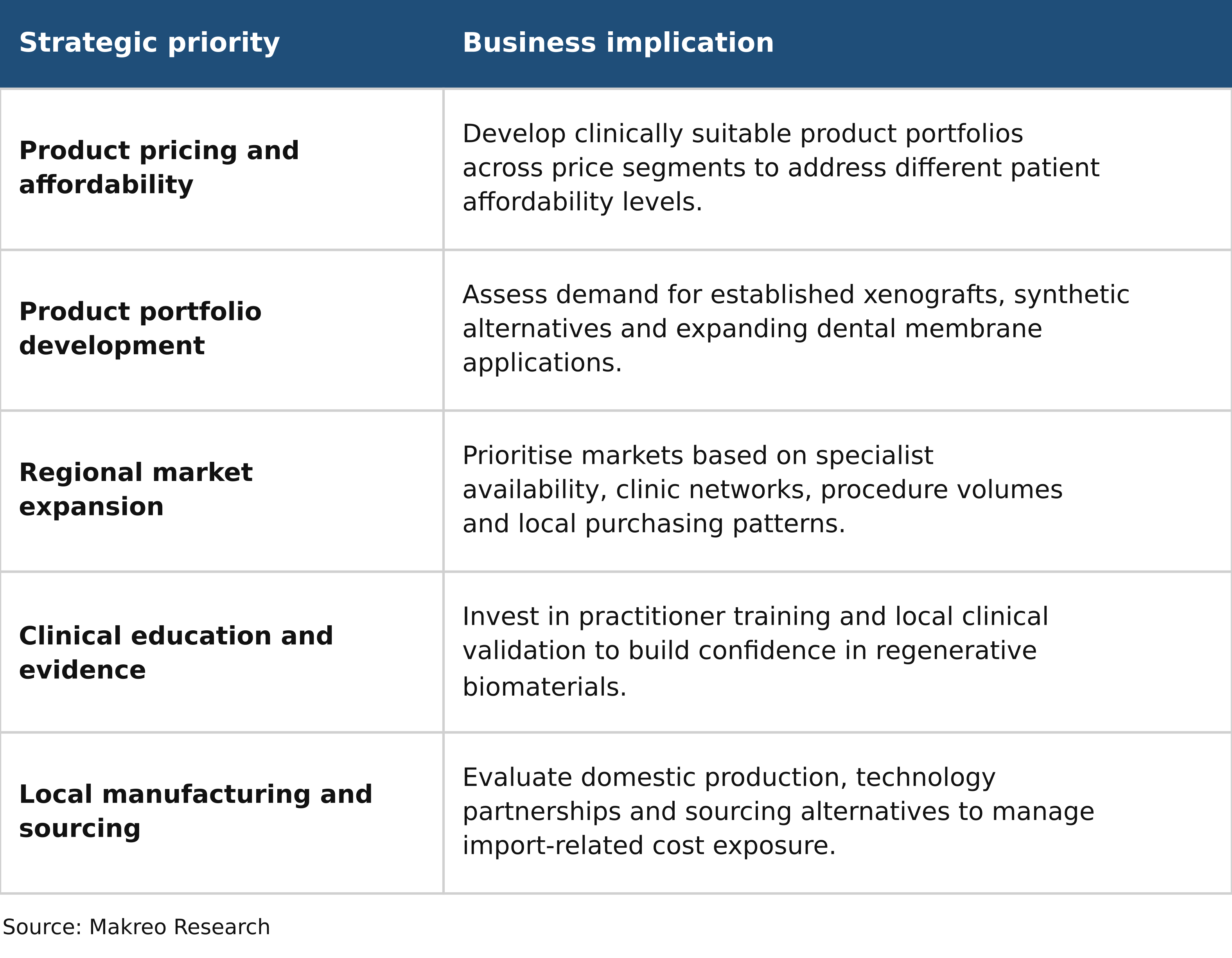 Suppliers and investors should monitor four key indicators through 2032:
-
Implant and regenerative procedure volumes per specialist clinic.
-
Average graft and membrane costs per treatment case.
-
Availability of trained dental practitioners across regions.
-
Share of domestically manufactured products in clinic procurement.
The opportunity in India's dental membrane and bone graft substitutes market extends beyond rising implant volumes. Suppliers and investors will need to assess where clinical capability, patient affordability and product availability intersect.
These factors will influence which products, distribution networks and manufacturing investments can capture market growth through 2032.
How Can Makreo Research Help You Evaluate Opportunities in India's Dental Biomaterials Market?
Understanding India's dental membrane and bone graft substitutes market requires more than tracking implant sales and registered dentist numbers.
Manufacturers, distributors, dental service providers and investors need visibility into procedure volumes, material preferences, treatment costs, purchasing behaviour and regional specialist availability to make informed commercial decisions.
Makreo Research supports businesses operating in the dental biomaterials and medical devices sector through:
-
Market Sizing and Opportunity Assessment: Evaluate demand across product categories, materials, clinical applications, end users and geographic markets.
-
Pricing and Competitive Benchmarking: Assess material prices, treatment costs, product portfolios and competitive positioning.
-
Primary Market Surveys: Understand practitioner preferences, clinic procurement practices, purchasing behaviour and product adoption barriers.
-
Market Entry and Expansion Strategy: Identify suitable product segments, distribution partners, manufacturing opportunities and regional expansion priorities.
Our India Dental Membrane and Bone Graft Substitutes Market and Forecast to 2032.provides historical market analysis, growth forecasts, detailed segmentation, pricing benchmarks and competitive profiles of seven leading companies.
For businesses evaluating product launches, distribution partnerships, manufacturing investments or geographic expansion, Makreo Research offers customised market research and business consulting solutions aligned with specific commercial objectives.
If you are planning a product launch, looking for a distribution partner, considering local manufacturing or expanding into new regions, explore our Consulting Services and Market Survey services, or write to us at [email protected].
India Dental Membrane Market, India Dental Bone Graft Substitutes Market, India Dental Biomaterials Market, India Dental Implants Market, Dental Bone Graft Materials, Dental Collagen Membranes, Guided Bone Regeneration, Guided Tissue Regeneration, Dental Biomaterial Manufacturers in India, India Dental Devices Market, India Dental Market Research