
India Warehousing and Cold Chain Market to Cross USD 40 Billion After 2030 as Grade A Demand Rises and Cold Chain Gaps Persist
India's warehousing and cold chain market is projected to cross USD 40 billion after 2030. Explore rising Grade A demand, cold chain infrastructure gaps and investment trends.
India has 402.89 lakh MT of cold storage capacity, yet the country continues to lose an estimated INR 92,651 crore worth of fruits and vegetables annually after harvest. This contrast highlights a structural challenge in India's cold chain infrastructure, where much of the existing capacity is concentrated in a few states and designed for a limited range of commodities.
A similar imbalance is visible in warehousing. During H1 2026, Mumbai added 4.6 million sq ft of new warehouse supply but recorded only 2.7 million sq ft of net absorption, despite leading the country in leasing activity. Delhi NCR and Kolkata, meanwhile, absorbed more space than they added. These differences indicate that warehouse demand is becoming increasingly dependent on location, facility specifications and occupier requirements rather than overall capacity expansion.
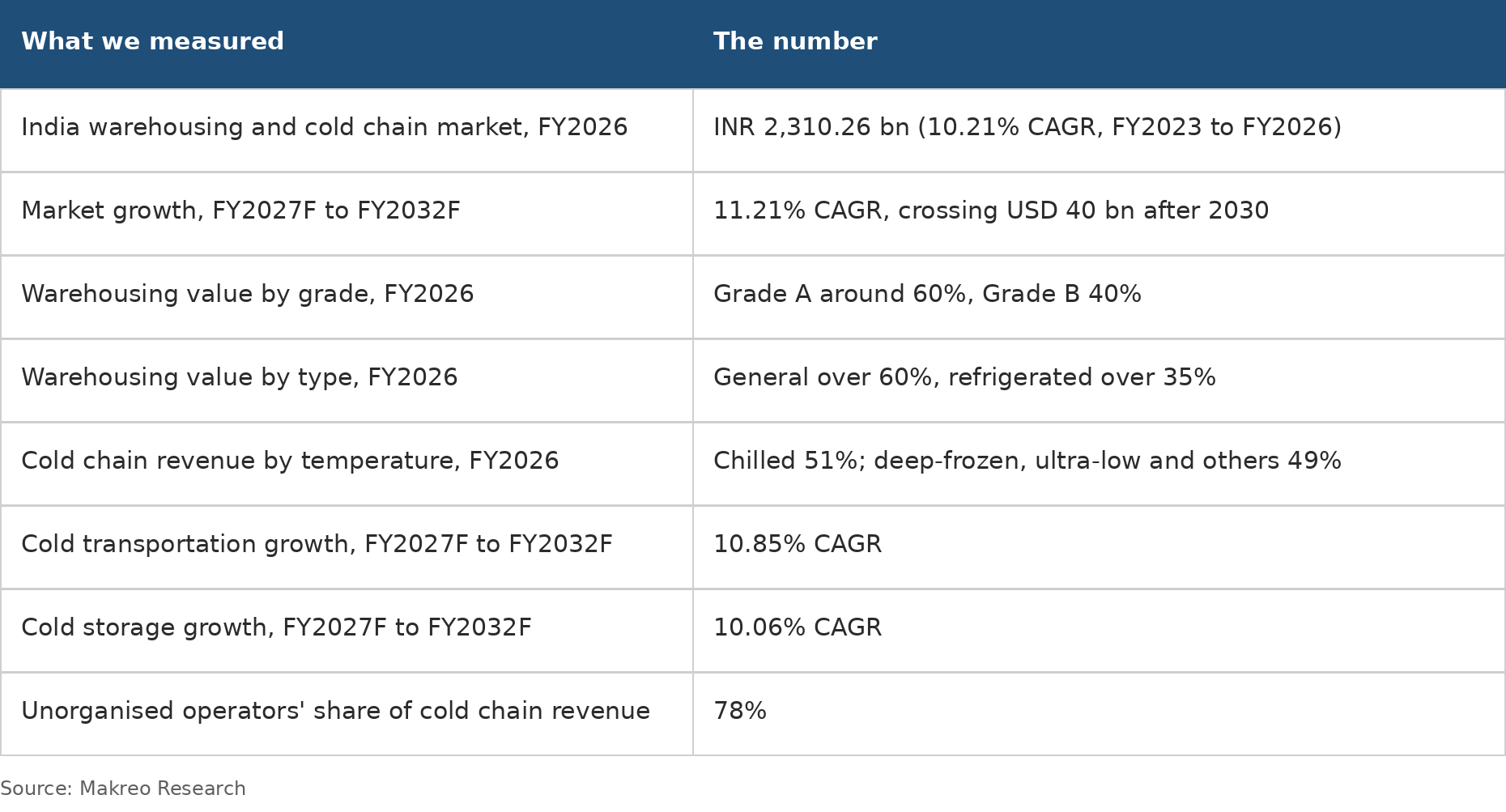
Makreo Research estimates that India warehousing and cold chain market will grow at an 11.21% CAGR from FY2027 to FY2032, taking the market revenue past USD 40 billion after 2030. This growth is being shaped by increasing demand for Grade A and refrigerated facilities, manufacturing and 3PL expansion, changing warehouse absorption patterns and persistent gaps in refrigerated transportation and farm-gate infrastructure.
For developers, logistics operators and investors, these developments underline the importance of aligning new capacity with industry requirements, geographic demand and operating economics.
India Warehousing and Cold Chain Market at a Glance
 Where Is the India Warehousing and Cold Chain Market Growing, and Which Segments Offer the Strongest Opportunities?
The India warehousing and cold chain market is still growing, but the value is moving towards higher-specification, temperature-controlled and colder space.
Grade A and Refrigerated Space Are Taking a Larger Share of Warehousing Value
In FY2026, Grade A facilities accounted for around 60% of warehousing market value, against 40% for Grade B, and refrigerated storage accounted for over 35%. Makreo Research expects Grade A and refrigerated facilities to grow fastest through FY2032. Multi-storey warehouses are also gaining adoption in cities where industrial land is scarce, helped in Maharashtra by its Logistics Policy 2024.
These shares measure value, not floor area. Temperature-controlled warehouses earn around INR 58.5 per sq ft per month, against about INR 30 for standard space, so refrigerated storage takes a larger share of revenue than of physical footprint. The space that earns the most is still the space in shortest supply.
The move towards Grade A is not one-directional. In supply-constrained markets such as Mumbai and Delhi NCR, Grade B leasing rose 51% year on year in H1 2026, because occupiers that could not wait for new supply accepted older buildings in the right locations. For owners of well-located Grade B stock, that points to refurbishment value rather than obsolescence.
Cold Chain Growth Is Moving Towards Colder Temperatures and Refrigerated Transport
Within the cold chain, chilled storage held 51% of FY2026 revenue, while deep-frozen, ultra-low and other temperature ranges held 49%. The colder end carries the stronger growth potential, as frozen foods, quick commerce and biologics all need lower and more tightly controlled temperatures.
Transport is growing faster than storage. Makreo Research projects cold transportation revenue to grow at a 10.85% CAGR from FY2027 to FY2032, ahead of cold storage at 10.06%. The same gap held over FY2023 to FY2026, when cold transportation grew at 10.52% and cold storage at 9.70%.
Unorganised operators still earn 78% of cold chain revenue. That leaves room for consolidation by operators that can offer validated, multi-temperature space with monitored transport.
Growth in the overall market does not mean every grade, city or temperature range will grow equally. So which occupiers are setting the specification, and where do they want to be?
Which Industries, Cities and Occupiers Should Warehousing and Cold Chain Investors Target?
Investors and operators should focus on occupiers whose space needs are already defined, in micro-markets where absorption keeps pace with new supply.
Manufacturers and 3PL Operators Now Drive Warehouse Leasing
In H1 2026, manufacturing occupiers, including automotive, electronics, pharmaceutical and engineering companies, accounted for 46% of warehouse leasing, and 3PL operators for 30%. Retail took 7%, e-commerce 5%, FMCG 4% and FMCD 3%. Two occupier groups now account for three-quarters of India's warehouse leasing.
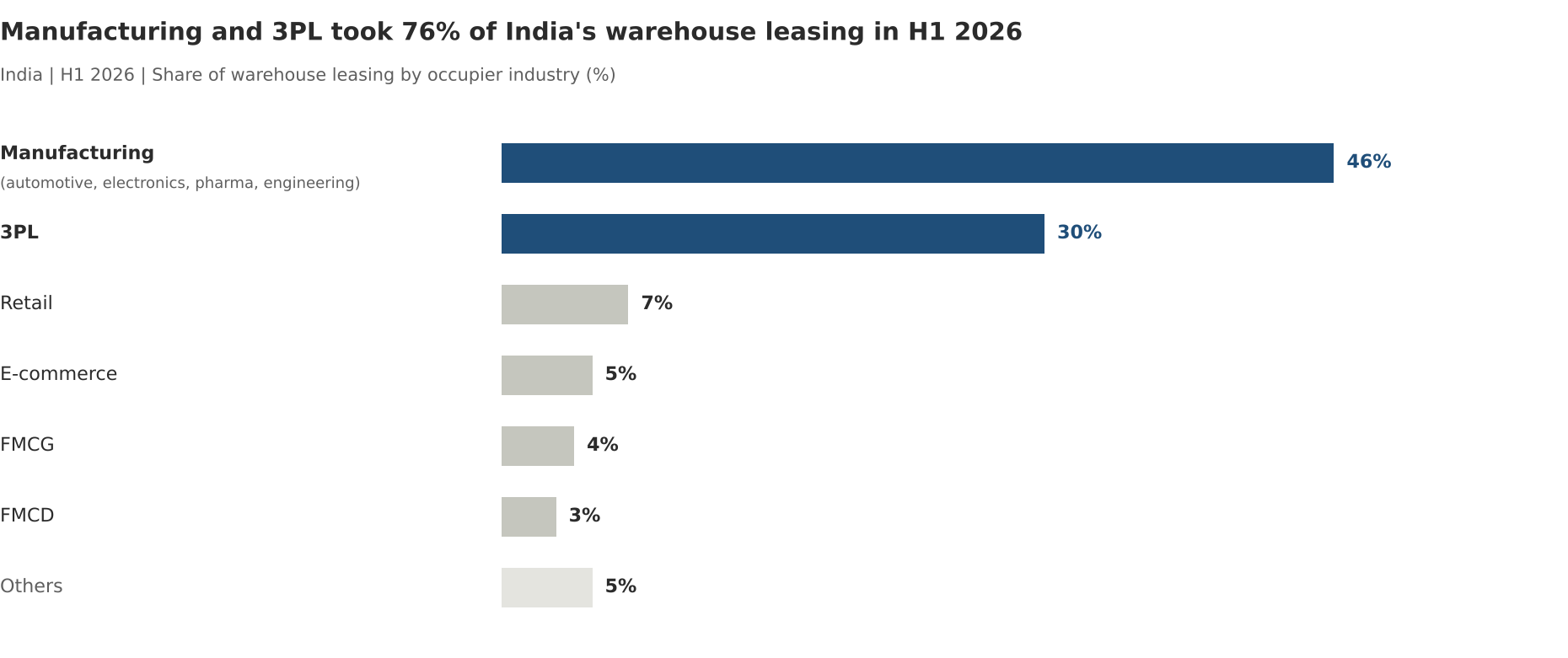 The two groups need different buildings. Manufacturers need space for components, vendor inventory and finished goods near the plant, so the production cluster decides the site. 3PL operators need flexible, multi-client buildings on regional distribution routes.
Both pipelines are filling. 3PL leasing reached 3.5 million sq ft in Q1 2026, 1.8 times the Q1 2025 level, as companies consolidated hubs after GST changes. On the manufacturing side, INR 1.91 lakh crore in production-linked incentives and INR 33,660 crore for 100 plug-and-play industrial parks between FY2027 and FY2032 point to sustained factory-linked demand.
Requirements are also splitting by size. Large Grade A distribution hubs serve national networks, while compact urban dark stores carrying 2,000 to 4,000 SKUs serve quick commerce, with 5,625 dark stores active by July 2026. A mid-sized, generic warehouse between the two suits neither group well.
Absorption, Not City Size, Separates Strong Warehouse Markets
India's largest warehouse markets are not equally attractive for new capital, because each plays a different economic role and has a different supply position.
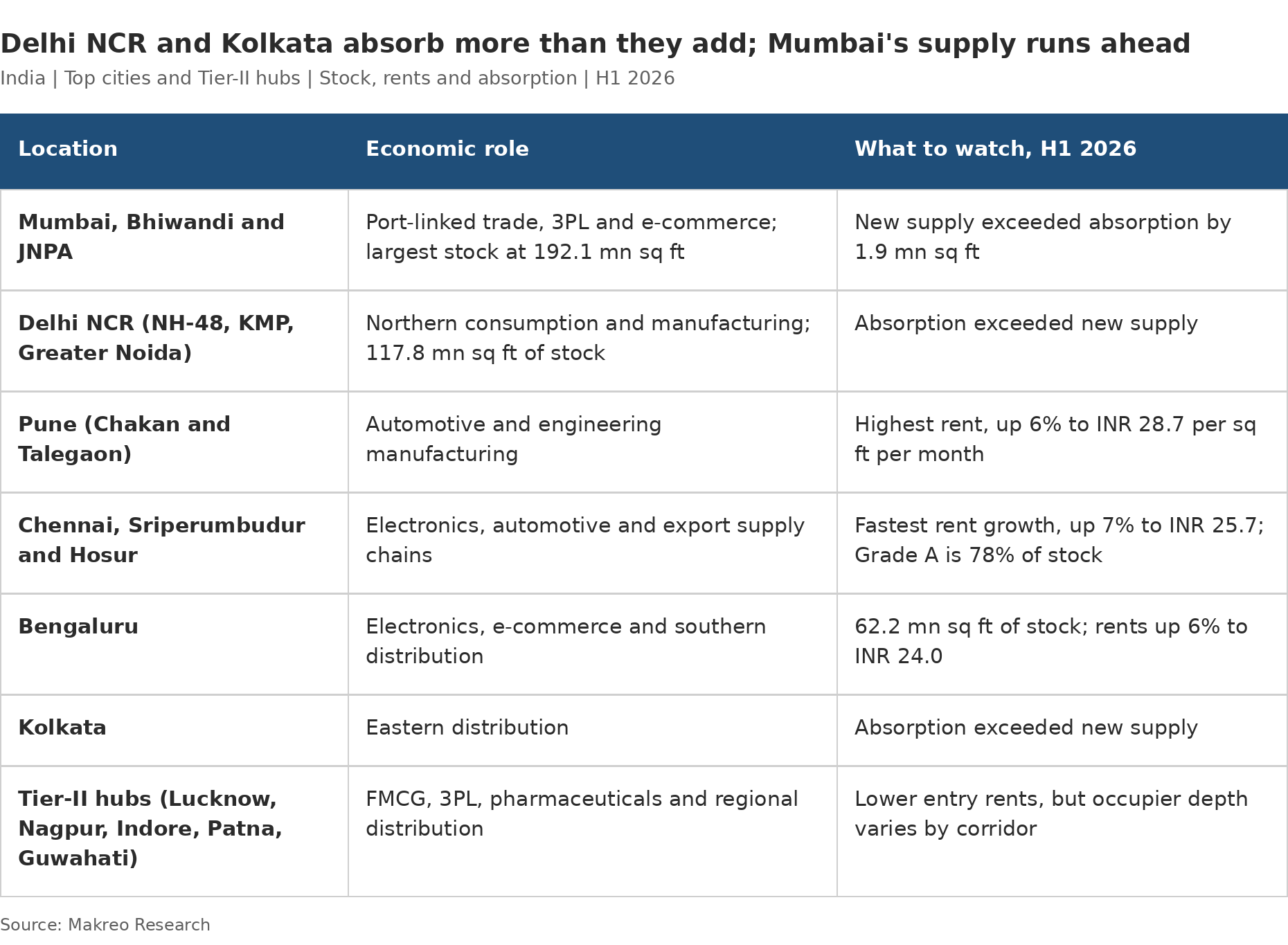 Mumbai shows why city totals can mislead. It led India in H1 2026 with 10.7 million sq ft leased, up 44% year on year, yet completions still exceeded absorption. Leasing counts every signed lease, including renewals and relocations, whereas absorption measures only the net increase in occupied space. Strong leasing does not prove that speculative supply will be filled.
Rents need the same care. They rose in all top eight cities in H1 2026, but Makreo Research's analysis shows that higher land, construction and financing costs explain part of the increase. Average Tier-I Grade A rents moved from INR 24.8 per sq ft per month in 2024 to INR 25.3 in 2025, and Tier-II Grade A rents from INR 22.0 to INR 22.5. A rent rise driven by cost does not signal the same depth of demand as one driven by occupiers competing for space.
Beyond the metros, the Dedicated Freight Corridors, new expressways and 35 planned Multimodal Logistics Parks are extending the warehousing map. Nagpur's MIHAN ecosystem supports central distribution, Indore and Pithampur attract engineering and pharmaceutical demand, and Lucknow and Patna serve FMCG and e-commerce consumption.
Temperature-Sensitive Shippers Need Validated, Multi-Temperature Space
Cold chain occupiers choose sites by product and temperature as much as by city. Around 60% of pharmaceutical products need 2 to 8°C or sub-zero conditions, and biologics increasingly need storage at minus 80°C. India's frozen food economy is valued at about INR 30,000 crore, while dairy, meat and seafood together need 9.5 to 10.5 million MT of cold storage, according to Makreo Research.
These shippers need validated, multi-temperature space close to production and export routes. More of the single-commodity stock that already exists does not serve them.
Once the occupier and the micro-market are clear, the asset follows. The next question is where capital should go first.
Where Should Investors Prioritise Warehousing, Cold Storage, Reefer Fleet and Farm-Gate Investments?
Investors should prioritise assets that match a known occupier, a temperature range that is genuinely short and a route that already carries cargo.
The test for each asset type is different. In general warehousing, it is absorption. In cold storage, it is location and temperature. In refrigerated transport and farm-gate infrastructure, it is whether the asset connects to the rest of the chain.
1. Warehousing Investment: Build Speculatively Only Where Absorption Exceeds Supply
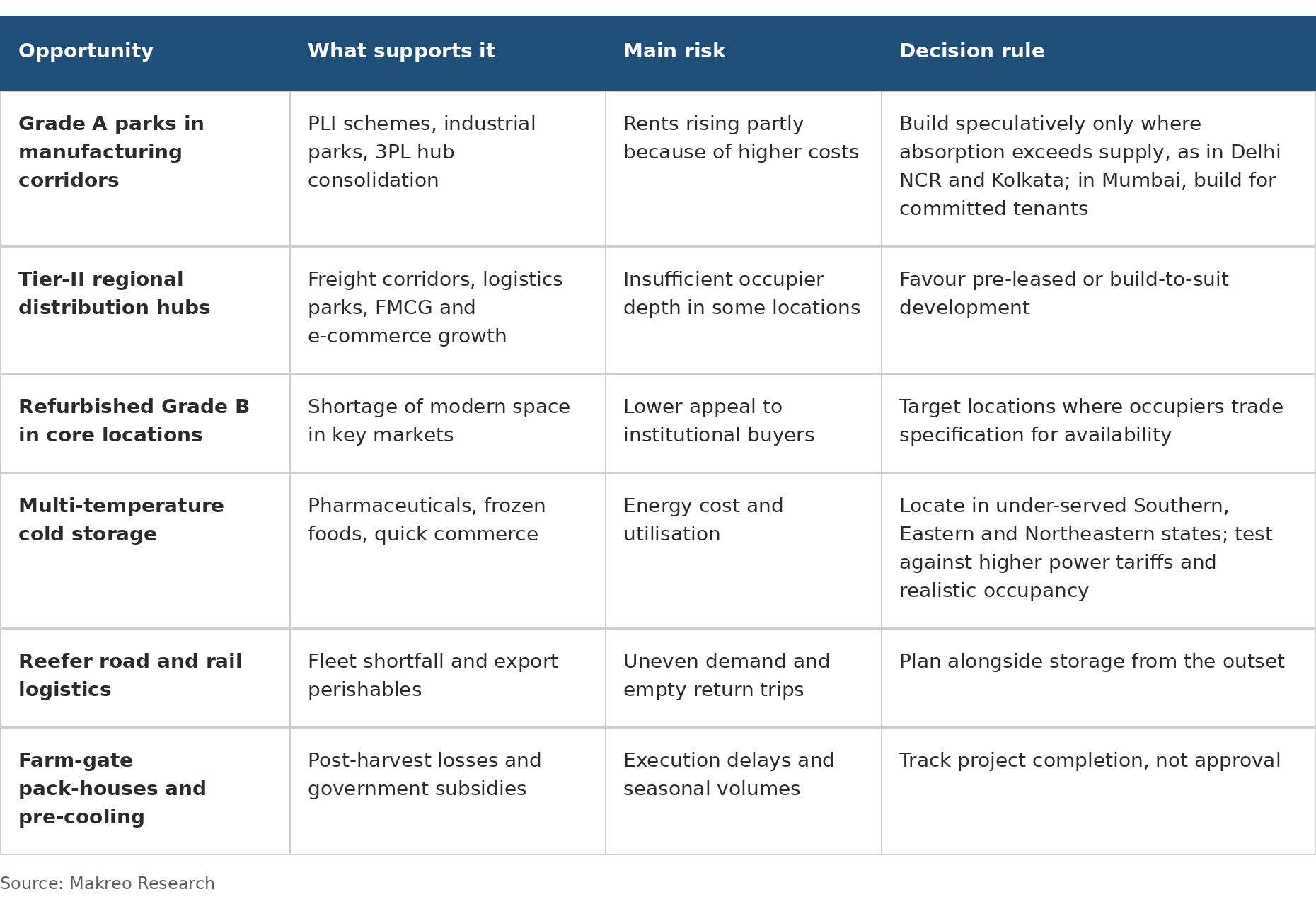
Delhi NCR and Kolkata absorbed more space than they added in H1 2026, which supports new Grade A supply in the right corridors. Mumbai's 1.9 million sq ft gap between supply and absorption points the other way: new development there is safer when tied to committed tenants.
In Tier-II hubs such as Lucknow, Nagpur, Indore, Patna and Guwahati, entry rents are lower, but occupier depth varies by corridor. These markets favour pre-leased or build-to-suit development over speculative construction. In core metros, refurbishing well-located Grade B stock can capture occupiers that trade specification for immediate availability.
2. Cold Storage Investment: Record Capacity Sits in the Wrong States and Serves the Wrong Crop
India's cold storage gap is geographic and functional rather than a shortage of total volume. Five states hold 73.91% of national capacity, and Uttar Pradesh alone holds 37.48%. As a result, states in the South, Centre, Northeast and East (outside West Bengal) remain under-served.
The design of existing stock adds to the gap. Roughly 75% of cold stores are built only for potatoes, and 70% are more than 20 years old, so they cannot readily hold frozen seafood at minus 18°C or vaccines at 2 to 8°C. The storage gap for fruit and vegetables is still estimated at 68 to 148 lakh MT.
The opportunity is multi-temperature capacity in under-served Southern, Eastern and Northeastern states. Another potato store in a state that already has ample capacity adds volume but little value.
3. Fleet Investment: Refrigerated Transport Is the Weaker Link
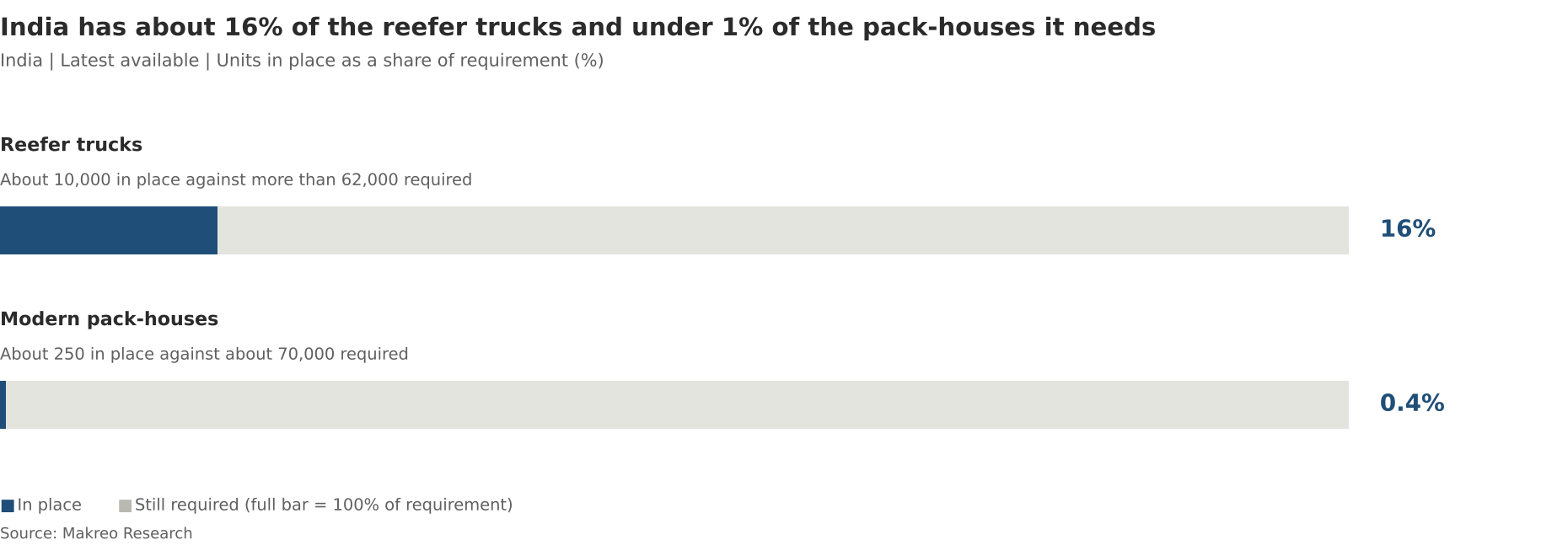
A cold store protects products only while they remain inside it. India operates about 10,000 reefer trucks against a requirement of more than 62,000, a shortfall of more than 80%. As a result, perishables often travel 800 to 1,000 km from growing regions to ports over three to four days without refrigeration, and a further 5% to 6% of fruit and vegetables is wasted at retail.
Rail is beginning to close part of this gap. In May 2026, Maersk and CONCOR launched a weekly refrigerated rail service carrying pharmaceutical exports from Hyderabad to Nhava Sheva port. Refrigerated rail links between Sanand and Pipavav, and perishable cargo hubs at Ahmedabad and Hyderabad airports, give exporters comparable options.
Although the fleet shortfall is large, reefer operators face uneven seasonal demand and empty return trips. Refrigerated fleets earn best when they are planned alongside storage, not bought on their own.
4. Farm-Gate Investment: Pack-Houses and Pre-Cooling Are the Widest Gap
The shortfall begins before produce reaches a cold store. India has about 250 modern pack-houses, where produce is sorted, packed and pre-cooled, against a requirement of about 70,000. Post-harvest losses of fruit and vegetables run at 10% to 15%, and much of that value is lost at the farm gate.
Government support helps projects start, with capital subsidies of 35% to 50% under the MIDH scheme. However, 26% of cold chain projects approved under PMKSY remained incomplete in December 2025. Approval does not always become operational capacity, so investors should track completion rather than approvals.
 Higher Cold Storage Rents Do Not Always Mean Higher Profits
Higher cold storage rents do not guarantee higher profits. Frozen storage at minus 18°C earns INR 800 to 2,000 per pallet per month, against INR 500 to 1,200 for ambient and chilled pallets. However, a cold store's annual operating costs can equal 15% to 40% of its construction cost, and electricity accounts for 45% to 60% of those operating costs. Power demand from cold storage is rising by 19.8% a year, about 2.8 times faster than power supply.
Utilisation and product mix therefore decide profitability. Snowman Logistics returned to a standalone net profit in Q2 FY27, with its EBITDA margin rising to about 14.7% from around 13% a year earlier, after adding multi-temperature capacity in Hyderabad, Pune and Kolkata. Rent sets the ceiling on cold storage returns, but occupancy and power costs decide how close an operator gets to it.
 Which Companies Are Investing in India Warehousing and Cold Chain, and Where?
Brookfield, IndoSpace, Prologis, Welspun One and NDR InvIT are leading warehousing investment in India, while Snowman Logistics, Maersk and Indicold are adding cold chain capacity. Most capital is going to Mumbai, Pune, Chennai, Bengaluru, Delhi NCR and Gujarat, with new parks in Guwahati, Nagpur and Indore.
The following developments show where investment is taking place across the India warehousing and cold chain market:
-
Brookfield entered Indian warehousing at scale. It agreed to acquire eight of ESR India's industrial and logistics parks, covering 10.5 million sq ft and about 98% leased, with INR 4,300 crore committed to the acquisition and future development (October 2026).
-
Pension capital bought ready income. IndoSpace and CPP Investments acquired six parks totalling 9 million sq ft across Bengaluru, Chennai, Delhi, Mumbai and Pune for INR 3,000 crore (November 2025).
-
Public markets tested the story. Blackstone-backed Horizon Industrial Parks listed on the NSE close to its issue price (August 2026) and plans to double its portfolio to 100 million sq ft.
-
InvITs expanded in the South. NDR InvIT acquired a 1.78 million sq ft asset in Hosur, Tamil Nadu, for INR 285 crore (February 2026), and 0.79 million sq ft in Kochi and Coimbatore for INR 260 crore (April 2026).
-
Developers built next to industrial and port demand. Prologis began projects worth INR 3,300 crore, including a 1.1 million sq ft park at Redhills, North Chennai (March 2026). Welspun One announced an INR 550 crore, 1.2 million sq ft park at Talegaon, Pune, and secured INR 2,300 crore of financing for its JNPA park near Mumbai. IndoSpace is developing a 1.7 million sq ft park at Bhiwandi.
-
3PL capacity moved into new regions. Mahindra Logistics added more than 4 lakh sq ft in Guwahati and Agartala (October 2025), and Allcargo Supply Chain opened a 275,000 sq ft park at Panapakkam near Chennai (September 2025).
-
Rail-linked and multimodal capacity grew in central India. Gateway Distriparks is investing INR 150 crore in a rail-linked inland container depot near Pithampur, Indore, and Central Warehousing Corporation signed an agreement for a multimodal logistics park with pharmaceutical and perishable cold storage at MIHAN, Nagpur (March 2026).
-
Cold chain operators added pallets and automation. Maersk and HyFun Foods opened a 260,000 sq ft, 14,700-pallet frozen facility at Mehsana, Gujarat. Snowman Logistics added 10,000 pallets in Hyderabad, 5,900 in Pune and 9,557 across Kolkata and Krishnapatnam. Indicold commissioned an automated frozen facility with more than 10,000 pallet positions at Detroj, Gujarat, and Celcius Logistics raised INR 250 crore to extend its network to more than 1,000 cities (May 2025).
These developments highlight three investment priorities:
-
Established rental income. Large investors are buying parks that already earn rent. The flat listing of Horizon Industrial Parks shows that investors want leased warehousing but are not paying a large premium for future growth, so returns will depend on rental growth and occupancy.
-
Development next to known demand. New parks sit beside factories, ports and rail terminals, and those in Guwahati, Nagpur and Indore show developers following manufacturing and regional distribution beyond the largest metros.
-
Multi-temperature networks. Cold chain operators are moving from single-commodity stores to automated, multi-temperature capacity in Hyderabad, Gujarat and Tier-II hubs such as Patna, Lucknow and Kolkata. Unlike a leased park, this capacity earns only when its pallets are full.
Makreo Research's study benchmarks 12 leading India warehousing and cold chain companies by revenue, warehousing footprint, pallet capacity, fleet strength and geographic presence. That comparison helps investors and operators see where competitors are strong, where service gaps remain and where expansion is likely to face less competition.
What This Means for India Warehousing and Cold Chain Investors to FY2032
The India warehousing and cold chain market will keep growing to FY2032, but returns will follow fit with demand rather than headline growth. Four priorities emerge from the analysis:
-
Grade A and refrigerated space, built to a known specification. Value is moving to higher-specification space, but well-located Grade B stock still leases when modern supply is short. Developers should match grade to the occupier rather than assume Grade A always wins.
-
Buildings for defined occupiers. Manufacturers and 3PL operators take three-quarters of leasing, and quick commerce needs compact urban stores. Mid-sized, generic warehouses that suit neither face the highest vacancy risk.
-
Micro-markets where absorption leads supply. Delhi NCR and Kolkata support new supply today, while Mumbai calls for committed tenants and Tier-II hubs for pre-leased development.
-
Cold chain capacity linked from farm to market. Multi-temperature storage in under-served states, planned with reefer road or rail links and farm-gate pre-cooling, will earn more than stand-alone storage, provided power costs and occupancy are tested first.
Through FY2032, investors and operators should track new supply against absorption in each micro-market, cold store utilisation by temperature range, electricity cost per pallet, reefer truck availability on key routes and the completion rate of approved cold chain projects.
India does not simply need more warehouses and cold stores. It needs capacity that matches where goods are produced, how they move and the temperature at which they keep their value.
How Makreo Research Supports Warehousing and Cold Chain Investment Decisions in India
The decisions that matter in this market rest on evidence that headline capacity and leasing data cannot provide: which micro-markets are absorbing more than they add, which occupiers are committing to new space, which temperature ranges are genuinely short and how power costs change project returns. Makreo Research supports investors, developers, 3PL operators and cold chain companies with that evidence through consulting and B2B market surveys.
Our research services include:
-
Market entry and expansion planning - Prioritise Indian cities, Tier-II hubs and logistics corridors by demand, supply and rents.
-
Site selection and feasibility studies - Test locations and specifications for Grade A, multi-storey and cold storage assets.
-
Cold chain feasibility - Assess demand by product category, temperature range and location, including power cost and utilisation scenarios.
-
Reefer and multimodal logistics assessment - Evaluate fleet requirements, rail options and connections between farms, cold stores, ports and markets.
-
Competitor benchmarking - Compare operators by warehousing footprint, pallet capacity, fleet strength and geographic presence.
-
Occupier and customer surveys - Understand space requirements, lease intentions and switching triggers among manufacturers, 3PLs and cold chain users.
-
Pricing and commercial due diligence - Benchmark rents and pallet rates and validate markets for proposed acquisitions.
Our India Warehousing and Cold Chain Market and Forecast to 2032 covers FY2023 to FY2032, with FY2026 as the base year. It segments warehousing by grade, type, end-use industry, city tier, infrastructure, ownership and structure, and cold chain by service, market structure, sector, application and temperature, across North, South, East and West India. The study projects an 11.21% CAGR from FY2027 to FY2032 and includes scenario analysis, 312 figures and tables and profiles of 12 leading companies.
To discuss a site selection study, corridor assessment or cold chain entry plan, visit our Custom Research or Market Survey pages, or contact [email protected].
Frequently Asked Questions
What is the India warehousing and cold chain market forecast to FY2032?
Makreo Research forecasts the India warehousing and cold chain market to grow at an 11.21% CAGR from FY2027 to FY2032, passing USD 40 billion after 2030. The market was valued at INR 2,310.26 billion in FY2026, after growing at 10.21% a year over FY2023 to FY2026.
Which industries drive warehouse leasing in India in 2026?
Manufacturing and third-party logistics (3PL) firms took 76% of India’s warehouse leasing in H1 2026. Manufacturers, including automotive, electronics, pharmaceutical and engineering companies, held 46% and 3PL operators 30%, while retail, e-commerce and consumer goods each took under 10%.
Is Grade A warehousing still preferred if Grade B leasing is rising in India?
Yes. Grade A facilities made up around 60% of India’s warehousing market value in FY2026 and are expected to grow fastest to FY2032. Even so, Grade B leasing rose 51% year on year in H1 2026 in Mumbai and Delhi NCR, as occupiers accepted older buildings in the right locations.
Which Indian cities are absorbing more warehouse space than they add?
Delhi NCR and Kolkata absorbed more warehouse space than they added in H1 2026, which supports new supply there. Mumbai led India with 10.7 million sq ft leased, yet it added 4.6 million sq ft of new supply and absorbed only 2.7 million sq ft, so new projects there need committed tenants.
Why does India still lose produce despite record cold storage capacity?
India’s 402.89 lakh MT of cold storage sits in the wrong places and serves the wrong crops. Five states hold 73.91% of capacity and about 75% of cold stores are built only for potatoes, so fruit and vegetables worth about INR 92,651 crore are still lost after harvest every year.
Why is cold transportation growing faster than cold storage in India?
About 10,000 refrigerated (reefer) trucks serve India against a need for more than 62,000. That shortfall is why cold transportation revenue is projected to grow at a 10.85% CAGR from FY2027 to FY2032, ahead of cold storage at 10.06%, according to Makreo Research.
India Warehousing Market, India Cold Chain Market, India Warehousing and Cold Chain Market, Grade A Warehousing India, Grade B Warehousing India, India Warehouse Rents, India Warehouse Absorption, Mumbai Warehousing, Delhi NCR Warehousing, India 3PL Warehousing Demand, Quick Commerce Dark Stores India, India Cold Storage Capacity, Multi-Temperature Cold Storage India, Reefer Transport India, India Logistics Investment, Multimodal Logistics Parks India