
UAE Logistics Market Set to Exceed USD 70 Billion by 2032 - Which Ports, Corridors and Cold Chain Assets Will Capture Growth?
UAE logistics revenue is forecast to exceed USD 70 billion after 2030, growing at an 8.13% CAGR. Explore investment opportunities in ports, rail, warehousing and cold chain.
In 2026, UAE trade grew 13% while its biggest port lost almost all its containers. Both things are true, and together they explain where the UAE logistics market goes next.
In the first half of 2026, UAE non-oil foreign trade reached AED 1.937 trillion, up 13.1% year on year. Over the same months, container volumes through Jebel Ali fell by 90 to 95%, after regional conflict disrupted shipping through the Strait of Hormuz. Trade did not collapse. It took a different road.
Over the past several months, Makreo Research sized the UAE logistics, warehousing and cold chain market and spoke with port operators, 3PLs, developers and investors who have run Gulf supply chains through more than one crisis. One conclusion stood out. Growth to 2032 is not in doubt. What is in doubt is which ports, corridors, warehouses and cold stores will capture it.
Makreo Research estimates that UAE logistics market revenue will grow at an 8.13% CAGR, taking the market past USD 70 billion after 2030. Our analysis points to four shifts behind that number: cargo is moving to east coast gateways, road and rail are carrying more of the inland load, warehouse demand is concentrating in quality space, and cold chain capacity is falling behind demand.
The market forecast shows the overall growth potential, but investment returns depend on which assets and locations investors choose. The following five questions help investors and operators assess these opportunities. Each addresses a key concern: can the asset remain profitable both if shipping through the Strait of Hormuz remains restricted and if normal operations resume?
UAE Logistics Market at a Glance
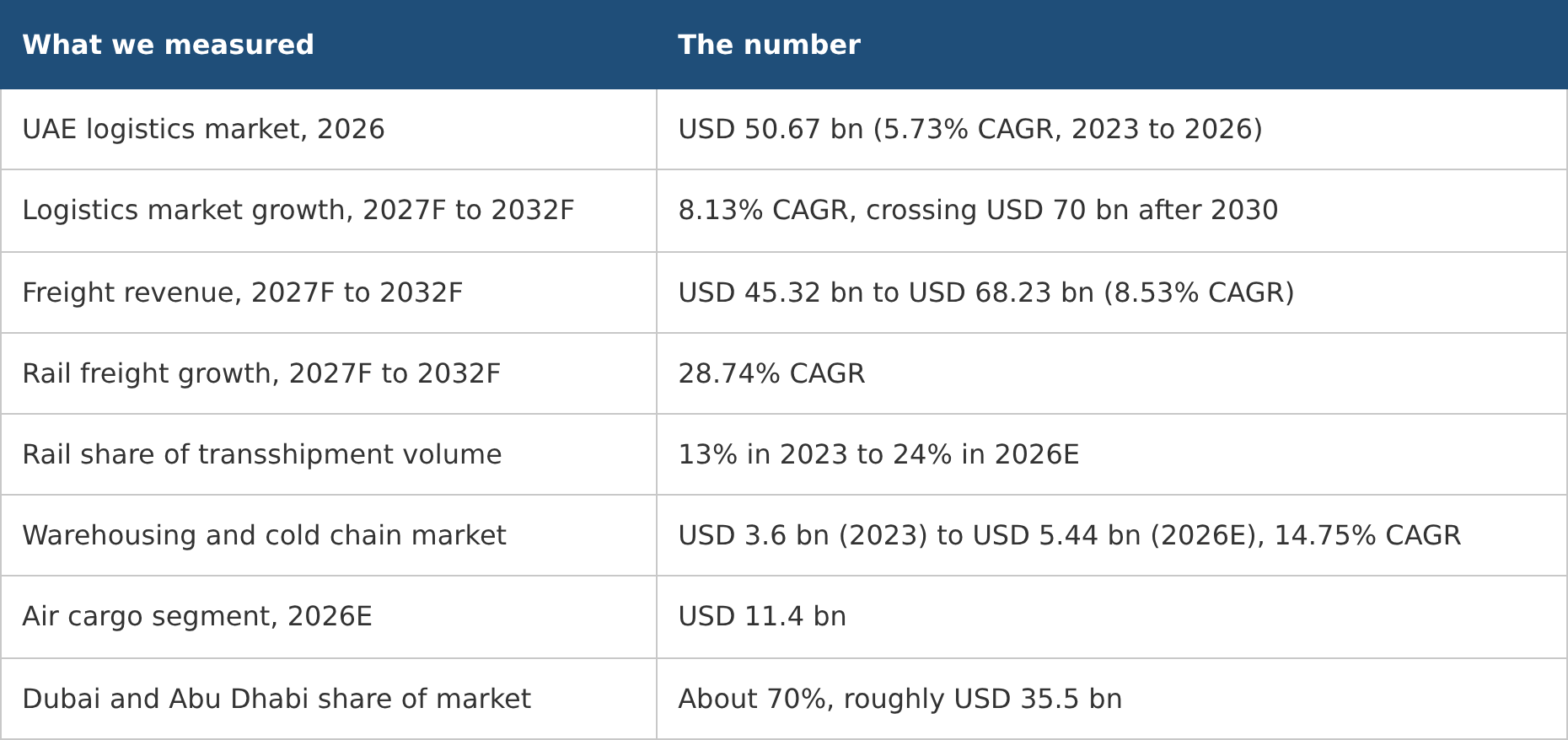
Source: Makreo Research
Where Is the Market Growing, and Which Segments Offer the Strongest Opportunities?
The UAE logistics market is still growing, but the growth is moving to new gateways, new modes and more specialised space.
Geopolitical disruption has changed established shipping routes, and with them the way cargo moves, the way infrastructure is used and the way customers buy logistics services. Even so, trade activity, road freight, rail connectivity and industrial demand continue to create new openings. As a result, the market is moving towards alternative logistics gateways, multimodal transportation and specialised warehousing.
Road Freight and Cross-Border Trade Are Strengthening Regional Connectivity
Road freight supports both domestic distribution and cross-border trade. Dubai recorded more than 500,000 truck trips per day in 2026, compared with about 300,000 in 2024. Internal movements accounted for 83% of total truck traffic, supported by around 85,000 registered trucks.
Road freight revenue exceeded USD 8 billion, with the segment growing at an estimated 11.2% CAGR. Growth reflects rising trade volumes and greater demand for road transport as businesses adjust to changes in shipping routes.
The UAE–Saudi Arabia and UAE–Oman corridors are important links for regional cargo movement. In 2026, the UAE accounted for approximately 50% of Saudi Arabia’s cross-border land freight market, while bilateral road freight between the UAE and Saudi Arabia was estimated to exceed USD 1.3 billion.
Trade activity continues to support transport demand. UAE non-oil exports reached AED 452.8 billion in H1 2026, representing 23.4% of total non-oil foreign trade. Road freight has helped maintain deliveries during shipping disruptions, although rail freight is forecast to grow faster.
Growth Opportunities Differ Across Logistics Segments
-
Rail freight offers the fastest projected growth. Makreo Research forecasts revenue growth of 28.74% CAGR from 2027F to 2032F. Rail’s share of transshipment volume has increased from 13% to 24%, creating opportunities for facilities connected to the rail network.
-
Total freight revenue is projected to increase from USD 45.32 billion to USD 68.23 billion, at an 8.53% CAGR. Returns for individual operators will depend on the routes they serve, customer demand and operating costs.
-
Air cargo was valued at USD 11.4 billion in 2026E. Opportunities include combined sea-air services and pharmaceutical shipments requiring reliable delivery and specialised handling.
-
Cold chain logistics offers opportunities in temperature-controlled storage and transport. Food and beverage accounts for 55% of demand. Investors should assess capacity shortages by location, product category and temperature requirement.
-
Well-located Grade A warehouses offer rental growth opportunities. Average warehouse rents increased by 17.6% in 2025, although performance varies by location and building quality. Proximity to ports, industrial areas and transport connections remains important.
-
Marine cargo faces a projected decline of 1.5% annually. Investment decisions should assess whether assets remain commercially viable both if restrictions around the Strait of Hormuz continue and if normal shipping operations resume.
Overall freight market growth does not mean every port or corridor will grow equally. Investment opportunities depend on where cargo moves, which industries generate demand and whether local infrastructure can support it.
Which Industries, Geographies and Customer Segments Should We Target?
Investors and logistics operators should focus on industries with sustained demand and locations with suitable transport connections and storage facilities.
Industries Driving Logistics Demand
-
Retail and industrial activities each account for 27% of logistics revenue, together representing more than half the market. Both support demand for freight transport, warehousing and distribution services.
-
Manufacturing contributed approximately 15% of UAE GDP in 2025 and accounted for 35.1% of the 12.35 million sq ft of industrial and logistics space requirements in H1 2026. Logistics companies accounted for a further 15.5% of these space requirements.
-
Food and beverage accounts for 55% of cold chain demand in 2026E. Longer delivery times can encourage importers to hold additional stock near consumers, increasing demand for temperature-controlled storage.
-
Pharmaceuticals create demand for specialised handling and temperature-controlled logistics. At Abu Dhabi International Airport, pharmaceuticals represented 28% of cargo in May 2026, while perishables accounted for another 22%. Together, these categories represented half the airport’s cargo, highlighting the importance of facilities suited to temperature-sensitive products.
Locations Offering Different Investment Opportunities
Investment opportunities vary across the UAE according to trade activity, industrial demand, transport connections and available warehouse capacity.
-
Dubai supports international trade, distribution and re-exports through Jebel Ali, Dubai International Airport, Dubai South and JAFZA. Warehouse rents in Dubai South increased by 22%, indicating strong demand in this location.
-
Abu Dhabi supports industrial, manufacturing and energy-related logistics through KEZAD and Khalifa Port. KEZAD accounts for approximately 55% of the country’s industrial area, making it an important location for industrial logistics and warehousing.
-
Fujairah and Khor Fakkan are handling cargo redirected from routes through the Strait of Hormuz. However, further growth depends on available port and inland transport capacity. Khor Fakkan is operating at a reported capacity limit of 65,000 TEUs per week.
-
Inland Sharjah, particularly Al Dhaid and Sajaa, offers opportunities for logistics facilities connecting road and rail transport. These locations could benefit as rail carries a larger share of cargo.
-
Other Northern Emirates locations offer additional warehouse capacity, with more than 10 million sq ft available, including 5.2 million sq ft in Umm Al Thuoob. Investors should assess whether the available space meets occupiers’ requirements for location, building quality and connectivity.
Dubai and Abu Dhabi together account for approximately 70% of the UAE logistics market, equivalent to USD 35.5 billion. Dubai’s logistics demand is closely linked to international trade and distribution, while Abu Dhabi’s demand is supported by industrial production, manufacturing and energy activities.
Customer Segments to Prioritise
-
Importers generate demand for port handling, freight transport, customs clearance and domestic distribution. Import freight accounts for 40% of cargo activity, making changes in shipping routes an important consideration for this customer group.
-
Re-exporters and transit shippers need reliable connections between ports, airports, warehouses and regional markets. UAE non-oil exports reached AED 452.8 billion in H1 2026, while total non-oil trade approached AED 3 trillion over nine months. These figures provide context for the scale of trade activity, although they do not measure re-export or transit demand separately.
-
Large warehouse occupiers require modern facilities with sufficient space and suitable transport access. In Dubai, units larger than 50,000 sq ft accounted for 59.2% of demand. Higher lease renewals also indicate that many existing occupiers are retaining their facilities.
-
Shippers of temperature-sensitive goods, including food, pharmaceuticals and perishables, require suitable storage and transport throughout delivery. These requirements remain important regardless of which port handles the cargo.
Identifying the target industry, location and customer group helps investors determine which facilities, fleet capacity and services are needed.
Where Should Investors Prioritise Infrastructure, Fleet, Warehousing and Technology Investments?
Investors should prioritise assets that stay viable whether the Strait of Hormuz remains constrained or reopens.
Investment decisions in the UAE logistics sector need to follow the changing geography of cargo movement. The disruption has raised the importance of alternative ports, inland logistics corridors and multimodal transportation. However, investors should avoid building capacity on temporary cargo diversion alone.
The priority is locations and assets that remain commercially viable under two scenarios: continued restrictions around the Strait of Hormuz, and a gradual return to normal maritime operations. Long-term viability will depend on cargo volumes, operating costs, connectivity, utilisation and the ability to serve more than one trade route.
1. Infrastructure Investment: East Coast Ports Are Gaining Strategic Importance, but Capacity Remains a Constraint
As shipping companies became cautious about navigating the Strait of Hormuz, a growing share of UAE-bound cargo was redirected to Fujairah and Khor Fakkan. To handle this shift, the UAE is strengthening its east coast port infrastructure.
The largest development is the proposed expansion of Fujairah through a 50-year concession covering two new terminals:
-
Al Rugaylat Terminal: planned capacity of up to 2.5 million TEUs, 1.7 million tonnes of general cargo and 190,000 CEUs. Its container-handling capacity is nearly three times that of Fujairah’s existing container terminal.
-
Dibba Terminal: an additional 3.6 million tonnes of general cargo capacity, widening the range of cargo the region can handle.
Together, these projects point to a long-term strategy to position Fujairah as an alternative maritime gateway for the UAE and regional markets.
The immediate challenge, however, is the limited capacity of existing infrastructure. Khor Fakkan’s weekly container throughput rose from about 8,000 TEUs to 65,000 TEUs after a new landside gate complex opened. That is a large improvement, but further growth depends on the next development phases being completed. For scale, Jebel Ali handled about 15.6 million TEUs in 2025, which shows how far the east coast ports still are from the established gateway.
Investment opportunities include port infrastructure, cargo handling, container terminals, bonded warehousing and logistics facilities near the ports. Investors should assess whether these facilities can attract sufficient cargo after normal shipping routes resume.
Even if traffic through the Strait of Hormuz returns to normal, the east coast keeps a strategic advantage. Its position on Indian Ocean shipping routes could cut sailing times by up to five days on certain services. That creates a longer-term case based on route efficiency, connectivity and supply chain resilience rather than temporary congestion at other ports.
A container landed on the east coast, though, is only halfway to its customer. The next question is how that cargo travels inland.
2. Fleet Investment: Road Transport Is Critical During Disruptions, but Expansion Must Be Linked to Sustainable Cargo Demand
Road transport has carried much of the load during the disruption, connecting east coast ports with Jebel Ali and other domestic destinations.
Between March and October 2026, more than 1 million TEUs moved from UAE east coast ports to Jebel Ali and domestic markets by road and rail. That is about 3,500 TEUs per day, supported by a fleet of more than 3,000 trucks. To speed this up, customs-approved green corridors were set up in coordination with Oman. Sealed trucks can move directly towards Jebel Ali, avoiding repeated customs procedures and making cross-border transport more efficient.
The scale of this movement needs context. About 3,500 TEUs a day is less than 10% of Jebel Ali’s normal average daily throughput of around 42,700 TEUs. Road transport is also estimated to cost 2.4 to 4.2 times more per tonne-kilometre than sea freight, which makes it an expensive option for sustained high-volume cargo. The sudden rise in truck traffic has also put pressure on key road corridors, border infrastructure, truck parking and cargo-handling networks.
Investment perspective: Trucks purchased mainly to transport cargo redirected during the disruption may be used less frequently once normal shipping routes resume. Investors should focus on fleets that can continue serving cross-border trade, transporting goods between rail terminals and warehouses, and collecting and delivering goods for local customers.
What Does This Mean for Future Investment?
Investors should consider logistics facilities that connect road and rail transport alongside any plans to purchase additional trucks. These facilities allow operators to choose between trucks and trains based on transport costs, available capacity and delivery requirements.
Locations around Al Dhaid and Sajaa in Sharjah could offer investment opportunities where suitable road and rail connections are available. Facilities in these areas could support cargo movement both during shipping disruptions and after normal operations resume.
Rail connections are also expanding. Jebel Ali is connected to the national rail network, and a freight service links Fujairah with Abu Dhabi’s industrial city. The planned Hafeet Rail connection with Oman is expected to provide another option for transporting goods across the border.
The investment priority is to connect transport and storage facilities efficiently. Trucks have helped maintain deliveries during the disruption, but moving large cargo volumes entirely by road can be expensive and increase congestion. Facilities that combine road access, rail connections and suitable warehousing could help operators manage costs and respond to changes in shipping routes.
Demand for Well-Located Warehouses Is Supporting Rental Growth Across UAE Logistics Hubs
Businesses in the UAE are increasingly renewing their existing warehouse leases. Demand for well-located, high-quality facilities is supporting higher rents, even as the number of new leases declines.
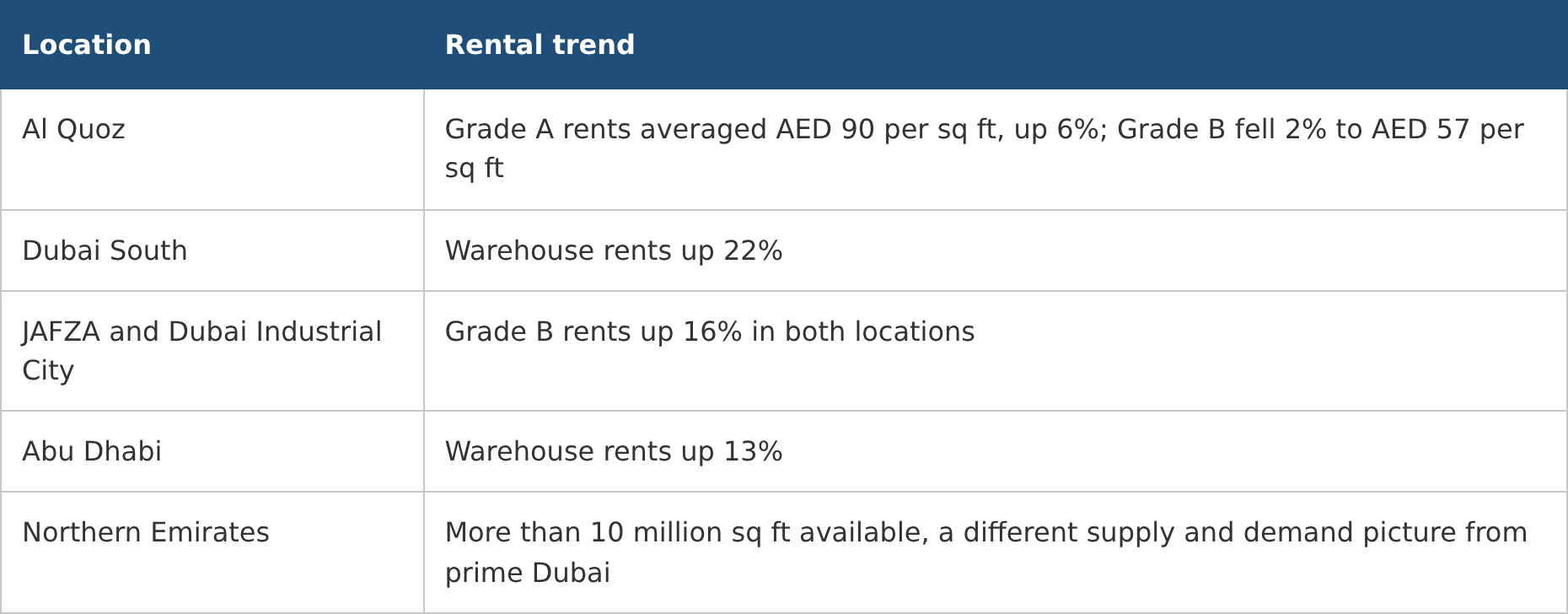
Approximately 19,100 warehouse lease transactions were recorded in 2025. New leases fell by 29.4%, while renewals increased by 18%, indicating that more existing tenants chose to remain in their facilities.
Despite the decline in new leases, the total value of warehouse leases increased by 14.2% to AED 3.2 billion, while average rental rates rose by 17.6%. Rental rates increased further in early 2026, rising by approximately 37.8% year on year.
However, rental performance varies by location and warehouse quality. Facilities with convenient transport access and specifications that meet tenants’ operating requirements are better positioned to attract demand and command higher rents.
Key rental trends across the UAE
Investment Decisions Should Reflect Location and Tenant Requirements
Warehouse performance in the UAE varies by location, building quality and transport access. Although space is available across the country, some facilities may not meet the requirements of logistics companies, manufacturers and distributors.
Before developing or purchasing a warehouse, investors should assess:
-
Local demand from businesses likely to use the facility.
-
Building specifications, including whether the space supports tenants’ storage and handling requirements.
-
Road access and connections to relevant ports and rail facilities.
-
Expected occupancy and the risk that the facility could remain partly unused.
Investors should assess where warehouse space is needed and what potential tenants require before adding capacity. This is particularly important for food, pharmaceuticals and other products that require temperature-controlled storage.
Cold Storage Requires Facilities Designed for Specific Temperature Requirements
Conventional warehouse space cannot replace purpose-built cold storage without suitable refrigeration, insulation and monitoring systems. Storage temperatures vary by product, with typical ranges including:
-
Frozen storage: −25°C to −18°C.
-
Chilled storage: 0°C to 4°C.
-
Controlled ambient storage: 15°C to 25°C.
As a result, the availability of more than 10 million sq ft of conventional warehouse space does not necessarily address shortages of suitable cold storage.
A recently announced AED 150 million distribution centre in Dubai illustrates the difference between total warehouse area and dedicated cold storage. The facility covers 350,000 sq ft, but only 25,000 sq ft, approximately 7%, is allocated to cold storage.
Investment opportunities include facilities with separate temperature zones near food distribution centres, airports, seaports and inland logistics hubs connected to rail. Investors should assess demand from food, pharmaceutical and other temperature-sensitive businesses before deciding on location, capacity and temperature requirements.
Technology Should Help Operators Adjust Routes and Improve Efficiency
The 2026 disruption highlighted the importance of changing transport routes and cargo-handling arrangements quickly. Technology investment should help operators make these adjustments, manage available capacity and maintain reliable deliveries.
Four areas deserve attention:
-
Transport planning across different modes: Systems that help operators choose between sea, road, rail and air services based on cost, capacity, delivery schedules and route availability.
-
Port gate and yard management: Automated entry systems, truck appointment scheduling and container yard management that help reduce queues and improve cargo collection and delivery.
-
Digital customs documentation and shipment tracking: Systems that help operators submit documents, monitor cargo movements and coordinate deliveries through approved cross-border routes.
-
Temperature and cold storage monitoring: Systems that track product temperatures and the use of storage space, helping operators identify temperature changes, manage capacity and reduce product losses.
Technology should support practical operating decisions. It should help companies adjust routes, use vehicles and storage space efficiently, complete customs procedures and protect temperature-sensitive cargo.
Investment priorities at a glance
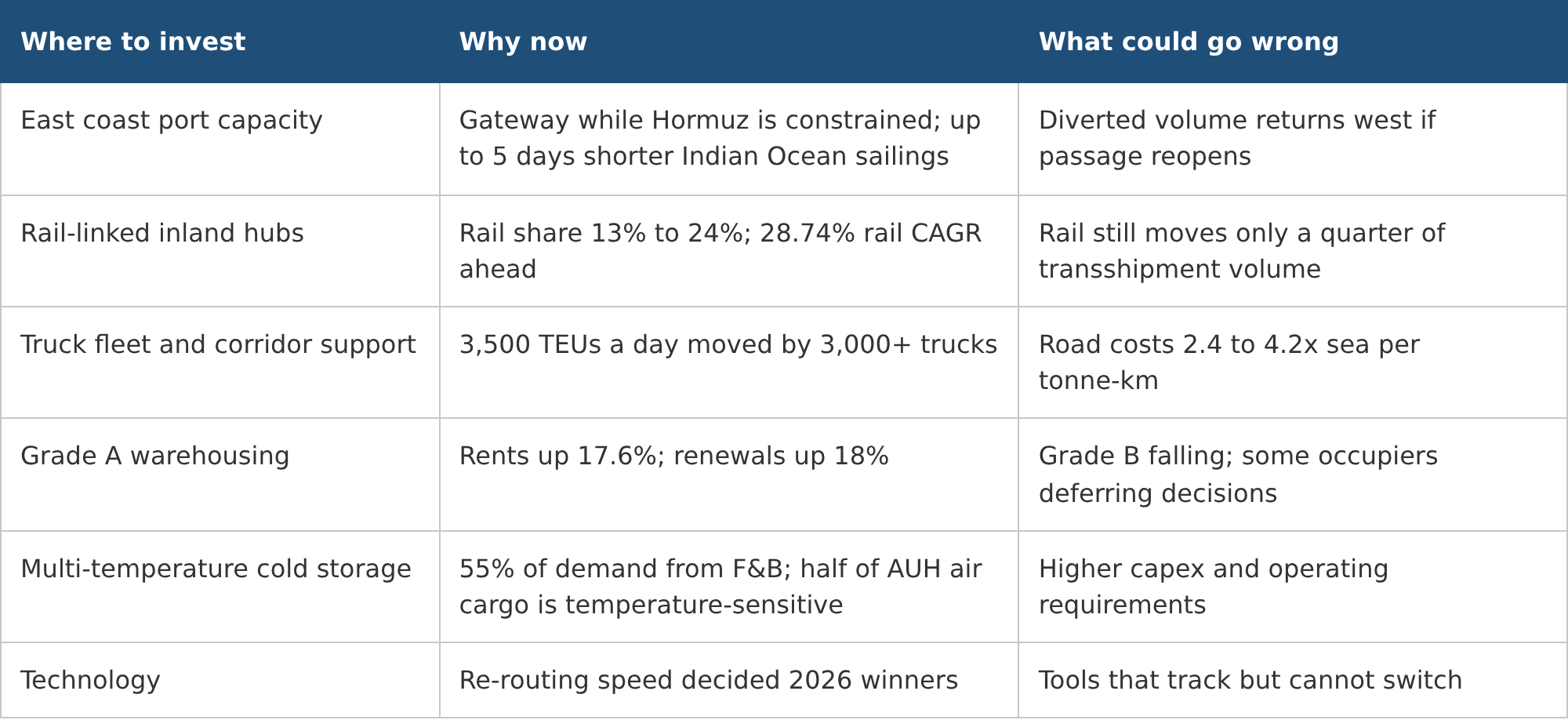
East coast capacity is a strong hedge, but it is not the right answer for every cargo type or every investor. Which asset fits depends on the cargo, the corridor and the scenario.
How Are Major Logistics Companies and Developers Expanding in the UAE?
Major companies are investing in east coast ports, inland transport connections, specialised warehouses and cold storage as cargo routes and customer requirements change.
The following developments illustrate where investment is taking place across the UAE logistics, warehousing and cold chain market:
-
DP World is expanding its east coast port operations. Its 50-year agreement covers the development and operation of the Al Rugaylat and Dibba terminals in Fujairah. The expansion is expected to bring its UAE container-handling capacity to almost 22 million TEUs.
-
KEZAD is adding temperature-controlled warehouse space in Abu Dhabi. A 75,241 m² facility beside the Abu Dhabi Food Hub will offer units starting from 18,807 m². The project forms part of a 43% expansion in warehousing capacity.
-
Specialised warehousing is expanding in JAFZA. A 20,000 m² Grade A facility, designed for a specific occupier’s requirements, is scheduled for completion in Q1 2027. It will include temperature-controlled storage and facilities for dangerous goods.
-
Dubai South is adding capacity for third-party logistics services. A 55,000 m² facility serving multiple customers is expected to be completed by summer 2027, supporting storage and distribution near Al Maktoum International Airport.
-
Some new distribution centres allocate a limited share of space to cold storage. A new AED 150 million facility in Dubai covers 350,000 sq ft, including 25,000 sq ft of cold storage. This illustrates why total warehouse area should be assessed separately from temperature-controlled capacity.
-
Institutional investors are acquiring warehouses with high occupancy. Three KEZAD warehouses, covering approximately 163,000 m², were acquired for AED 650 million at 97% occupancy. This transaction indicates investor interest in facilities with established tenants.
-
Rail connections are supporting inland cargo movement. Jebel Ali is connected to the national rail network, and a freight service links Fujairah with Abu Dhabi’s industrial city. The planned Hafeet Rail connection with Oman is expected to expand cross-border transport options.
These developments highlight three investment priorities:
-
Alternative port access. East coast port expansion provides additional options for cargo movement when shipping through the Strait of Hormuz is restricted.
-
Facilities designed for specific customer needs. New developments include temperature-controlled storage, dangerous-goods facilities and warehouses built to occupiers’ requirements.
-
Established rental income. Acquisitions of highly occupied warehouses show interest in assets with existing tenants, although this does not eliminate investment risk.
Makreo Research study assesses 18 logistics, warehousing and cold chain companies by operating locations, warehouse area, pallet capacity, fleet size and services offered. This comparison helps investors and operators understand competitors’ capabilities, identify service gaps and evaluate expansion opportunities.
What This Means for UAE Logistics Investors and Operators to 2032
Investment opportunities will depend on where cargo moves, what customers need and whether facilities remain commercially viable when shipping routes change. Four priorities emerge from the analysis:
-
Port facilities and nearby warehousing. Cargo redirected to Fujairah and Khor Fakkan is creating demand for cargo handling, bonded storage and warehouses near these ports. Investors should assess whether sufficient demand will remain after normal shipping through the Strait of Hormuz resumes.
-
Connected road and rail services. The expansion of Etihad Rail and transport connections through Oman could create opportunities for inland logistics hubs and fleets that move goods between ports, rail terminals, warehouses and customers.
-
Warehouses suited to tenant requirements. Investment decisions should consider location, building specifications and transport access alongside warehouse size. Manufacturing expansion and construction activity also support demand for industrial storage and distribution facilities.
-
Temperature-controlled storage and transport. Food imports, pharmaceutical distribution and certain chemical and industrial products require specific storage conditions. Investors should assess demand by product, location and temperature range before developing facilities with separate temperature zones.
Across these areas, digital customs systems, transport planning tools and real-time shipment monitoring can help operators coordinate deliveries and respond to route changes.
How Makreo Research Supports UAE Logistics Investment Decisions
Makreo Research support investors, developers and logistics companies assess market opportunities, select suitable locations and plan expansion across the UAE. Through consulting and B2B market surveys, we evaluate customer demand, competitor capabilities, infrastructure availability and operating costs to support these decisions.
Our research services include:
-
Market entry and expansion planning - Assess demand across logistics segments and emirates, identify target customers and evaluate market entry options.
-
Site selection and feasibility studies- Compare locations by warehouse availability, rents, building specifications and access to ports, roads and rail networks.
-
Port and transport capacity assessment - Evaluate cargo volumes, infrastructure constraints and connections between ports, inland facilities and cross-border markets.
-
Cold chain feasibility - Assess storage and transport requirements by product category, temperature range and location to guide facility planning.
-
Competitor benchmarking - Compare logistics providers by operating locations, warehouse capacity, fleet size and services offered.
-
Customer and occupier surveys - Understand service requirements, purchasing criteria, lease renewal intentions and reasons for changing providers or locations.
-
Pricing and commercial assessment - Evaluate warehouse rents, freight charges and operating costs, including commercial due diligence for proposed acquisitions.
-
Shipping disruption scenario analysis - Assess how continued restrictions around the Strait of Hormuz or a return to normal operations could affect demand, utilisation and revenue.
Our UAE Logistics, Warehousing and Cold Chain Market study examines opportunities across all seven emirates, compares leading companies and assesses how changes in shipping through the Strait of Hormuz could affect investment decisions.
To discuss your investment or expansion requirements, visit our Consulting services or contact [email protected].
Frequently Asked Questions
How big is the UAE logistics market in 2026?
The UAE logistics market is valued at USD 50.67 billion in 2026, after growing at a 5.73% CAGR from 2023 to 2026. Makreo Research expects growth to accelerate to an 8.13% CAGR between 2027 and 2032, taking the total market past USD 70 billion after 2030.
How has the Strait of Hormuz disruption affected UAE logistics in 2026?
Container volumes through Jebel Ali fell by 90 to 95% in the first half of 2026 after regional conflict disrupted shipping through the Strait of Hormuz. Trade still grew, with UAE non-oil foreign trade reaching AED 1.937 trillion, up 13.1% year on year, as cargo shifted to other routes.
Which UAE logistics segment is growing fastest to 2032?
Rail freight is the fastest-growing segment, with revenue projected to rise at a 28.74% CAGR from 2027 to 2032. Rail’s share of transshipment volume has already climbed from 13% to 24%, which favours inland hubs with road and rail access, such as Al Dhaid and Sajaa in Sharjah.
Which industries, locations and customers should UAE logistics investors target?
Retail and industrial activities each account for 27% of UAE logistics revenue, and food and beverage drives 55% of cold chain demand. Dubai and Abu Dhabi hold about 70% of the market, while importers, re-exporters, large warehouse occupiers and temperature-sensitive shippers are key customer segments.
Who are the leading UAE logistics companies, and where are they expanding?
Makreo Research assesses 18 logistics, warehousing and cold chain companies by location, warehouse area, pallet capacity, fleet size and services. DP World is expanding in Fujairah, KEZAD is adding temperature-controlled space beside the Abu Dhabi Food Hub, and new Grade A facilities are under way in JAFZA and Dubai South.
UAE Logistics market, UAE Warehousing market, UAE Cold Chain Market, UAE Logistics Investment, Strait of Hormuz Shipping Disruption, UAE East Coast Ports, Fujairah Port Expansion, Khor Fakkan Port, Jebel Ali Container Volumes, UAE Rail Freight, Etihad Rail Freight, Hafeet Rail, UAE Road Freight, UAE Warehouse Rents, UAE Grade A Warehousing, UAE Cold Storage Shortage, UAE Cold Chain Investment, Multimodal Logistics UAE, Dubai South Logistics, KEZAD Warehousing, UAE Logistics Supply Chain Resilience