Nigeria Remittance Market Size and Forecast (2021–2028) – Analysis by Remittance Type, Channel (Banks, MTOs, Mobile Money, Fintech, and Informal Transfers), Payment Method, Corridors, Service Provider, and Technology Trends
Nigeria Remittance Market Size
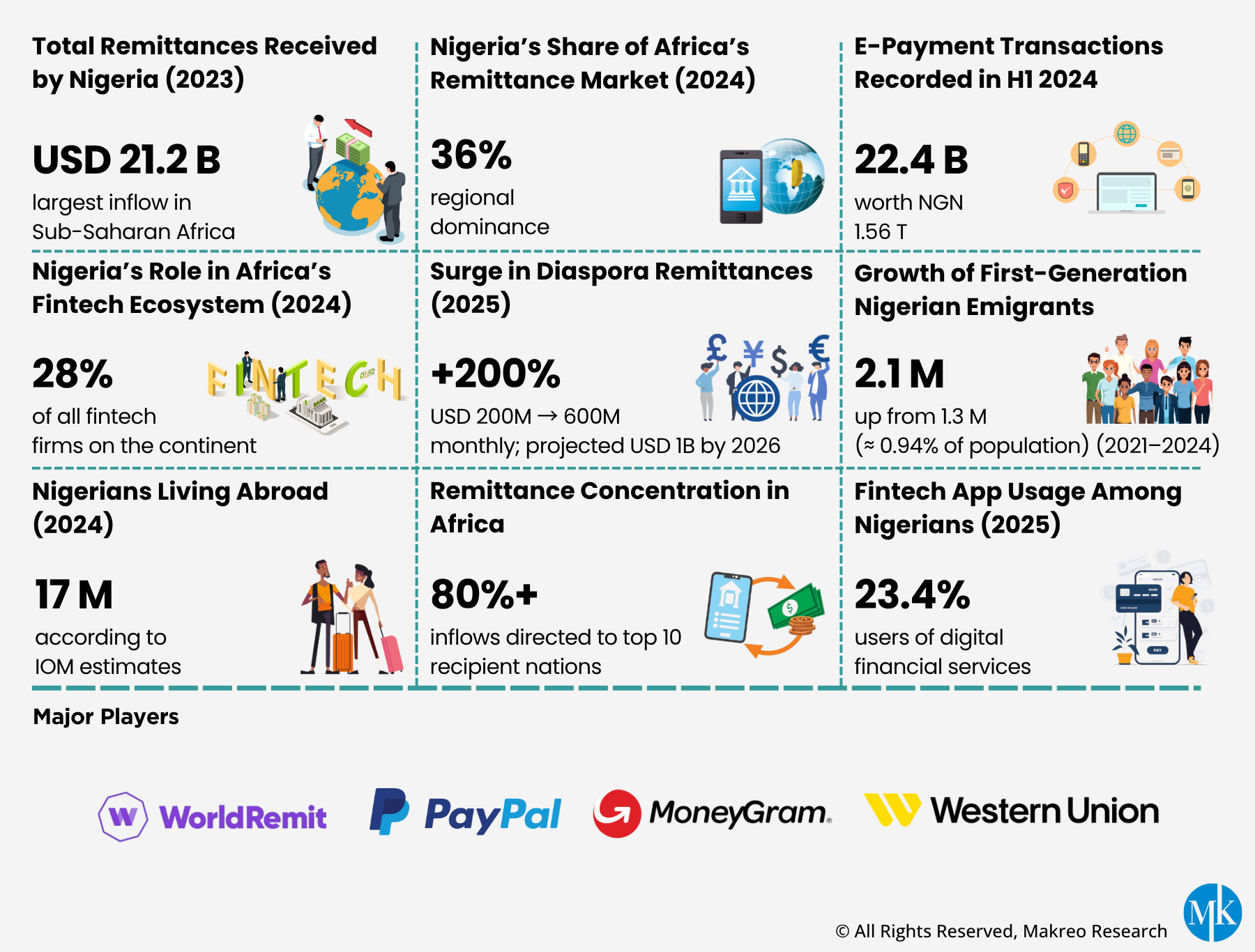
The Nigeria Remittance Market reached USD 21.2 billion in 2023, continuing to serve as a critical pillar of the country’s economy. Remittances are projected to account for approximately 12% of Nigeria’s GDP in 2025, highlighting their significance as a source of foreign exchange and household income, and reflecting the robust financial linkages with the global diaspora.
In 2024, the market was predominantly segmented by remittance type, with inward remittances representing over 50% of total flows. Personal remittances remained the dominant component, underscoring their essential role in supporting family welfare and consumption.
While traditional transfer channels, including banks and money transfer operators, maintained a leading market share, digital remittances in Nigeria experienced rapid adoption. Digital platforms grew at an impressive annual rate of 15.92%, driven by increased financial inclusion, mobile penetration, and the convenience of online transactions.
-
Talent Migration: The continued outflow of skilled professionals, particularly in technology and engineering, to countries such as the United States, Canada, and the United Kingdom remains a major driver of Nigeria diaspora remittances. This trend is fueled by the pursuit of better employment opportunities, political stability, and improved living standards abroad.
-
Digital Transformation: The expansion of fintech remittance platforms in Nigeria is enhancing accessibility, reducing transaction costs, and accelerating payment speed. This digital shift is encouraging the transition from traditional cash-based remittances to digital and mobile money remittance solutions.
-
Policy Initiatives: The Nigerian government is actively engaging its diaspora through strategic measures, including the proposed USD 10 billion Nigeria Diaspora Fund, aimed at channeling remittance inflows into priority sectors such as infrastructure, education, and economic development.
-
Economic Dependence: Remittances constitute a significant portion of household income and foreign reserves, positioning the sector as a stabilizing force amid global and domestic economic fluctuations.
Nigeria Remittance Industry Insights
, 2021 – 2024.png)
In 2024, Nigeria received USD 21.2 billion in remittances, representing a 9% increase compared to the previous year and marking the highest inflow in five years. Despite their dominant position in formal remittance channels, banks face limitations in rural outreach due to infrastructure constraints, which affects their ability to serve remote populations effectively.
Increasing Talent Migration
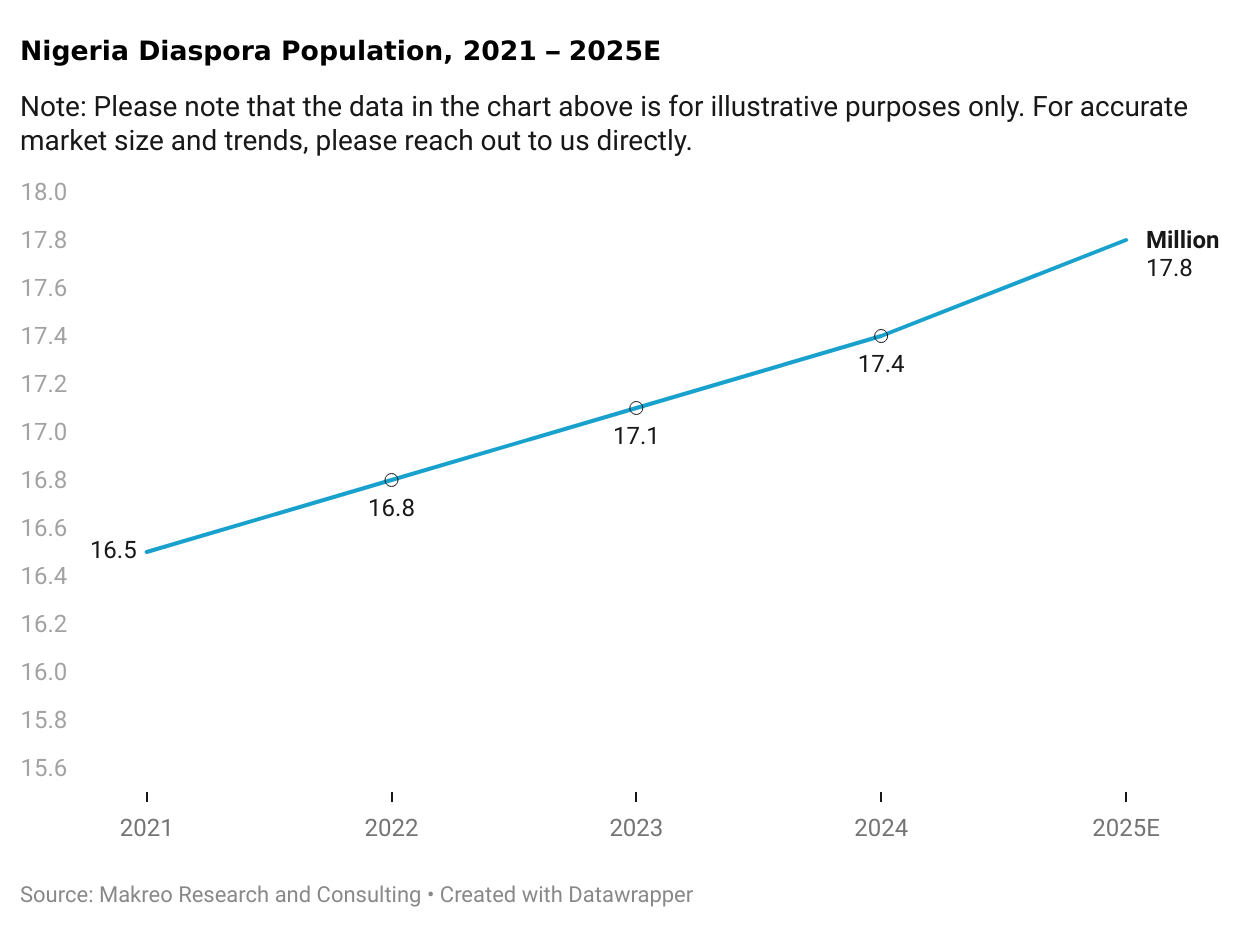
An increasing number of skilled Nigerians, particularly in technology and engineering sectors, have been migrating to countries like the United States, Canada, and the United Kingdom. This trend is driven by factors such as better career opportunities, political stability, and improved living conditions.
 Limited Revenue, 2021 - Q1’2025.png)
Recent Developments and Investments in the Nigeria Remittance Market
-
PayPal: In September 2025, PayPal committed USD 100 million to the Middle East and Africa to accelerate digital remittance adoption in Nigeria and regional fintech growth.
-
WorldRemit: In 2025, WorldRemit expanded mobile money services in Nigeria, enabling direct transfers to mobile wallets, thereby enhancing accessibility and recipient options.
-
Interswitch: In 2024, Interswitch partnered with NIBSS to improve the efficiency and reliability of Nigeria cross-border payments and domestic remittance transactions.
-
Wise: In 2024, Wise resumed naira payouts to Nigerian bank accounts following CBN remittance regulations that reversed previous requirements for remittance inflows to be disbursed exclusively in U.S. dollars.
Nigeria Diaspora Investment Summit (NDIS)
- The Nigeria Diaspora Investment Summit (NDIS) serves as a pivotal platform for connecting Nigerians abroad with investment opportunities in Nigeria. The summit facilitates discussions on sectors such as healthcare, agriculture, education, ICT, housing, and real estate. In 2024, over NGN 673 million in diaspora investment deals were recorded during the summit.
National Diaspora Policy
- The Nigerian government has implemented a National Diaspora Policy to streamline and enhance the contributions of Nigerians abroad. This policy aims to encourage active engagement in trade and investment, ensuring that the diaspora's potential is fully harnessed for national development.
Scope of the Study for Nigeria Remittance Market
Makreo Research has recently published a comprehensive report titled "Nigeria Remittance Market Size and Forecast (2021–2028) – Analysis by Remittance Type, Channel (Banks, MTOs, Mobile Money, Fintech, and Informal Transfers), Payment Method, Corridors, Service Provider, and Technology Trends", providing an in-depth assessment of Nigeria’s remittance ecosystem and its evolving structural, regulatory, and technological landscape.
Nigeria Remittance Market Analysis – Trends & Insights
-
The Nigeria Remittance Market report offers a comprehensive analysis of the country’s remittance ecosystem, detailing key statistics, the role of the banking sector, and the Nigeria cross-border payments landscape.
-
The study provides segmental insights into personal remittances, trade-related transfers, and inflows across major Nigeria remittance corridors, along with an assessment of value-based channel distribution and regional differences in remittance costs.
-
The study further analyzes cost structures across key corridors, examines payout market restrictions, and estimates the impact of ecosystem strengthening measures.
Nigeria Diaspora and Remittance Dynamics
-
This section examines the Nigeria diaspora population, analyzing its size, geographic distribution, and major emigration destinations, including the United States, United Kingdom, Canada, and the European Union.
-
It also examines immigration patterns, PR status trends, and diaspora remittance outlook, assessing how migration flows and global employment opportunities influence remittance inflows.
Regional and Global Nigeria Remittance Market Insights
-
The report presents a regional assessment of Africa remittance trends, highlighting top remittance-receiving countries and comparing Africa’s inflows with U.S. aid contributions.
-
A focused analysis of the global remittance landscape examines flows to low- and middle-income countries, trends in average transfer fees for a USD 200 transaction, and cost differences between cash-based and digital remittance channels across regions.
Nigeria Fintech Remittance, Policy Support and Technological Advancements
-
The report evaluates Nigeria’s fintech ecosystem, detailing recent investments, funding trends, and regulatory initiatives driving the growth of digital remittances in Nigeria.
-
It highlights key technological advancements, including mobile money remittance, app-based remittances, blockchain-enabled remittance solutions, and Central Bank of Nigeria CBN remittance regulations fostering the country’s digital finance landscape.
Nigeria Digital Payments and Remittance Ecosystem
-
This chapter analyzes Nigeria’s digital payments ecosystem, assessing transaction volumes and values across non-cash channels, POS systems, e-commerce payments, and the digital infrastructure that supports digital remittances in Nigeria.
-
A regional comparison with the Middle East and Africa (MEA) highlights instant payment systems (IPS) and the growth of domestic and cross-border payment networks, illustrating the evolution of Nigeria cross-border payments.
Nigeria Macroeconomic and Financial Indicators Impacting Remittances
-
The study reviews Nigeria’s foreign exchange policies, reserves, trade settlements, and corporate cross-border payment flows, alongside key public finance metrics such as FAAC allocations and capital importation.
-
It also examines employment statistics, financial deepening indicators, savings patterns, and interest rate trends that influence Nigeria personal remittance inflows and household spending behavior.
Nigeria Remittance Market Competitive Landscape and Key Players
-
The study provides a detailed overview of the Nigeria remittance market competitive landscape, including comparative analyses of leading service providers such as Western Union, MoneyGram, Wise, and Pagatech.
-
It evaluates transfer fees, exchange margins, transaction speed, and coverage across major corridors (U.S., U.K., EU, South Africa), while highlighting the most popular remittance apps in Nigeria.
-
The report also tracks mergers, acquisitions, investments, and funding events, alongside company-specific business highlights, financials, and innovation strategies shaping Nigeria’s market positioning and growth.
Nigeria Remittance Market Case Studies
-
The study includes multiple case studies highlighting practical challenges and innovations within the Nigeria remittance market, such as regulatory complexities in the UK–Nigeria corridors, cash-dependence among diaspora senders, and private ID solutions for underserved recipients.
-
Comparative frameworks are also examined, including India’s Aadhaar system, CBDC innovations via Nigeria’s eNaira, and diaspora banking models such as Inpay’s non-resident account model.
Market Challenges and Growth Opportunities
-
A comprehensive section identifies structural challenges within Nigeria’s remittance system using Six Sigma analysis, including compliance costs, FX volatility, and informal channel dominance.
-
The opportunities section highlights digital transformation, diaspora investment, corridor diversification, and policy-driven formalization as key growth levers through 2030.
Nigeria Remittance Market Future Outlook and Strategic Insights
The report provides forward-looking insights on the Nigeria remittance market, focusing on diaspora engagement initiatives, policy priorities, and scenario-based forecasts through 2030. It emphasizes how digital remittance adoption in Nigeria, regulatory modernization, and active diaspora participation are likely to shape the next phase of the country’s remittance-driven financial inclusion journey.
Nigeria Remittance Market Segmentation
-
Personal Remittances
-
Trade-Driven Remittances
-
Diaspora Investment and Savings Flows
-
Formal Channels - Banks, MTOs, Mobile Money, Fintech Wallets
-
Informal Channels - Cash-Based and Unregulated Transfers
-
Cash Pickup
-
Bank Account Transfer
-
Mobile Wallet Transfer
-
Card-Based Payment
-
Digital Wallets and App-Based Transfers
-
United Kingdom–Nigeria
-
United States–Nigeria
-
Canada–Nigeria
-
European Union–Nigeria
-
Middle East–Nigeria (UAE, Saudi Arabia, Qatar)
-
Intra-African Corridors (South Africa, Ghana, Kenya)
-
Low-Cost Digital Transfers (<3%)
-
Traditional Transfers (3–6%)
-
High-Cost Cash Channels (>6%)
-
Household Consumption
-
Education and Healthcare
-
Investment and Business Setup
-
Savings and Property Purchases
-
MTOs
-
Banks and Financial Institutions
-
Fintech and Mobile Payment Players
-
Cash-Based Remittance
-
Digital / Online Transfer
-
Mobile Money / App-Based Remittance
-
Blockchain and Crypto-Enabled Transfers
Geography Assessed
-
Urban Regions - Lagos, Abuja, Port Harcourt
-
Semi-Urban Regions
-
Rural Regions
-
Competition
-
Mergers, Acquisitions, and Investments
-
Funding Timeline
-
Company Profiles
Companies Covered in the Nigeria Remittance Market
-
Western Union Support Services (Nigeria) Limited
-
MoneyGram
-
PayPal Holdings, Inc.
-
WorldRemit Ltd
There are 13 players covered in this report. To know more, please reach out to [email protected]
What is driving the Nigeria remittance market? +
Which corridors send the most remittances to Nigeria? +
How is fintech changing remittances to Nigeria? +
How does Nigeria compare with other African countries on remittance flows and costs? +
Who are the key players in the Nigeria remittance market? +
Looking for a Section from Report? Start your Partial Purchase Request
Table of Contents
- 1.Research Methodology
- 1.1.Objective of the Study
- 1.2.Market Definitions and Key Terminologies
- 1.3.Research Design and Procedure
- 1.4.Data Collection Methods
- 1.5.Analytical Framework
- 2.Nigeria Remittance Market Analysis
- 2.1.Nigeria Key Remittance Statistics
- 2.2.Nigeria Banking Sector and Cross-Border Remittance Overview
- 2.3.Nigeria Remittance Market Scenario
- 2.3.1.Nigeria Personal Remittances
- 2.3.2.Nigeria Remittance Inflows by Different Corridors
- 2.3.3.Nigeria Remittance Inflows by Channel (Value-Based, % of Total)
- 2.3.4.Regional Comparison of Remittance Costs to Nigeria
- 2.4.Nigeria Remittance Cost Breakdown by Different Corridors
- 2.5.Cost and Impact Estimates for Strengthening Nigeria Remittance Ecosystem
- 2.6.Remittance Payout Market Restrictiveness Across Countries
- 2.7.Nigeria Trade-Driven Remittance Corridors
- 3.Nigeria Diaspora and Migration Dynamics
- 3.1.Nigeria Diaspora Population
- 3.2.Key Diaspora Destinations for Nigeria
- 3.2.1.Nigeria Number of International Emigrants
- 3.3.Nigeria Immigrant Population
- 3.3.1.Nigeria Immigration and Permanent Residency (PR) Status
- 3.3.2.Nigeria Diaspora Population Distribution by Different Corridors
- 3.4.Nigeria Diaspora and Remittance Outlook
- 4.Regional Remittance and Financial Flows – Africa Focus
- 4.1.Top African Countries Remittances
- 4.2.Africa Remittances vs US Aid to Africa
- 5.Global Remittance Landscape and Cost Analysis
- 5.1.Global Remittance Flows to Low and Middle-Income Regions
- 5.2.Global and Regional Trends in Remittance Fees for a USD 200 Transfer
- 5.3.Global Remittance Cost by Region – Cash vs Digital Services
- 5.4.Remittance Flows to Low and Middle-Income Regions
- 6.Nigeria Fintech Landscape, Policy Support, and Technological Advancements
- 6.1.Nigeria Fintech Market Overview
- 6.2.Nigeria Fintech Market Recent Developments and Investments
- 6.3.Nigeria Regulatory and Policy Support for Fintech Development
- 6.4.Nigeria Fintech Market Technological Developments
- 6.5.Nigeria Fintech Funding Trends
- 6.6.Nigeria Payday Lending Market: Growth Amid Economic & Regulatory Challenges
- 6.7.Nigeria Objectives and Targets of Digital Economy
- 7.Nigeria Digital Payments Ecosystem
- 7.1.Nigeria Digital Payments Market Overview
- 7.2.Nigeria Payment Channels by Volume and Value
- 7.3.Nigeria Digital Payment Methods for E commerce and POS (Point of Sale)
- 7.4.Analysis of Non-Cash Retail Payment Channels in Nigeria
- 8.Regional Digital Payment Infrastructure – Africa & MEA
- 9.Nigeria Macroeconomic Environment and FX Policy
- 10.Nigeria Public Finance and Capital Flows
- 11.Nigeria Financial and Employment Indicators
- 12.Comparative Analysis of Leading Remittance Service Providers Across Key Corridors to Nigeria
- 12.1.Top Providers – Transfer Fees & Exchange Margins by Corridor
- 13.Nigeria Market Reach and Competitive Positioning of Remittance Players
- 13.1.Nigeria Remittance Market Players Transfer Speed Comparison
- 13.2.Nigeria Remittance Market Players Geographical Reach Comparison
- 13.3.Top 10 Remittance Apps Used by Nigerian Users by Downloads
- 14.Nigeria Remittance Market Mergers /Acquisitions/ Investments
- 14.1.Mergers /Acquisitions/ Investments/ Disinvestments
- 15.Nigeria Remittance Market Funding Timeline
- 15.1.Funding Timeline
- 16.Nigeria Remittance Market International/Global Players Company Profiles
- Player 1 - Business Overview
- • Key Highlights
- • Company Timeline
- • Business Highlights
- • Business Financials
- Player 2 - Business Overview
- • Company Timeline
- • Business Highlights
- Player 3 - Business Overview
- • Company Timeline
- • Business Highlights
- • Business Financials
- Player 4 - Business Overview
- • Company Timeline
- • Business Highlights
- Player 5 - Business Overview
- • Company Timeline
- • Business Highlights
- • Business Financials
- Player 6 - Business Overview
- • Company Timeline
- • Innovations
- • Business Highlights
- • Business Financials
- Player 7 - Business Overview
- • Payment Preferences and Platform Innovations
- • Company Timeline
- • Business Highlights
- • Business Financials
- Player 8 - Business Overview
- • Company Timeline
- • Business Highlights
- • Business Financials
- Player 9 - Business Overview
- • Company Timeline
- • Business Highlights
- • Nigeria Money Transfer Corridors
- Player 10 - Business Overview
- • Company Timeline
- • Business Highlights
- 17.Nigeria Remittance Market Local/Nigerian Players Company Profiles
- Player 1 - Business Overview
- • Company Timeline
- • Business Highlights
- • Business Financials
- Player 2 - Business Overview
- • Company Timeline
- • Business Highlights
- • Business Financials
- Player 3 - Business Overview
- • Company Timeline
- • Business Highlights
- 18.Case Studies
- 19.Nigeria Remittance Market Challenges
- 19.1.Nigeria Remittance Market Challenges Overview
- 19.1.1Nigeria Remittance Market Challenges - Six Sigma Analysis
- 19.1.Nigeria Remittance Market Challenges Overview
- 20.Nigeria Remittance Market Opportunities
- 20.1.Nigeria Remittance Market Opportunities Overview
- 20.1.1.Nigeria Remittance Market Opportunities
- 20.1.Nigeria Remittance Market Opportunities Overview
- 21.Africa Economic Outlook and Emerging Market Opportunities
- 21.1.Africa GDP Growth Future Outlook
- 21.1.1.Africa GDP Growth Future Outlook – West Africa Region
- 21.1.2.Africa Key Economies Future Outlook
- 21.1.3.Africa Fintech Market Opportunities - Favorable Demographics
- 21.1.4.Africa Trade Performance Future Outlook
- 21.1.Africa GDP Growth Future Outlook
- 22.Nigeria Remittance Market Future Outlook
- 22.1.Nigeria Diaspora Forecast
- 22.1.1.Nigeria Diaspora Engagement and Investment Initiatives
- 22.2.Nigeria Remittance Market Scenario Analysis
- 22.1.Nigeria Diaspora Forecast
- Limitations of the Study
Related Reports - Banking, Financial Services & Insurance