Global Polymer Banknote Substrate Market Size and Forecast (2018-2030) - Analysis by Product Type (Polymer, Hybrid), by Application (Circulating, Commemorative), and Geography (Asia-Pacific, Europe, Middle East and Africa, North America)
Global Polymer Banknote Substrates Market Size
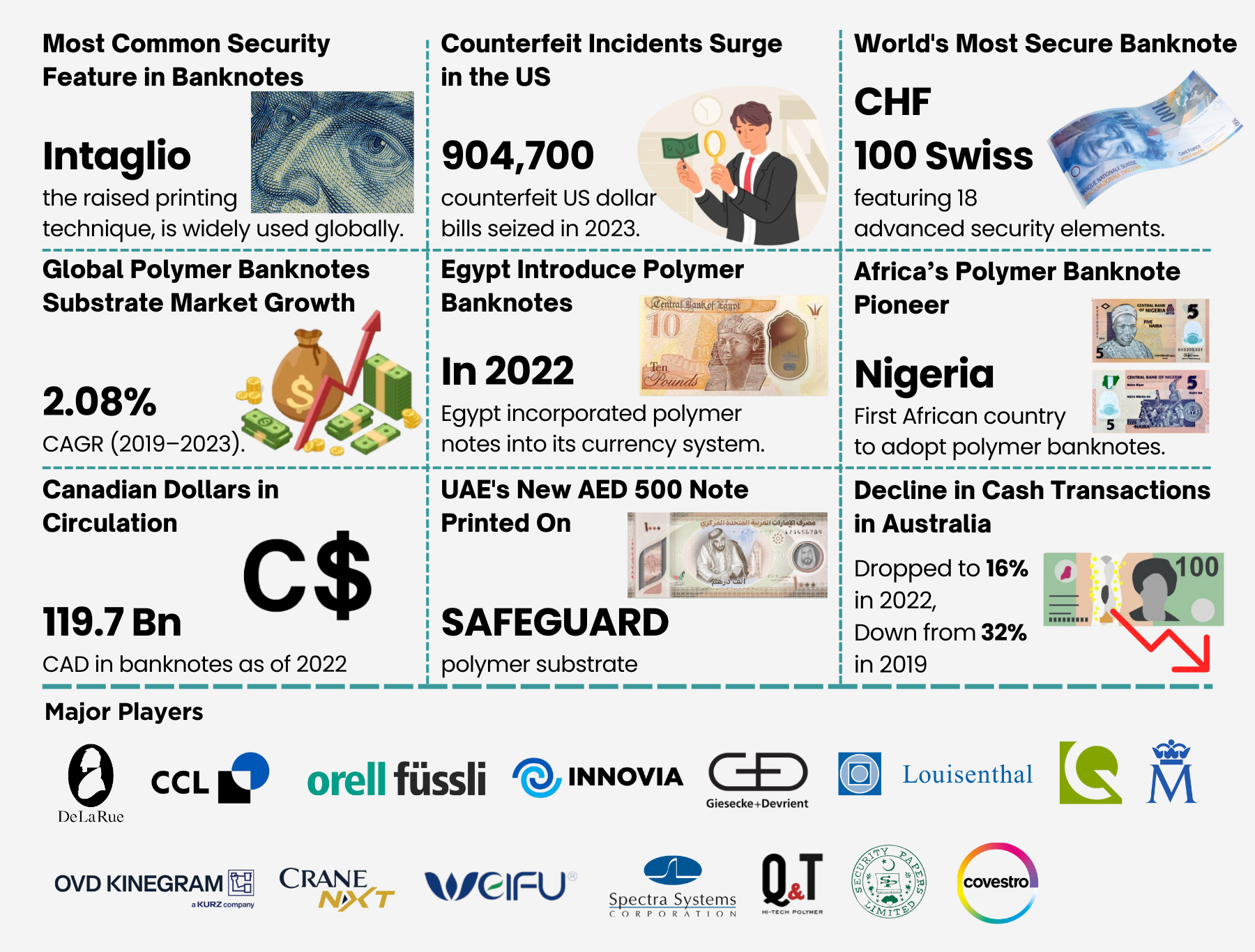
The global polymer banknote substrate market is experiencing a significant transformation, driven by a Compound Annual Growth Rate (CAGR) of 2.08% from 2019 to 2023. Central banks worldwide are increasingly adopting polymer substrates for their durability, advanced security features, and environmentally sustainable benefits. With a growing focus on robust anti-counterfeiting measures and reduced lifecycle costs, polymer banknotes are becoming the preferred choice for many nations. This report provides a comprehensive analysis of the market's historical and current performance, regional adoption patterns, competitive dynamics, and innovation-led growth across North America, Europe, Asia-Pacific, and the Middle East & Africa.
Global Polymer Banknote Substrate Market Adoption Trends
-
Global Adoption: As of 2024, approximately 76 out of 195 countries have transitioned to polymer banknotes, including prominent nations like Canada, the UK, New Zealand, and Israel.
-
Projections: This trend is expected to accelerate, with more countries anticipated to switch from paper to polymer currency by 2030. The growing demand for polymer banknotes reflects their superior durability, cost efficiency, and environmental benefits.
-
Currency Landscape: As of 2024, 1,045 different banknote denominations are in circulation worldwide, underscoring the growing diversity of currency formats globally.
Global Polymer Banknote Substrate Industry Insights
Advantages of Polymer Banknotes
Durability and Lifespan
-
Polymer banknotes last approximately 2.5 to 4 times longer than traditional paper notes.
-
Reduced wear and tear lead to less frequent replacements, significantly lowering associated costs.
-
In contrast, paper banknotes typically last only six months to a year, necessitating higher production and replacement rates.
Environmental Impact
-
Polymer banknotes reduce global warming potential by 32% and primary energy demand by 30% compared to paper notes.
-
End-of-life polymer notes can be shredded and recycled into plastic products, reducing landfill waste and enhancing sustainability.
Environmental Impact
-
Polymer banknotes reduce global warming potential by 32% and primary energy demand by 30% compared to paper notes.
-
End-of-life polymer notes can be shredded and recycled into plastic products, reducing landfill waste and enhancing sustainability.
Cost Considerations
- Although the initial production cost of polymer banknotes is higher due to the expensive substrate, the reduced replacement frequency offers substantial savings. For example, Australia saved nearly $1 billion over 25 years after transitioning to polymer banknotes.
Countries that have Implemented Polymer Banknotes
Currency Printing and Circulation Trends in Africa
Overseas Printing of African Currencies:
-
More than two-thirds of African countries print their currencies overseas, primarily in Europe and North America.
-
Around 40 African countries rely on facilities in the UK, France, and Germany for banknote production.
Developments in Currency Circulation and Denomination Policies in Egypt and Nigeria
In August 2024, Egypt announced the introduction of a new EGP 2 banknote to address the growing demand for smaller denominations. The total currency in circulation, excluding smaller denominations, reached approximately EGP 1.08 trillion (around USD 22.6 billion). Inflation soared to 27.13%, reflecting significant economic challenges, while the Central Bank of Egypt (CBE) maintained high-interest rates at 27.25% and 28.25% to curb inflationary pressures.
Nigeria became the first African nation to adopt polymer banknotes on February 28, 2007, with new versions of the NGN 5, NGN 10, NGN 20, and NGN 50 denominations. As of early 2024, the country’s currency circulation is undergoing significant changes due to a recent currency crisis. Legal rulings now permit both old and new naira notes to remain in circulation. The naira has experienced substantial depreciation, with exchange rates reported at over NGN 1,400 to USD 1 as of February 2024. The Central Bank of Nigeria (CBN) is considering upgrades and new denominations to address persistent economic challenges. In 2023, fluctuations in currency circulation followed the introduction of redesigned notes and a Supreme Court decision extending the use of old notes indefinitely.
The Bank of England's Transition to Polymer Banknotes
Transition to Polymer
In 2016, the Bank of England issued its first polymer banknote, made of polypropylene, a thin, flexible plastic. This substrate allows the integration of clear sections or “windows,” enhancing counterfeit resistance. The Bank of England now exclusively issues polymer banknotes, which are more durable and secure than paper. The Bank of England has currently adopted polymer banknotes for 4 denominations. These banknotes feature the portraits of either Queen Elizabeth II or King Charles III, depending on their issuance date, with Charles III banknotes circulating from June 5, 2024. rephrase and give an overall heading
Polymer Banknotes of the Bank of England
The Bank of England transitioned to polymer banknotes in 2016, replacing paper with a more durable and secure polypropylene substrate. These banknotes incorporate innovative security features, such as clear windows, to deter counterfeiting. The Bank currently issues four denominations: £5, £10, £20, and £50. Banknotes bear the portrait of either Queen Elizabeth II or King Charles III, depending on the date of issuance, with Charles III banknotes entering circulation on June 5, 2024.
England Total Annual Issuance of Polymer Banknotes, by Value, 2017/18 – 2023/24
Share of APAC Polymer Banknote Substrates by Countries in %, 2023
Recyclability of Polymer Banknote Substrates in APAC
- Adoption of Circular Economy Principles
-
Certified Circular Polymer: Spectra Systems has introduced the world's first polymer banknote substrate integrated into a mass-balanced recycling supply chain, certified by the ISCC PLUS process. This initiative ensures that for every kilogram of polymer used in banknotes, an equivalent amount is recycled, promoting a sustainable approach to currency production and waste management. This model is particularly relevant for APAC countries, where plastic waste management is a growing concern.
-
- Environmental Benefits
-
Lower Carbon Footprint: Polymer banknotes have a significantly lower carbon footprint compared to paper notes due to their durability and recyclability. They can be disinfected and reused, which became particularly important during the COVID-19 pandemic when hygiene was a top priority for consumers.
-
Utilization of Plastic Waste: The adoption of certified circular Polymer allows for the use of recycled plastic waste as an alternative to fossil fuels in the production process, further enhancing the environmental benefits associated with polymer banknotes.
-
Australia's Polymer Banknote Production and Considerations
The Reserve Bank of Australia is responsible for overseeing the printing and distribution of the country's banknotes. Note Printing Australia Limited (NPA), located in Craigieburn, Victoria, has been functioning as a fully owned subsidiary of the Reserve Bank since July 1998, operating as an independent incorporated entity. The polymer banknote technology, which Australia is renowned for, was developed through a collaboration between the Reserve Bank and Commonwealth Scientific and Industrial Research (CSIRO).
2023 and 2024: Considerations and Innovations: As of 2024, the RBA continues to produce and circulate only polymer banknotes. In 2023, the Reserve Bank of Australia contemplates featuring King Charles III on the AUD 5 note, while updating its design to pay tribute to the culture and history of the First Australians.
Australia Production of NGB Series of Polymer Banknotes, by Value, FY 2017/18 – FY 2022/23
The Asia-Pacific (APAC) Polymer Banknote Substrate Market is poised for robust growth, with a projected Compound Annual Growth Rate (CAGR) of 6.67% from 2024 to 2030. This growth reflects the increasing adoption of polymer substrates in banknotes across the region, driven by their superior durability, enhanced security features, and cost-effectiveness compared to traditional paper-based alternatives. As governments and central banks across APAC continue to prioritize anti-counterfeiting measures and sustainability in currency production, the demand for polymer substrates is set to expand significantly, shaping the future of the regional banknote industry.
Advanced Optical Security Features
-
Several European countries, including the UK and Germany, have incorporated advanced optical security features like 3D holographic elements and transparent windows with dynamic color shifts in their polymer banknotes.
-
Singapore, Australia, and South Korea could benefit from adopting these features to enhance their banknote security and deter counterfeiting. These countries have a strong focus on financial security and technology adoption, making them ideal candidates for implementing cutting-edge security features.
Thermochromic and Smart Materials
-
Some research institutions in the US and Europe are exploring the use of thermochromic and other smart materials in banknotes.
-
Thailand and Vietnam could consider incorporating these features for added security and visual appeal. Both nations are increasingly investing in modernizing their currency systems, making them receptive to innovative materials that enhance user experience.
Scope of the Study for the Global Polymer Banknote Substrate Market
Makreo Research has released an extensive series of reports under the umbrella of the “Global Polymer Banknote Substrate Market Size and Forecast (2018-2030)”, offering an in-depth analysis of this rapidly growing industry. Spanning the period from 2018 to 2030, these reports collectively provide a holistic view of the global market, evaluating historical trends, current market dynamics, and future growth opportunities across key regions including North America, Europe, Asia-Pacific (APAC), the Middle East, and Africa.
The research delves into the production, issuance, and cost dynamics of polymer banknotes, analyzing their direct influence on the substrate market. Special emphasis is placed on currency security features, covering advancements in anti-counterfeiting technologies, production expenses, and emerging trends. Additionally, country-specific assessments highlight adoption rates, market shares, and key market segments in regions such as Mauritius, Angola, Egypt, Nigeria, the United States, Canada, the United Kingdom, and other European nations. The APAC-focused segment explores growth drivers in markets like China, India, Pakistan, Australia, and Southeast Asia, underlining the region's significant contribution to the global market.
The reports also provide a detailed analysis of the competitive landscape, profiling major players such as De La Rue, CCL Secure, Innovia Films, Giesecke+Devrient (Louisenthal), Landqart AG, Crane NXT, Orell Fussli AG, FNMT RCM, Security Papers Limited, Q&T Hi-Tech Polymer, and Covestro AG. These profiles examine key business strategies, technological innovations, product portfolios, and international footprints while addressing mergers and acquisitions, funding timelines, and business highlights.
By addressing challenges and opportunities in the global polymer banknote substrate market, the research presents a forward-looking perspective, offering stakeholders valuable insights into market dynamics, future growth potential, and strategic investment opportunities. This comprehensive analysis equips industry participants with the knowledge required to navigate the evolving landscape of polymer banknotes effectively.
-
2018 - 2023: Past and Present Scenario
-
2024: Base Year
-
2024 - 2030: Future Outlook of the Market
Global Polymer Banknotes Substrate Market Segmentation
-
Polymer
-
Hybrid
-
Circulating
-
Commemorative
Geography Assessed
-
Asia-Pacific
-
Europe
-
Middle East and Africa
-
North America
-
Latin America
Countries Covered
-
United States
-
Canada
-
Caribbean
-
United Kingdom (including England, Scotland, Northern Ireland)
-
Germany
-
France
-
Italy
-
Russia
-
Egypt
-
Nigeria
-
Angola
-
Mauritius
-
Mergers and Acquisitions
-
Funding Timeline
Companies Covered in the Global Polymer Banknote Substrate Market
-
De La Rue
-
CCL Secure
-
CCL Secure (Innovia Films)
-
Giesecke+Devrient
-
Giesecke+Devrient (Louisenthal)
-
Landqart AG
-
Crane NXT
-
Orell Fussli AG
-
FNMT RCM
-
Security Papers Limited
-
Q&T Hi-Tech Polymer
-
Spectra Systems
-
KURZ Group (KINEGRAM)
-
Oberthur Fiduciarie SAS
-
Weifu
-
Covestro AG
Looking for a Section from Report? Start your Partial Purchase Request
Table of Contents
- 1.Research Methodology
- 1.1.Research Objective
- 1.2.Market Definition
- 1.3.Financial Years and Currency Codes in Various European Countries
- 1.4.Research Design and Procedure
- 1.5.Data Collection Methods
- 1.6.Research Methodology
- 1.7.Analytical Framework
- 2.Global Banknote Market Performance
- 2.1.Role of Banknotes in the 21st Century: Security, Accessibility, and Growth
- 2.2.Global Banknote Market Performance
- 2.3.Global Banknote Market Revenue – Past, Present and Future Outlook
- 3.Global Polymer Banknote Market
- 3.1.Global Paper Currency vs. Polymer Banknotes- Key Facts
- 3.2.Polymer Banknote Production Process
- 3.3.Different Security Layers for a Polymer Banknote
- 3.3.1.Security Features Patent Distribution by Category
- 3.4.World’s Most Secure Currencies
- 3.5.Countries Using Hybrid Polymer Banknotes
- 3.6.Countries that have Implemented Polymer Banknotes
- 3.6.1.Chronology of Polymer Banknote Adoption by Country
- 3.7.Global Polymer Banknotes: Durability and Currency Volatility
- 3.8.Adoption of Different Types of Substrates for Banknotes in Different Countries
- 4.Global Polymer Banknote Substrate Market
- 4.1.Global Polymer Banknotes Substrate Market: Past and Present Performance
- 4.2.Global Polymer Banknotes Substrate Market: Regional Share
- 4.3.Global Polymer Banknotes Substrate Market Segmentation: by Product
- 4.4.Global Polymer Banknotes Substrate Market Segmentation: by Application
- 5.Middle East and Africa Polymer Banknote Substrate Market
- 5.1.Middle East and Africa Polymer Banknote Market Overview
- 5.1.1.Middle East and Africa Polymer Banknote Substrate Market Revenue and Forecast
- 5.2.Countries in Africa that have adopted Polymer Banknotes
- 5.2.1.Polymer Banknotes by Denominations - Egypt, Angola, Nigeria, and Mauritius
- 5.2.2.Africa Polymer Banknote Substrate Market Revenue and Forecast
- 5.3.Africa Polymer Banknote Printing and Shipping
- 5.4.Egypt Banknotes Key Facts
- 5.4.1.Egypt Banknotes Issued by Denomination
- 5.4.2.Egypt Currency in Circulation
- 5.4.3.Egypt Polymer Banknote Introduction Timeline
- 5.4.4.Egypt Polymer Banknotes Substrate: Key Features
- 5.5.Nigeria Banknotes Key Facts
- 5.5.1.Nigeria Banknotes Production
- 5.5.2.Nigeria Polymer Banknotes in Circulation
- 5.5.3.Nigeria Polymer Banknotes in Circulation by Denomination
- 5.5.4.Nigeria Polymer Banknote Introduction Timeline
- 5.5.5.Nigeria Polymer Banknotes Substrate: Key Features
- 5.6.Angola Banknotes Key Facts
- 5.6.1.Angola Banknotes Production
- 5.6.2.Angola Banknotes Circulation
- 5.6.3.Angola Polymer Banknote Introduction Timeline
- 5.6.4.Angola Polymer Banknotes Substrate: Key Features
- 5.7.Mauritius Banknotes Key Facts
- 5.7.1.Mauritius Banknotes Expenditure and Production
- 5.7.2.Mauritius Currency in Circulation
- 5.7.2.1.Mauritius Banknotes Examined for Circulation
- 5.7.2.2.Mauritius Banknotes Circulation by Denomination
- 5.7.3.Mauritius Banknotes Destroyed
- 5.7.4.Mauritius Volume of Polymer vs Paper Banknotes in Circulation
- 5.7.5.Mauritius Polymer Banknote Introduction Timeline
- 5.7.6.Mauritius Polymer Banknotes Circulation by Denomination
- 5.7.7.Upgraded Security Features in Mauritius Polymer Banknotes
- 5.7.8.Mauritius Polymer Banknotes Substrates: Key Features
- 5.7.9.Mauritius Polymer Banknotes Substrate: Key Features
- 5.1.Middle East and Africa Polymer Banknote Market Overview
- 6.Europe Banknote Substrate Market
- 6.1.Countries in Europe Utilizing the Euro as their Official Currency
- 6.2.Europe Paper Banknotes Substrate: Key Features
- 6.3.Countries in Europe that have adopted Polymer Banknotes
- 6.4.Europe Polymer Banknote Substrate Market Revenue and Forecast
- 6.5.Polymer Banknote Denominations in European Countries
- 7.United Kingdom Polymer Banknote Market: England
- 7.1.England Polymer Banknotes Key Facts
- 7.2.England Polymer Banknote Introduction Timeline
- 7.3.England Polymer Banknotes Production
- 7.4.England Polymer Banknotes in Circulation
- 7.5.England Polymer Banknotes in Circulation by Denomination
- 7.6.England Counterfeit Polymer Banknotes
- 7.7.England Polymer Banknotes Carbon Emissions and Disposal
- 7.8.Polymer Substrate Supply Contract Details for Bank of England
- 7.9.England Energy Demand by Life Cycle for Paper & Polymer Banknotes
- 7.10.England Polymer Banknotes Substrates: Key Features
- 7.11.England Commemorative Polymer Banknote Substrate: Key Features
- 8.United Kingdom Polymer Banknote Market: Scotland & Northern Ireland
- 8.1.United Kingdom Polymer Banknote Market: Regional Issuance & Circulation Dynamics
- 8.2.Banknotes Circulating Entities in Scotland
- 8.2.1.Scotland Banknotes in Circulation
- 8.2.1.1.Scotland Banknotes in Circulation by Different Banks
- 8.2.2.Scotland Counterfeit Banknotes
- 8.2.3.Scotland Polymer Banknotes Substrate: Design and Security Features
- 8.2.4.Scotland Polymer Banknotes Supplier
- 8.2.1.Scotland Banknotes in Circulation
- 8.3.Northern Ireland Banknotes in Circulation
- 8.3.1.Northern Ireland Banknotes in Circulation by Different Banks
- 8.3.2.Northern Ireland Counterfeit Banknotes
- 8.3.3.Northern Ireland Polymer Banknotes Substrate: Design and Security Features
- 8.3.4.Northern Ireland Polymer Banknotes Supplier
- 9.Russia Banknote Market
- 9.1.Russia Banknotes Key Facts
- 9.2.Russia Currency in Production
- 9.3.Russia Currency in Circulation
- 9.3.1.Russia Cash in Circulation
- 9.3.2.Russia Banknotes in Circulation by Denomination
- 9.3.3.Russia Banknotes in Circulation Comparison over the years
- 9.3.4.Russia Share of Banknotes in Circulation by Denomination
- 9.4.Russia Counterfeit Banknotes
- 9.5.Russia Banknotes Substrate: Key Features
- 9.6.Russia Commemorative Polymer Banknote Substrate: Key Features
- 9.6.1.Russia Banknote Production Company- Goznak
- 10.Countries in Europe Utilizing Euro Banknotes
- 10.1.Germany Banknotes Key Facts
- 10.1.1.Banknotes Suppliers in Germany
- 10.1.2.Germany Euro Banknotes Expenditure and Production
- 10.1.3.Germany Euro Banknotes Circulation and Share Allocation
- 10.1.4.Germany Euro Banknotes Counterfeit
- 10.1.4.1.Germany Euro Banknotes Counterfeit by Denomination
- 10.1.5.Germany Deutsche Mark Banknotes Deposits and Circulation
- 10.1.6.Germany Deutsche Mark Banknotes Returned and Unreturned
- 10.2.France Banknotes Key Facts
- 10.2.1.France Preference for the use of Cash
- 10.2.2.Banknote Production and Technological Advancements at Banque de France
- 10.2.3.Europafi and the Banque de France’s Role in Banknote Production
- 10.2.4.France Banknotes Production and Circulation
- 10.3.Italy Banknotes Production and Security Printing
- 10.3.1.Italy Banknotes Production
- 10.3.2.Italy Banknotes in Circulation
- 10.1.Germany Banknotes Key Facts
- 11.North America Polymer Banknote Substrate Market
- 11.1.Countries in North America that have adopted Polymer Banknotes
- 11.1.1.North America Polymer Banknote Substrate Market Revenue and Forecast
- 11.1.2.North America Polymer Banknote Substrate Market – by Geography
- 11.2.United States Banknotes Key Facts
- 11.2.1.United States Currency Operations Budget
- 11.2.2.United States Paper Banknotes Production Facts
- 11.2.3.United States Paper Banknotes Print Order
- 11.2.5.United States Paper Banknotes Production
- 11.2.5.1.United States Paper Banknotes Production by Denomination
- 11.2.6.United States Paper Banknotes in Circulation by Value
- 11.2.6.1.United States Paper Banknotes in Circulation by Volume
- 11.2.7.United States Banknotes Processed and Destroyed
- 11.2.8.United States Paper Banknotes Substrate: Key Features
- 11.3.Canada Polymer Banknotes Key Facts and Expenditure on Printing
- 11.3.1.Canada Banknote Company Ltd. Contracts
- 11.3.2.Canada Polymer Banknote Introduction Timeline
- 11.3.3.Canada Polymer Banknotes Production Facts
- 11.3.4.Canada Polymer Banknotes in Circulation
- 11.3.5.Canada Polymer Banknotes in Circulation by Denomination
- 11.3.6.Canada Counterfeit Polymer Banknotes
- 11.3.7.Lifecycle and Sustainability of Canadian Polymer Banknotes
- 11.3.8.Canada Polymer Banknotes Substrates: Key Features
- 11.3.9.Canada Commemorative Polymer Banknote Substrate: Key Features
- 11.1.Countries in North America that have adopted Polymer Banknotes
- 12.Challenges and Opportunities for the Global Polymer Banknote Substrate Market
- 12.1.Challenges in the Global Polymer Banknote Substrate Market
- 12.1.1.Challenges in Infrastructure Compatibility for Polymer Banknote Adoption
- 12.1.2.Cultural and Infrastructure Challenges in Adopting Polymer Banknotes
- 12.1.3.Ongoing Counterfeiting Challenges Despite Advanced Polymer Security Features
- 12.2.Cost Dynamics and Opportunities in the Global Polymer Banknote Market
- 12.2.1.Innovations Driving the Future of Polymer Banknote Substrates
- 12.2.2.Revolutionizing Banknote Hygiene: Opportunities in the Polymer Substrate Market
- 12.2.3.Opportunity for Enhancing Sustainability through Polymer Banknote Recycling
- 12.2.4.Countries that have the potential to introduce polymer banknotes in the future
- 12.1.Challenges in the Global Polymer Banknote Substrate Market
- 13.Global Polymer Banknote Substrates Market Future Outlook
- 13.1.Innovative Security Features and Polymer Advancements in Banknotes
- 13.1.1.Dynamic Ink and Fluorescent EPDs: Enhancing Polymer Banknote Security
- 13.2.Global Polymer Banknotes Substrate Market Future Outlook by Regions
- 13.3.Global Polymer Banknotes Substrate Market: Future Outlook
- 13.1.Innovative Security Features and Polymer Advancements in Banknotes
- Limitations of the Study
Related Reports - Banking, Financial Services & Insurance