Germany Warehousing and Cold Storage Market Size and Forecast (2020-2030) - Focus on Warehouse Market By Type, Industries and Major Cities
Overview
Executive Summary
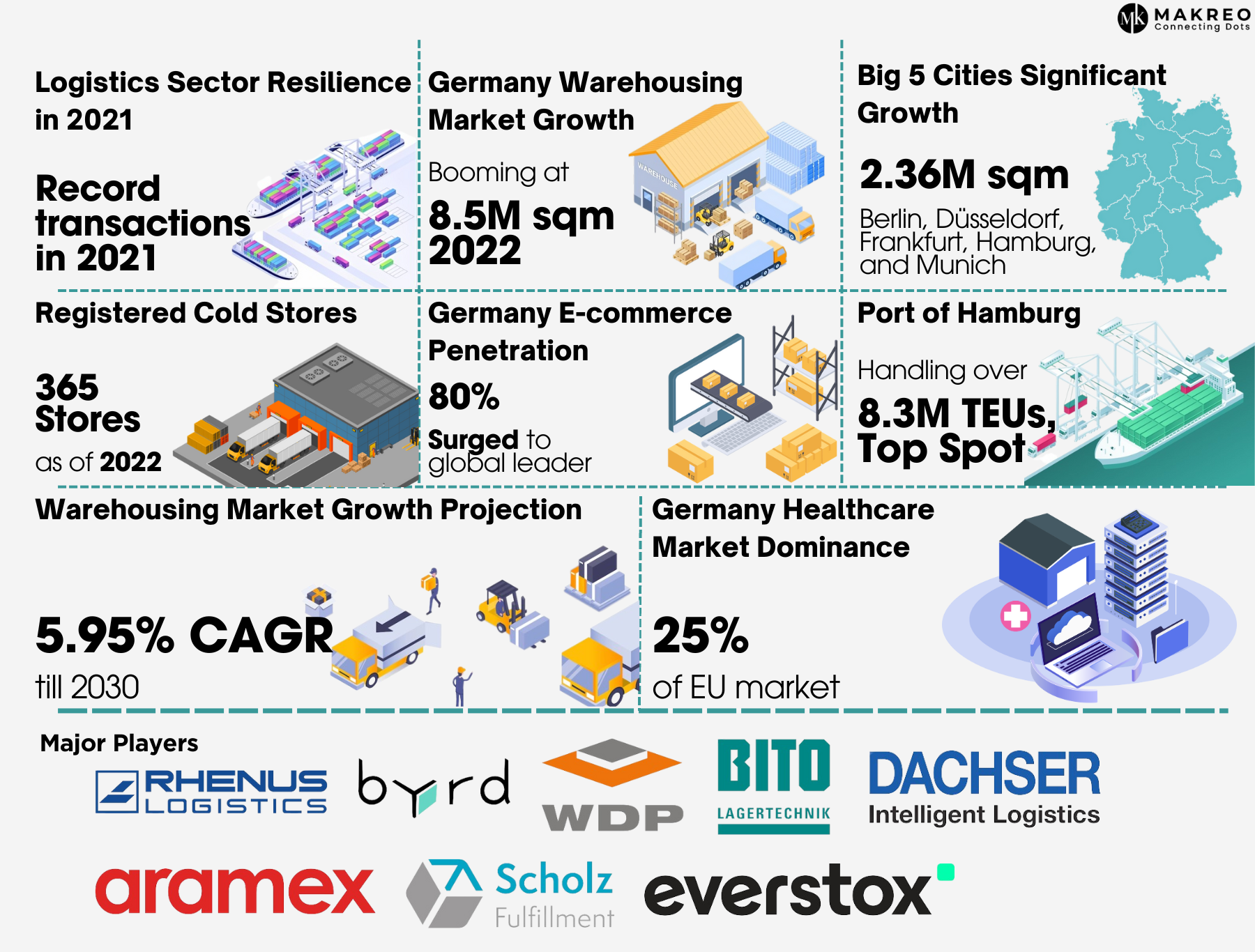
Germany's strategic geographical location at the heart of Europe confers significant advantages, contributing substantially to the robustness of its warehousing industry. The onset of the pandemic served as a catalyst, accelerating the pre-existing trend of heightened online shopping activity. Consequently, the demand for warehouse space has surged. In the initial six months of 2023, approximately 2.05 million square meters were absorbed by the German logistics and warehousing sector, marking a notable 58% decrease compared to the same period in the preceding year. This decline can be attributed to several factors, including a scarcity of available space, limited supply, and the absence of speculative properties.
Regarding industrial construction trends and development, the first half of 2022 witnessed a substantial completion volume of 835,000 square meters, followed by an additional 530,000 square meters in the latter half of the year. This surge signifies a doubling of the new construction volume compared to the previous year.
The warehousing market in Germany has seen a steady rise in its market revenue since 2018 to 2020, with the country reaching a high of USD 11.60 billion in 2020. Following the onset of the COVID-19 pandemic in 2020, the logistics sector in Germany witnessed a surge in the warehousing market, marked by increased investments and a heightened dependence on the country's cold chain infrastructure.
The Vital Role of Cold Storage Facilities in Germany
Germany's strong agricultural industry and its position as a major exporter of perishable goods such as fruits, vegetables, meat, and dairy products have led to the establishment of a highly efficient cold chain infrastructure. Situated strategically within Europe, Germany functions as a central hub in the cold chain market, facilitating the smooth transportation of goods across the continent and enhancing international trade. The country's commitment to quality and reliability has prompted significant investments in cold chain logistics, including the adoption of state-of-the-art refrigeration technologies, temperature-controlled warehouses, and advanced transport systems. As of January 9, 2024, Germany boasts a total of 133 cold storage facilities.
The cold transport market in Germany has experienced notable growth, spurred by a series of industry acquisitions that attracted global players such as Lineage, DHL, and Maersk. This influx of investment has led to the establishment of new warehouses and the development of a robust cold chain network throughout the country, further solidifying Germany's position as a leader in the field of cold storage and transportation.
Notable Developments in Germany Warehousing Market
- Expansion Initiatives in E-commerce Market Access:
Shipwire, a subsidiary of CEVA Logistics, unveiled its expansion plans within CEVA's warehouse near Berlin, Germany in 2022. This addition of a new facility aims to bolster Shipwire's endeavors to facilitate improved access to the European e-commerce market for its clientele. The primary goal is to broaden selling opportunities for Shipwire's customer base.
- Strategic Expansion in the Warehouse-Related Logistics Market:
GXO Logistics, recognized as the largest provider of contract logistics globally, has articulated its strategic aim to substantially amplify its presence in Germany's warehouse-related logistics market over the ensuing five years. This expansion strategy underscores GXO Logistics' steadfast commitment to fortifying its position in the German logistics landscape.
- Augmentation of DHL's E-commerce Warehouse Network:
In October 2023, DHL inaugurated its fourth e-commerce warehouse in Germany, marking a significant milestone in the company's DHL fulfillment network (DFN). Originating in Germany, the DFN framework currently encompasses a global network spanning 30 locations worldwide. This initiative underscores DHL's unwavering dedication to enhancing its e-commerce logistics capabilities in Germany and beyond.
Future Growth Outlook
The Germany Warehousing Market is expected to experience robust growth, highlighting a promising outlook characterized by a compelling compound annual growth rate (CAGR) of 5.95% through the year 2030. This projected trajectory indicates a notable surge in market revenue, with expectations soaring by USD 5.0 billion in revenue growth during the period from 2024 to 2030. The factors driving this expansion are diverse, propelled by significant transformations and increased investments within the country.
Scope of the Study
Makreo Research has recently released an extensively analyzed report titled "Germany Warehousing and Cold Storage Market Size and Forecast (2020-2030) - Focus on Warehouse Market By Type, Industries, and Major Cities" presenting a comprehensive overview of the German Warehousing and Cold Chain Market, which is expected to experience significant growth from 2018 to 2030. This summary provides a succinct outline of the Germany Warehousing and Cold Chain Market, highlighting revenue trends across various dimensions. The thorough examination covers a wide spectrum, assisting stakeholders in strategic decision-making and market positioning from 2018 to 2030. The report places particular emphasis on key players with a strong presence in the industry, offering insights into their financial and business performance, including trade performance, market performance, company profiles, mergers and acquisitions, and funding timelines. This extensive compilation of information aims to furnish stakeholders and industry professionals with an in-depth and meticulous understanding of the developments unfolding in this rapidly evolving industry.
- By Type of Warehouses
- General
- Specialized
- Cold Chain
- By Cities
- Dusseldorf
- Hamburg
- Berlin
- Stuttgart
- By Sectors
- Retail
- E-commerce
- Pharmaceuticals
- Mergers/Acquisitions/Investments
- Company Profiles
- 2020–2023: Past and Present Scenario
- 2023–Base Year
- 2024–2030: Future Outlook of the Industry
- Dachser Group SE & Co. KG
- Rhenus AG & Co. KG
- DHL Group
- DB Schenker
- BITO-Lagertechnik Bittmann GmbH
- Warehouses De Pauw
- NV (WDP)
- Everstox GmbH
- Scholz Fulfillment GmbH & Co. KG
- Byrd Technologies GmbH
- Aramex Group
- What is the overall size and growth trajectory of the India Warehousing and Cold Chain Market from 2018 to 2030?
- How is the market revenue distributed among Generalized, Specialized and Cold Chain warehouse structures?
- What are the revenue trends based on industry-specific demands and which sectors are driving the demand for warehousing services?
- How does infrastructure development, including technological advancements and facility improvements, influence the warehousing and cold chain market?
- What is the breakdown of market revenue based on warehouse size categories and what are the preferences across different storage capacities?
- How is the market revenue distributed among Generalized, Specialized, and Cold Chain services?
- What is the revenue distribution based on ownership structures, including privately-owned and publicly-owned operated warehouses?
- How does market revenue vary across major cities in Germany, and what are the regional growth patterns?
- Who are the key players in the Germany Warehousing and Cold Chain Market, and what are their profiles, market share, and strategies?
- What are the primary challenges faced by the warehousing and cold chain industries in Germany?
- What opportunities exist for stakeholders in the evolving market landscape?
- What are the potential threats to the warehousing and cold chain market, and how can they be mitigated?
Looking for a Section from Report? Start your Partial Purchase Request
Table of Contents
- 1.Research Methodology
- 1.1.Objective of the Study
- 1.2.Research Process
- 1.3.Data Collection Methods
- 1.4.Analytical Framework
- 2.Germany EPTD Analysis
- 2.1.Country Overview: EPTD Analysis
- 2.2.Germany Economic Overview
- 2.3.Germany Political Overview
- 2.4.Germany Technology Overview
- 2.5.Germany Demographic Overview
- 3.Germany Trade Performance
- 3.1.Germany Trade Statistics
- 3.2.Germany Export Performance
- 3.2.1Germany Export Ratio
- 3.2.2.Germany Foreign Trade Export by Commodities
- 3.3.Germany Import Performance
- 3.3.1.Germany Import Ratio
- 3.3.2.Germany Foreign Trade Import by Commodities
- 4.Europe Warehousing Market
- 4.1.Europe Warehousing Market: An Overview
- 4.2.European Countries Warehouse Take up
- 4.3.Average Rental Rates for Prime Logistics Locations (Euro/sqm/year)
- 5.Germany Warehousing Market - Past & Present Performance
- 5.1.Germany Warehousing Market Structure
- 5.2.Germany Warehousing Market: An Overview
- 5.3.Germany Warehouse Market Key Developments
- 5.4.Top 10 of fulfillment Centres and Logistics Operators in Germany
- 5.5.Germany Warehouse Rental Rates
- 5.6.Germany Warehouse Construction Completion
- 5.7.Germany Total Warehouse Take-up
- 5.8.Germany Warehouse Management System
- 6.Germany Warehousing Market- By Type of Warehouses
- 6.1.Germany General and Specialized Warehousing Market Performance
- 6.2.Germany Cold Storage Market Performance
- 6.2.1.Germany Cold Storage Utilization
- 6.2.2.Germany Cold Storage Capacity
- 6.3.Germany Frozen Food Key Facts
- 6.4.Germany Average Pallet Occupancy by Food Products
- 6.5.Germany Temperature Controlled Trucks
- 7.Germany Warehousing Market- By Cities
- 7.1.Germany Warehouse Rentals in Top Cities: An Overview
- 7.2.Germany Warehousing Key Facts by Major Cities
- 7.3.Berlin Warehouse Market: An Overview
- 7.3.1.Berlin Warehouse Rental Band
- 7.4.Dusseldorf Warehouse Market: An Overview
- 7.5.Frankfurt Warehouse Market: An Overview
- 7.6.Hamburg Warehouse Market: An Overview
- 7.7.Munich Warehouse Market: An Overview
- 8.Germany Warehousing Market - By Sectors
- 8.1.Germany Warehousing Market: By Sector
- 8.2.Germany Warehousing Take-up by Sectors
- 8.3.Germany Retail Sector Performance
- 8.4.Germany Automobile Sector Performance
- 8.5.Germany E-commerce Sector Performance
- 8.6.Germany Food and Beverages Sector Performance
- 9.Germany Warehousing Market – Competitive Landscape
- 9.1.Germany Warehousing Market Competitive Landscape
- 9.2.Mergers & Acquisitions
- 9.3.Funding Timeline
- 10.Germany Warehousing Market: Company Profiles
- 10.1.Company Profile: Dachser Group SE & Co. KG
- 10.2.Company Profile: Rhenus AG & Co. KG
- 10.3.Company Profile: DHL Group
- 10.4.Company Profile: DB Schenker
- 10.5.Company Profile: BITO-Lagertechnik Bittmann GmbH
- 10.6.Company Profile: Warehouses De Pauw NV (WDP)
- 10.7.Company Profile: Everstox GmbH
- 10.8.Company Profile: Scholz Fulfillment GmbH & Co. KG
- 10.9.Company Profile: Byrd Technologies GmbH
- 10.10.Company Profile: Aramex Group
- 11.Germany Logistics and Warehousing Infrastructure (Rail, Road, Marine and Air)
- 11.1.Logistics Infrastructure in Germany: An Overview
- 11.2.Logistics Infrastructure in Germany: Road Transport
- 11.3.Logistics Infrastructure in Germany: Rail Transport
- 11.4.Logistics Infrastructure in Germany: Air Transport
- 11.5.Logistics Infrastructure in Germany: Maritime Transport
- 12.Germany Warehousing Market: Future Outlook
- 12.1.Germany Warehousing Market: Future Outlook
- 12.2.Germany E-Commerce Sector Future Outlook
- 12.3.Germany Pharmaceuticals Sector Future Outlook
- 12.4.Germany Frozen Foods Sector Future Outlook
- 12.5.Factors to Drive Germany Warehousing in the Future
- Limitations of the Study
Related Reports - Automotive & Transportation